James Tasamba
24 August 2026•Update: 24 August 2026
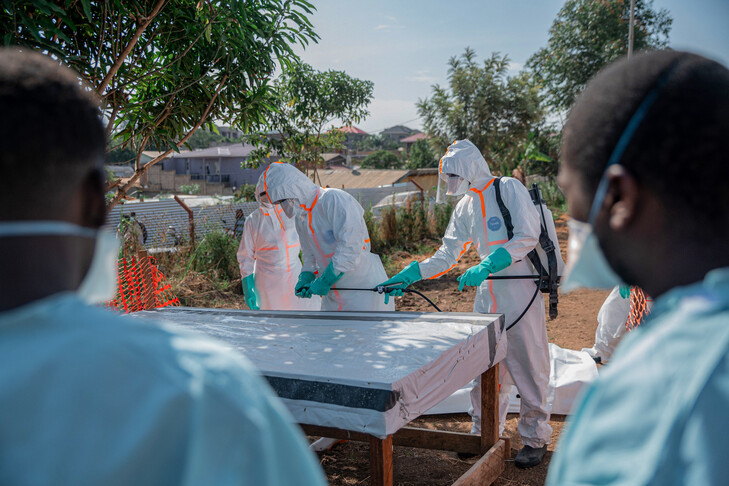
The International Red Cross and Red Crescent Movement voiced concern Monday about the recent attacks on Red Cross staff and volunteers involved in the Ebola virus response in the eastern Democratic Republic of Congo.
A statement jointly issued by the International Federation of Red Cross and Red Crescent Societies, the International Committee of the Red Cross together with the Red Cross societies in Congo and Uganda said 12 volunteers have been injured and ambulances damaged, including one that was set on fire during 11 separate violent incidents since the Ebola outbreak was declared in mid-May.
In one incident, on Aug.19, in Beni, North Kivu province, three volunteers involved in humanitarian activities as part of the response to the Ebola virus disease were violently attacked and injured by a group of individuals, the statement said.
The statement cited another incident on Aug.18, when two volunteers were allegedly injured while attempting to conduct a safe and dignified burial in the village of Malikuti, in the Rungu health zone in Haut-Uele province.
“Attacks against volunteers and humanitarian personnel are unacceptable. Respect for humanitarian personnel and humanitarian activities is essential to ensuring that communities affected by epidemics and other crises continue to receive the assistance and services they urgently need,” they said.
“We call on communities, local leaders, and all relevant stakeholders to support, respect, and protect humanitarian action. Volunteers, health workers, and humanitarian staff must be able to carry out their work in complete safety, without fear of violence, intimidation, or threats.”
Sunday marked 100 days since Congo declared the ongoing Ebola outbreak.
Confirmed cases since the outbreak have reached 5,514, including more than 2,600 deaths, according to the latest Health Ministry situation update.
The World Health Organization (WHO) on Monday said transmission is outpacing control efforts, requiring a substantial scale-up across all areas of response to halt the spread of the virus.
“This outbreak has reached a defining moment. We now need to significantly step up the response: moving faster to detect cases, reaching communities sooner and strengthening operations where they are needed most,” said Mohamed Janabi, WHO Regional Director for Africa.