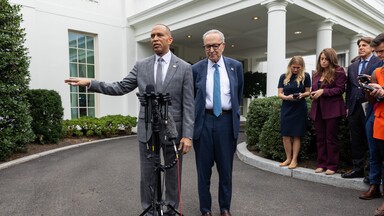
US President Donald Trump’s announcement that Washington would end security assistance to Israel by the end of this year has raised concerns among Israel’s security and financial establishments, raising concerns that the Israeli treasury could face billions of dollars in additional annual costs to replace the funding.
On Tuesday, Trump told the US broadcaster Fox News that his country would stop providing financial assistance to Israel by the end of this year, amounting to nearly $4 billion annually, under an agreement he claimed to have reached with Israeli Prime Minister Benjamin Netanyahu several months ago.
“We did not expect this announcement, and certainly not today. There is an ongoing dialogue with the Americans, and it can be said that we were surprised. We will examine the implications of the decision, which has not yet reached the relevant professional authorities,” Israel’s public broadcaster KAN quoted a senior security official as saying.
The broadcaster said Israel’s Defense Ministry would lose around 12 billion shekels ($4 billion) annually as a result of the suspension, forcing the treasury to cover the shortfall with taxpayers’ money.
According to an October 2025 report by the Council on Foreign Relations (CFR), an independent US research institute, US economic and military assistance to Israel has exceeded $300 billion since the country’s establishment in 1948, after adjustment for inflation.
The council said Israel is the largest cumulative recipient of US foreign assistance since its establishment, noting that it received substantial economic aid between 1971 and 2007, while most American assistance currently goes toward supporting the Israeli military.
In a separate report published in April 2025, the US State Department put the total value of bilateral assistance provided to Israel since 1948 at more than $130 billion.
The two figures reflect different reporting scopes and calculation methods, with the CFR figure adjusted for inflation, making it important to consider the basis and period covered when comparing the totals.
“An enduring commitment to Israel’s security has been a cornerstone of US foreign policy and has been embraced by every successive US administration since President Harry Truman,” the State Department said.
It added that assistance had focused on addressing “new and complex security threats,” closing gaps in Israel’s capabilities through assistance and security cooperation, strengthening operational compatibility through joint exercises, and helping Israel maintain its qualitative military edge.
The CFR report said Israel had used US-made weapons against its adversaries for decades. It also received emergency weapons shipments from a strategic stockpile maintained by the US inside Israel since the 1980s.
Since the outbreak of the genocidal war on the Gaza Strip in October 2023, Washington has approved legislation providing at least $16.3 billion in direct military assistance to Israel, according to the council’s October 2025 report.
The assistance was approved through three legislative measures, including $8.7 billion in April 2024 and annual allocations of $3.8 billion for 2024 and 2025.
Of the overall support, $6.7 billion was allocated to missile defense systems, the report said.
According to the US State Department, Israel is the largest recipient of American security assistance worldwide.
The support was formalized through a 10-year memorandum of understanding covering 2019-2028.
Under the agreement, the US provides $3.8 billion annually, including $3 billion through the Foreign Military Financing (FMF) program and $500 million for missile defense cooperation programs.
Trump’s announced deadline for ending the assistance, at the end of this year, would therefore come before the current memorandum expires in 2028.
Since fiscal year 2009, the US has provided Israel with $3.4 billion in missile defense funding, including $1.3 billion for the Iron Dome system starting in fiscal year 2011.
Through the FMF program, Washington enables Israel to obtain some of the world’s most advanced military equipment, including F-35 fighter jets.
Israel is also eligible for cash-flow financing and can use its annual allocations under the program to purchase defense equipment, services, and training through the Foreign Military Sales system, Direct Commercial Sales agreements, or the Overseas Procurement (OSP) mechanism.
The current memorandum allows Israel to use part of its allocations through the OSP mechanism to purchase Israeli-made defense equipment instead of US-made products. This share stood at 25% in fiscal year 2019.
The US State Department’s April 2025 report said the two countries had 751 active cases of Foreign Military Sales at the time, with a combined value of $39.2 billion.
The sales cases notified to Congress included F-35 fighter jets, CH-53K transport helicopters, KC-46A aerial refueling aircraft, and precision-guided munitions.
In addition, Washington approved permanent exports of defense equipment worth more than $12.2 billion through Direct Commercial Sales between 2018 and 2022.
These exports included turbine engines, launch vehicles, guided missiles, ballistic missiles, rocket projectiles, torpedoes, bombs, mines, and aircraft.
Beyond security assistance and arms sales, the US also participates in joint military activities with Israel, including exercises, research, and weapons development.
The two countries have signed several bilateral defense cooperation agreements, including the Mutual Defense Assistance Agreement in 1952, the General Security of Information Agreement in 1991, the Mutual Logistics Support Agreement in 1991 and the Status of Forces Agreement in 1994.
Since 1983, the two countries have also held regular meetings through the Joint Political-Military Group to strengthen common policies, address shared threats and concerns, and identify new areas of security cooperation, according to the State Department.
On Tuesday, Israeli newspaper Yedioth Ahronoth reported that the two countries had been negotiating a new cooperation agreement to replace the current memorandum, with expectations that funding would focus on joint defense research and development before Trump’s announcement that assistance would end this year.
The newspaper said US assistance to Israel had become increasingly controversial in recent years, with progressive Democrats calling for cuts and some Republican lawmakers opposing the use of American taxpayers’ money to fund foreign countries.
“Trump can now present this move to voters as a reduction of billions of dollars in foreign spending, while Netanyahu can portray the shift as a move away from dependence on the United States and toward strengthening Israel’s defense independence,” the newspaper said.
However, it quoted senior Israeli economic officials as warning that the consequences could be severe if Trump’s announcement is implemented.
“If Trump’s statement is true, this is an extremely dangerous decision for the Israeli economy. Giving up two years of American aid effectively means losing $8 billion. Where are we supposed to get this money? Obviously, it will come through imposing taxes on citizens,” an unnamed official was quoted as saying.
The newspaper also quoted another senior economic official expressing anger, noting that Democratic administrations, despite being viewed by some as less supportive of Israel, had provided generous assistance, while Trump and Republicans were now seeking to eliminate it.
According to the newspaper, the same official viewed Trump’s announcement, which coincided with Americans voting in the midterm congressional elections, as essentially an electoral maneuver.
In a similar context, Israeli newspaper Haaretz said: “While Americans were heading to the polls to elect members of Congress who will determine the agenda for the final two years of Trump’s term, the president announced that he had agreed with Netanyahu months ago on a date to end financial support.”
The newspaper added: “Perhaps Trump was addressing Republicans who have become more cautious about US-Israeli relations, particularly after the two countries entered into a confrontation with Iran.”
news_share_descriptionsubscription_contact

contact_the_ombudsman
is_there_an_error_in_this_story