By Hussein Mahmoud
CAIRO
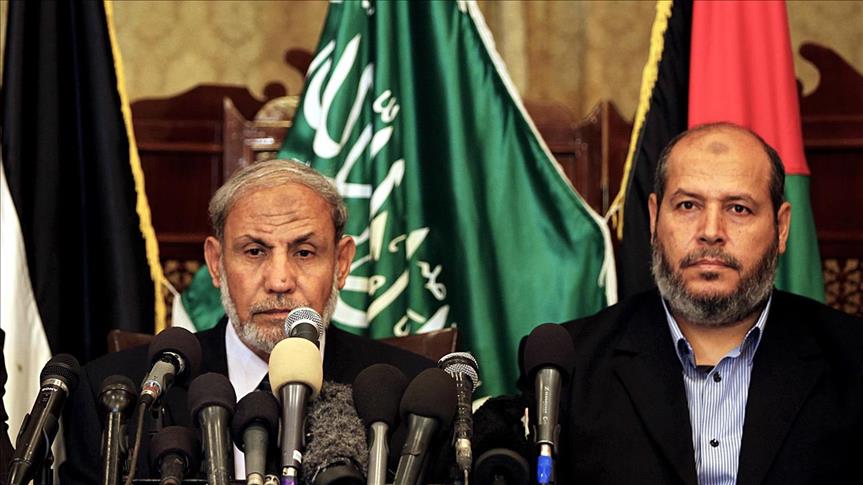
A current visit to Cairo by senior Hamas members could signal a degree of rapprochement between post-coup Egypt and the Gaza Strip’s de facto rulers, say political analysts.
"The Hamas delegation’s visit is aimed at mitigating the differences between the two sides on several important issues," Tarek Fahmy, head of the Israeli studies department at Cairo University’s National Center for Middle East Studies, told Anadolu Agency.
According to Fahmy, these issues include ongoing reconciliation efforts between Hamas and rival movement Fatah and the future of the Egypt-Gaza border, which has remained tightly sealed for the most part since Egypt’s 2013 military coup.
On Saturday, the Hamas delegation arrived in the Egyptian capital from the blockaded Gaza Strip via the Rafah border crossing.
According to a source at Gaza’s Hamas-run border authority, the delegation includes Mahmoud al-Zahar, Khalil al-Hayya, Imad al-Alami and Nizar Awadallah -- all members of the group’s Political Bureau.
On Thursday, a source close to Hamas told Anadolu Agency that the delegation would include senior group members both from within the Gaza Strip and from abroad.
According to Hamas spokesman Salah al-Bardawil, contacts between the two sides were being conducted between Khaled Meshaal, head of the group’s Political Bureau, and Egyptian General Intelligence chief Khaled Fawzy.
Accusations
Notably, the delegation’s visit comes only days after Egyptian officials accused Hamas of involvement in the assassination last year of Egyptian Attorney-General Hisham Barakat.
Last week, Egyptian Interior Minister Magdi Abdel-Ghaffar alleged that Hamas had trained "elements" of Egypt’s now-outlawed Muslim Brotherhood to carry out Barakat’s assassination in Cairo.
Hamas, an ideological offshoot of the Muslim Brotherhood, has strenuously denied the claims, as has the Brotherhood itself.
Egypt’s Muslim Brotherhood has been the target of a relentless crackdown by the Egyptian authorities since the army ousted Mohamed Morsi -- the country’s first freely elected president and a Brotherhood leader -- in mid-2013.
Fahmy, for his part, ruled out the notion that the accusations would influence the delegation’s visit, saying: "Rapprochement between Egypt and Hamas seems inevitable."
‘Major transformations’
Thabet Lamour, a Palestinian political researcher, believes the visit by the Hamas delegation should be viewed within the context of the "major transformations currently underway in the region and the Arab world".
"Although the visit comes amid Egyptian accusations [of involvement in Barakat’s assassination], Egypt still knows that Hamas cannot be removed from the Palestinian equation," he told Anadolu Agency.
Lamour also downplayed the likelihood that Hamas was actually involved in the attorney-general’s murder.
"If Egypt had any proof whatsoever of Hamas’ involvement, it is highly unlikely that it would have invited Hamas [to Cairo] at all," he said.
At the expected meetings between Hamas leaders and Egyptian officials, Lamour said, "Egypt will probably make several demands on Hamas, one of which will be to start thinking about the post-Abbas phase" -- a reference to Palestinian President Mahmoud Abbas.
In 2007, two years after Israeli forces withdrew from the Gaza Strip and one year after Hamas swept Palestinian legislative polls, clashes erupted in the coastal enclave between Hamas and Abbas’ Fatah movement.
The clashes ended with Fatah’s total defeat and the establishment of de facto Hamas rule throughout the Gaza Strip.
‘Tangible changes’
Lamour predicted that the delegation’s visit would lead to "tangible changes on the ground", such as an Egyptian decision to open the Rafah crossing and to stop media incitement against Hamas, which reached fever pitch following the 2013 military coup.
Mustafa Kamel al-Sayyid, a political science professor at Cairo University, believes Egypt "is keen to restore its relations with Hamas because of the latter’s importance in the Palestinian arena".
Mukhtar Ghobashi, vice head of the Arab Center for Political and Strategic Studies, an NGO, agreed with al-Sayyid’s assessment, saying: "It’s not in Egypt’s interest to consider Hamas an enemy."
"Maintaining contact with the group is essential," he added. "Hamas is highly influential in the Palestinian arena; it can’t be sidelined from the equation."
After Hamas took control of the Gaza Strip in 2007, Egypt took on a mediating role in the reconciliation process between Hamas and Fatah.
Since the 2013 military coup, however, Egypt’s pro-army media has frequently blamed Hamas for ongoing attacks on security forces in the Sinai Peninsula -- claims Hamas has consistently denied.