Martin Lejeune is a freelance journalist based in Berlin
By Martin Lejeune
BERLIN
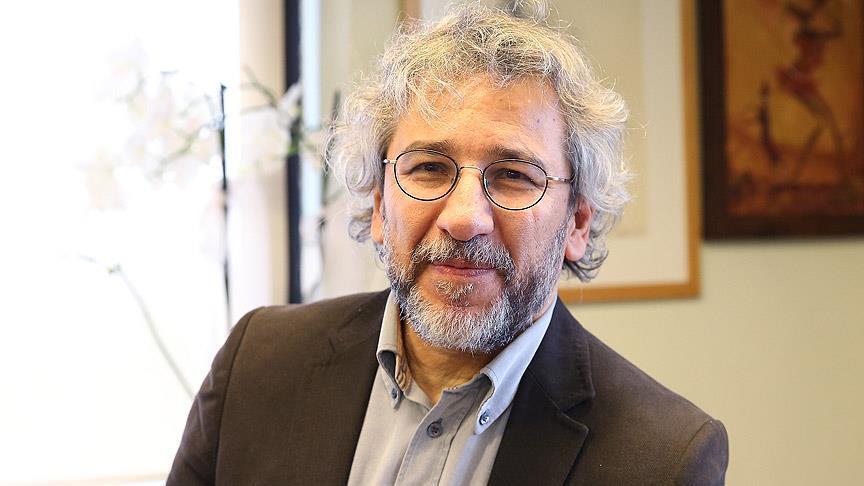
Can Dundar, the former editor-in-chief of Turkish daily Cumhuriyet, was awarded the Lighthouse Prize by Network Research. This award was presented to Dundar on July 8 at Network Research’s annual conference. Network Research is the most important association of journalists in Germany, whose annual conference in Hamburg is one of the biggest events for journalists in Europe.
Martin Schulz, the president of the European Parliament since 2012, said in his laudatory speech that Dundar is a perfect example of “a beacon of light” for outstanding publishing efforts.
“It is best this way, and this award is a clear message from the press-city of Hamburg to the government administration in Ankara. I hope that this message is understood,” added Schulz.
On his acceptance of the award, Dundar said that he came to Hamburg from “a country known as one of the world’s biggest prisons for journalists”.
“Every sentence you frame, every document you bring to light, every lie you expose gets you closer to imprisonment or even death. Being a journalist [in Turkey] is more dangerous than ever nowadays. As Mr. Schulz said, this award is a message to the government of Ankara: Do not count on the German government’s backing against the core values of democracy. We’re here to defend the freedom of press,” Dundar continued.
Let us take a closer look at where these exchanges of praise and pleasantries come from and what kind of “beacon of light” Can Dundar’s “outstanding” publishing efforts (as put by Schulz) are in Germany.
After the conference, in an interview with German public broadcaster WDR, Dundar further discussed alleged human rights abuses in Turkey.
“There is no law, there is no democracy, and there are no human rights. The cemeteries and prisons are full of journalists. But I am not afraid anymore since the moment I had to face the barrel of a gun,” said Dundar.
WDR is a German public broadcasting institution based in the Federal State of North Rhine-Westphalia with its main office in Cologne. WDR is watched by millions of Germans who are on the receiving end of these wrongful allegations against Turkey, coming from a leading Turkish journalist.
Authorized interview
In a subsequent interview with daily Berliner Zeitung published on Aug. 12, Dündar alleged that it was impossible to drink alcohol in Turkey except in three larger cities. He added that women and men now have to sit separately in restaurants and on public transport and also said that, during the month of Ramadan, Turkish police were on patrol to find out whether citizens were fasting or not. "If we are caught not fasting, the police may beat us up," he added. The statement was later removed from Berliner Zeitung’s website.
I contacted Berliner Zeitung for comment and its editor-in-chief, Brigitte Fehrle, said that Dündar had said what her publication had published. “Our interview with him was authorized in person by him. But we deleted the statement upon his request from our online page,” she explained.
Senior editor Kerstin Krupp and the head of the culture desk Christian Schluter, who have both worked for the Berliner Zeitung for many years, were present at the interview with Dundar. A recording of the interview proves what Dundar said. This is a conclusive explanation as to why Dundar never claimed that he was inaccurately quoted by Berliner Zeitung. He also did not initiate a legal procedure against the daily.
Dundar later claimed in a statement via Twitter on Aug. 18 (six days after the interview had been printed) that Berliner Zeitung had added “Western sauce” to his words. He wrote on Twitter that his words had been twisted. There sure was a case of twisting, or more than that, a blatant lie. But the question is, who was the twisting and lying perpetrated by?
Turkish journalist Ahmet Hakan, a columnist at Hürriyet daily, with the help of his paper’s Berlin office, did some detailed research on this issue, but claims that he could not find any evidence proving what was really said by Dundar during an online discussion via Twitter. On Aug. 19 Kai Diekmann asked Dundar, “What’s happening?” and after the issue was translated to him, he wrote and asked Berliner Zeitung “Is this true? If so, why did you do this?” Diekmann is the publisher of Bild, a tabloid with a circulation of 2.5 million sold copies.
The next day, Berliner Zeitung replied to Diekmann via Twitter: “It is not true, Berliner Zeitung printed the approved text by Dundar. After this, we changed this text on our webpage when Dundar wanted us to make changes regarding the content of the interview.” The staff at Berliner Zeitung deny these accusations, noting that the interview with Dundar was authorized by Dundar himself.
Seeking authorization for an interview before it is published is a special German custom. Newspaper desks first record the interview, as they did in the case of Dundar, then they transcribe the recording. Afterwards, the transcription of the interview is shown to the interviewee, who thus has a chance to edit it and approve the final wording of the interview. Being interviewed by a German daily such as Berliner Zeitung is a fairly conducted procedure of cooperation between the interviewers and interviewees. When one knows this background, Dundar’s situation does not look acceptable, because he had the chance to correct a lie that he actually told in the interview.
It is said that Berliner Zeitung just followed his request to delete the lies from its website because they do not want to harm him. After our research, what the editor-in-chief of Berliner Zeitung told us sounds trustworthy. As for Dundar, he has not yet responded to my request for an interview.
High credibility
Dundar operates in Germany with high credibility through his frequent print media, radio, and TV interviews. Right now, Dundar is everybody’s darling in the German mainstream media, which celebrate and facilitate the spread of groundless allegations against Turkey, and Dundar is their key "Turkey witness.” Beginning on Aug. 6, the major German weekly Die Zeit publishes, on a weekly basis, a column written by Dundar entitled “Meine Türkei” (My Turkey) in both German and Turkish. The fact that a German media outlet publishes a column also in Turkish can be considered a provocation against Turkey because all of their readers understand German.
In the meantime, it must be noted that Dündar will be hosted for a special talk at an M100 Sanssouci Colloquium in Potsdam on Sept. 15. This will be hosted in cooperation with Reporters Without Borders and sponsored by Germany’s Foreign Ministry as well as by the media boards of the federal German states of Berlin and Brandenburg. The opening speech of this 'distinguished' panel will be delivered by Professor Dan Diner of Hebrew University, located in the occupied and annexed East Jerusalem.
* Opinions expressed in this piece are the author's own and do not necessarily reflect Anadolu Agency's editorial policy.
news_share_descriptionsubscription_contact

contact_the_ombudsman
is_there_an_error_in_this_story