Anadolu Ajansı © 2026


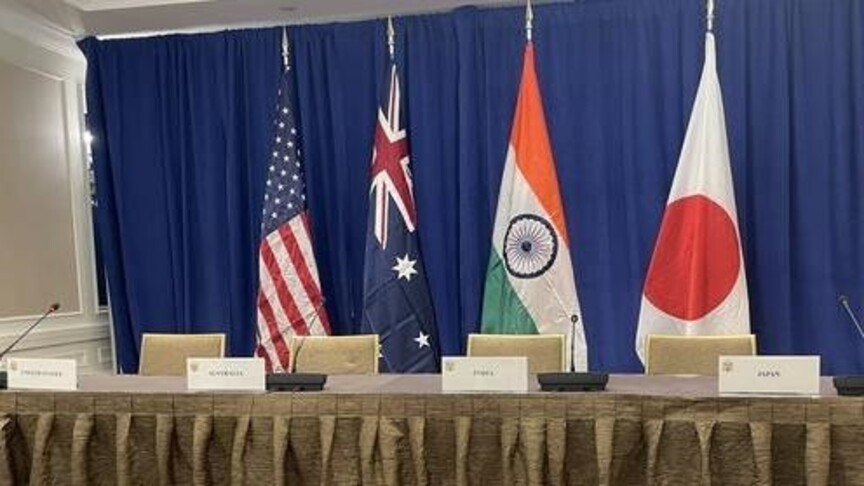
As foreign ministers of the Quad gather in New Delhi on Tuesday, the 4-nation grouping enters a familiar debate that has shadowed it since its revival in 2017.
That is whether the partnership is slowly evolving into an Asian security bloc or whether its real value lies in remaining deliberately flexible. The answer increasingly appears to be both, as pointed out by several analysts.
US Secretary of State Marco Rubio said on Saturday they will renew Quad, a partnership between the US, India, Australia and Japan.
“The relationship between our two countries is at the cornerstone of our approach to the Indo-Pacific...My very first meeting officially as secretary of state was a meeting of the Quad, and we were going to renew that,” Rubio said at the US Embassy in New Delhi.
The Quad has expanded its agenda well beyond symbolic diplomacy, developing cooperation on maritime security, semiconductors, artificial intelligence, resilient supply chains and critical minerals.
Yet the four countries of this bloc still diverge sharply on some of the world’s biggest geopolitical crises, including Russia’s war in Ukraine, the wars in the Middle East, sanctions policy and trade protectionism.
That contradiction, said analysts, has not weakened the Quad. In many ways, it has become the central feature of the grouping itself.
The meeting in New Delhi comes at a moment of renewed strategic uncertainty across the Indo-Pacific. China’s military assertiveness in the South China Sea, growing competition over technology and critical infrastructure, and concerns over vulnerable supply chains have pushed the four governments closer together.
The foreign ministers are expected to discuss maritime security, emerging technologies, infrastructure coordination and regional stability while reviewing progress on earlier initiatives aimed at preserving what they describe as a “free and open Indo-Pacific.”
But even as Quad’s agenda becomes broader and more institutionalized, its members continue to resist describing it as a military alliance.
“Indian policymakers do not view Quad as a military alliance comparable to NATO,” Sreeradha Datta, a professor of international relations at India's OP Jindal Global University, told Anadolu Agency.
“Quad is one of the many multilateral or in this case a minilateral.”
Datta said the grouping’s ability to survive despite internal differences reflects how middle and major powers increasingly operate in a fragmented international system.
“Even while there are different views on a few issues, these subjects all agree upon,” she said, referring to cooperation on technology, supply chains and regional security.
“In today’s fluid world nations want to engage with each other despite some differences and focus on issues that are core and relevant to all. In international politics, the choices are many.”
That flexibility may explain why repeated predictions about the Quad’s decline have consistently proved wrong. The grouping has endured changes of government in all four countries, periods of economic friction and differing responses to Russia and China.
It has also survived skepticism over whether it lacked the binding commitments necessary to function strategically.
For Washington, the Quad has become one layer in a much larger regional architecture designed to manage China’s rise without creating an overt Asian NATO. The US maintains formal treaty alliances with Japan and Australia, while India remains committed to its longstanding doctrine of strategic autonomy.
“The Quad has had a specific focus on cooperation in the Asia-Pacific region in response to the potential threat posed by a rising China,” Jon Danilowicz, a former American diplomat and foreign policy analyst, told Anadolu.
“It was never the case that Quad would become an alliance in traditional terms or otherwise dictate extra-regional policies of member states.”
Danilowicz argued that the grouping’s real strength lies less in collective defense than in the dense network of bilateral ties operating underneath it. “Embedded within the Quad are important bilateral relations which affect the utility of the broader grouping,” he said. “The stronger these bilateral ties are, the stronger the Quad will be.”
That reality has become particularly visible in the relationship between India and the US, which continues to deepen economically and strategically while also experiencing moments of visible tension.
American frustration over India’s ties with Russia and India’s discomfort with American tariff policies and regional calculations have occasionally exposed the limits of strategic convergence.
“India’s historic preference for ‘non-alignment’ or ‘strategic autonomy’ would prevent the Quad ever becoming a formal security alliance,” Danilowicz said.
“From the US perspective, there are other treaty commitments with Japan and Australia that will be much more important from a security perspective. The Quad plays more of a diplomatic role as part of broader efforts to manage China’s rise and contain its regional aspirations.”
The return of Donald Trump to the White House has further complicated calculations around the grouping’s future.
Although the Quad was revived during Trump’s first presidency and remains central to Washington’s Indo-Pacific framework, American policy toward China has shifted repeatedly over the past several years, moving between confrontation, containment and selective cooperation.
“Within a short span of time, across successive Trump-Biden-Trump administrations the American objective about China has moved from defeating China, to containment to finally cautious cooperation,” Shafquat Rabbee, a US-based political analyst, told Anadolu.
“Therefore, the value of Quad needs to be reassessed continuously from that optics.”
Rabbee said broader geopolitical crises have also tested the extent to which Washington and New Delhi can coordinate under pressure.
“Starting from the Ukraine war ending up with the latest war in Iran, both America and India found themselves in an awkward relationship where the sheer size of their engagement warrants much deeper coordination and common goals than what have been evidenced so far,” he said.
He added that some American analysts increasingly question whether India would ever function like a traditional ally during periods of global instability.
“An increasing number of US analysts are now publicly questioning India’s ability and willingness to act as an American ally under internationally stressful situations,” Rabbee said.
Those doubts, however, may misunderstand Quad’s original purpose. The grouping was never designed to replicate NATO’s collective defense structure.
Instead, as Datta pointed out, it emerged as a platform allowing “four democracies with overlapping interests to coordinate selectively without surrendering strategic independence.
news_share_descriptionsubscription_contact