07 November 2017•Update: 08 November 2017
By Nilay Kar Onum, Handan Kazanci
ISTANBUL
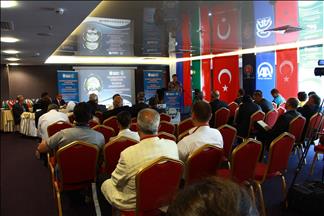
Ankara-based Research Center on Asylum and Migration (IGAM) on Tuesday trained Anadolu Agency’s reporters in Istanbul on refugee representation in the media.
This is the fourth leg of the program organized by IGAM jointly with the Turkish Journalists Association on Media and civil society cooperation for rights of refugees.
Other Anadolu Agency employees earlier got the similar training in capital Ankara and southern provinces of Hatay and Mersin.
The program is aiming to create awareness on how the refugees should be portrayed in the Turkish media and to establish a stronger relationship between the Turkish media and civil society.
In his remarks, IGAM President Metin Corabatir spoke on history of development of international refugee law and media’s role in covering the refugees.
“Our aim is to better teach and understand the issue of refugees in both Turkey and the world. So, this requires international law to be known well,” Corabatir said, adding “Being a refugee is a sensitive issue.”
He also underlined the importance of media’s role in covering the refugee crisis.
The researches show despite having 3 million refugees, Turkish people never opposed refugees but they welcomed them, he said.
The IGAM president said that the positive attitude of people toward the refugees showed Anadolu Agency has been playing a positive role in this respect.
For his part, Anadolu Agency News Academy Deputy Coordinator Hayri Cetinkus said that the agency was providing news to 1,600 national and international organizations.
The agency will contribute in the “creation of a common language” to be used by all media outlets while covering the refugee crisis, Cetinkus added.
The training is also planned in other provinces of Turkey where a high number of refugees are registered, such as Adana and Gaziantep.
Turkey has the largest refugee population in the world and is currently home to more than 3 million Syrians, according to official data.
The figure accounts for approximately 45 percent of all Syrian refugees in the region, the UN says. An additional 300,000 refugees in the region are mostly from Iraq, Afghanistan, Iran and Somalia.