By Burcu Arik
ISTANBUL
In the wake of a high-level government plan to cut Turkey’s energy dependency, experts are divided on what role renewable sources will play in meeting the country’s targets.
Earlier this month, Prime Minister Ahmet Davutoglu announced a nine-point economic reform plan aimed at – among other things – limiting Turkey's economic dependence on imported power.
"We aim to speed up work to increase our renewable energy production, such as solar, wind and geothermal power," he said.
However, according to experts, Turkey's renewable energy goals face many challenges before a 2018 deadline.
"Turkey needs to develop and enhance its renewable resources which are environmentally friendly and sustainable, and which have minimal environmental impact," says Abdurrahman Satman, energy professor at Istanbul Technical University.
"But to be honest, renewable energy alone can only provide 5 or 10 percent of the country's total energy demand," he adds.
Stating that Turkey will see its greatest demand increase for energy within 10 years, Satman says: "Diversity in energy sources is crucial. Placing our confidence largely in renewable energy sources has some risks."
"It is not only the very fact that renewable sources are hugely influenced by climate changes, but these can cause problems for operational performance and energy production," he says.
Between September 2013 and February 2014, the reserves of major dams in Istanbul, Ankara and Izmir dropped below 20 percent because of insufficient rainfall, significantly harming both agricultural and energy production.
According to the Environmental Protection Agency, changes in rainfall, increased risk of drought and reduced snowpack influence patterns of energy and water use.
Satman says: "I think Turkey has fallen behind the Western countries in terms of underground gas and petrol storage or nuclear power; these can save us."
"The country must particularly focus on the storage issue. Because we have to confess that the role of petrol and natural gas cannot be compared with any renewable energy sources."
Turkey is currently dependent on foreign imports for 74 percent of its energy needs.
"Turkey is taking steps to lessen dependence and aims to increase its renewable energy share to 30 percent," says Professor Ali Nezihi Bilge of the Energy Systems Engineering Department of Istanbul Bilgi University.
However, Bilge said if the country wants to reach its energy aims by 2018, it must hurry up and work hard on action plans.
"Turkey has been using water energy for a century. However, it exploited very little of this economically feasible potential," Bilge says.
Claiming that country knows its renewable energy capacity but does not know how to use it, Bilge said Turkey has to speed up work to increase renewable energy production, such as solar, wind and geothermal power.
"Turkey has serious geothermal energy capacity but this is behind the potential of the other renewable energies."
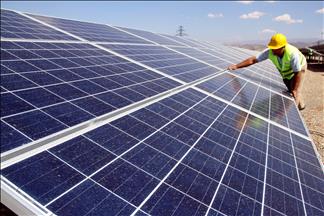
Pointing to Turkey's solar power capacity, Bilge said: "Turkey has solar power potential of 380,000 gigawatt hours per year, making it one of the leading countries for solar potential."
"Central Anatolia is especially suitable for developing solar energy power systems. But we need accurate projects to get the benefit of this potential," he said.
Turkey has over 61,000 megawatts of total installed capacity in electricity from renewable energy sources, and aims to supply 30 percent of its total energy demand from renewables, including wind, solar and hydro power.
Satman says as the interest in renewables rises, the requirement for relevant technology becomes greater.
"There have been many packages for years, but we need an action plan" he says.
www.aa.com.tr/en