By Huseyin Erdogan
ANKARA
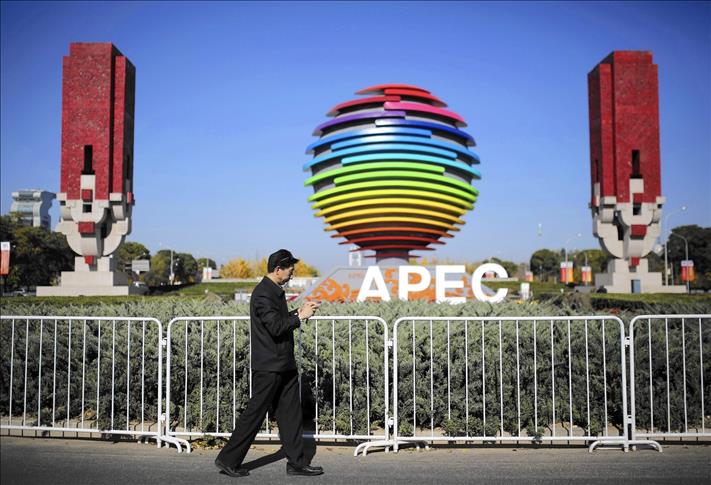
China and the U.S. plan to reduce greenhouse emissions and increase the use of renewable energy by 2030 or earlier, the leaders of the two countries pledged last Wednesday at the end of the Asia-Pacific Economic Cooperation Trade Summit in Beijing.
According to the deal, the U.S. plan to cut carbon emissions by between 26-28 percent by 2025. While China did not set a specific target for cutting emissions, it agreed to increase the share of non-fossil fuels in energy production to 20 percent by 2030.
"Although, these agreements are not sufficient, at least they show that China is more cooperative on this issue than before," said Ahmet Goncu, an associate professor at China's Xi’an Jiaotong-Liverpool University.
"China’s promise is real and probably will be met as a target," Goncu added.
According to Goncu, China will be able to reach this target before 2030, and gave two main reasons for this confidence: Firstly, China's economy is slowing down and the Chinese leadership is shifting its focus to quality and sustainable growth, which pushes green and environmental industries to the front line.
Secondly, Goncu stated that the Chinese realize that environmental problems will pose the biggest threat to their future prosperity if not handled on time.
The high level of air and water pollution is alarming in China, and from time to time, factories are required to stop production due to the high air pollution in many cities like Beijing.
According to a report in 2007, 'Cost of pollution in China' approximately 350,000 to 450,000 people die prematurely in China because of outdoor air pollution, The New York Times reported in April 2013.
"As the world's two largest economies, energy consumers and emitters of greenhouse gases, we have a special responsibility to lead the global effort against climate change," U.S. President Barack Obama has said at a joint press conference with Chinese counterpart Xi Jinping, in Beijing.
He called the deal a major milestone in the U.S.-China relationship, adding “It shows what’s possible when we work together on an urgent global challenge.”
China is approaching international climate diplomacy differently than before, Goncu maintains.
"Beijing realizes that if China does not address the issue of global warming and carbon emissions, its economy will be hit severely," said Goncu.
China already started to feel the effects of air and water pollution and knows its economy can slow down further. Environmental problems will also cause great reaction against both central and local governments if not addressed timely, Goncu added.
Responding to climate change statements from the U.S. and China, U.K. Energy and Climate Change Secretary Ed Davey said in a statement, “These climate announcements from the U.S. and China are a clear sign that major economies are serious about getting a global deal in Paris next year."
"People are questioning their quality of life and especially the emerging middle class in China is expecting better life quality with clean water and air. Therefore, it is politically very difficult for the Chinese government not to hear these voices," Goncu added.
He said the emerging Chinese middle class will be an important factor in the transformation of the Chinese economy towards a greener and more environmentally-friendly structure.
In 2011, coal supplied the vast majority of China's total energy consumption with 69 percent. Oil was the second-largest source, accounting for 18 percent of the country's total energy consumption, according to the U.S. Energy Information Administration.
The agency also said that the Chinese government plans to cap coal use to below 65 percent of the country's total primary energy consumption by 2017 in an effort to reduce heavy air pollution that has afflicted certain areas of the country in recent years.
"The Central government is already putting great efforts in reducing the use of coal and increasing the use of more environmentally-friendly fossil fuels such as natural gas. However, developing the environmental industries and promoting the use of non-fossil fuels will take several years," Goncu explained.
China has made an effort to diversify its energy supply with hydroelectric sources at six percent of the total consumption, natural gas with four percent, nuclear power at one percent along with renewables merely at one percent accounting for a relatively small share of China's energy consumption, the agency said.
www.aa.com.tr/en