Anadolu Ajansı © 2026


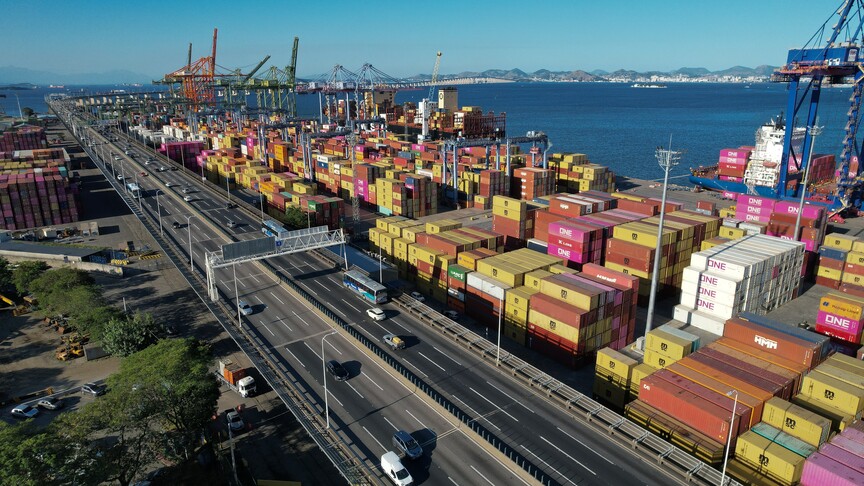
US President Donald Trump faces a key trade deadline on Friday as temporary 10% global tariffs under Section 122 of the Trade Act of 1974 are set to expire.
The tariffs, which have been in place for 150 days, will officially end at 12.01 am Eastern Time (0401GMT) on July 24.
This represents a hard statutory deadline, meaning the US president cannot unilaterally extend the tariffs.
Expanding or renewing the measures past the 150-day window would require an Act of Congress.
While lawmakers are considered unlikely to advance an extension bill, the administration is already moving to implement alternative trade barriers.
US Trade Representative Jamieson Greer signaled that replacement duties are highly likely, telling CNBC: “We expect to see some action soon.”
The Trump administration originally turned to Section 122 following a significant legal setback in early 2026.
On Feb. 20, the US Supreme Court issued a 6-3 ruling in Learning Resources, Inc. v. Trump, which was consolidated with Trump v. V.O.S. Selections, Inc.
The high court, in an opinion written by Chief Justice John Roberts, decided that the International Emergency Economic Powers Act (IEEPA) did not authorize the president to impose tariffs.
The ruling struck down both the Reciprocal Tariffs introduced in April 2025 and the Trafficking and Immigration Tariffs targeted at Canada, China, and Mexico.
Following the Supreme Court decision, US Customs and Border Protection stopped collecting the previous emergency tariffs on Feb. 24.
To maintain its tariff program, the administration immediately pivoted.
Hours after the court ruling, Trump signed Proclamation 11012, invoking Section 122 to establish a temporary 10% import surcharge.
The US president expressed a desire for a higher rate. In a post on his social media platform Truth Social, Trump indicated that he intended to raise the tariff level to the statutory ceiling of 15%, though the official legal order remained at 10%.
Section 122 of the Trade Act of 1974 serves as a legal tool designed to address severe macroeconomic crises. According to trade compliance trackers, the statute permits the US president to levy temporary import duties or surcharges under specific financial conditions.
These triggers include addressing serious balance-of-payments deficits, preventing a rapid depreciation of the dollar, or cooperating with other nations to correct international payments imbalances.
The provision reflects the economic climate of the 1970s, a period defined by global currency instability and balance-of-payments concerns.
According to a report by advisory firm O'Meara & Associates, the law was not intended to establish long-term trade policies or support permanent protectionist structures.
Instead, the statute lay largely dormant for more than 50 years until the administration revived it in early 2026.
The statute contains strict legal boundaries that restrict executive authority.
First, Section 122 caps any temporary tariff rate at 15%, meaning the executive branch cannot set higher duty levels.
Second, the measure features a strict statutory clock.
Under the law, any tariff imposed under this authority expires after 150 days unless Congress formally votes to extend the duties.
The temporary surcharge applied broadly to most goods entering the US, but the administration included significant exemptions to shield key economic sectors.
Goods qualifying under the United States-Mexico-Canada Agreement (USMCA) entering from Canada and Mexico were exempt from the 10% duty. Similarly, textiles and apparel from Central American nations under the CAFTA-DR agreement received standalone exemptions.
The administration also exempted critical minerals, pharmaceuticals, energy products, and certain agricultural goods, such as beef, tomatoes, and oranges “because of the needs of the United States economy.”
Passenger vehicles, light trucks, and buses were also excluded from the tariff.
To prevent double-charging, the government did not apply the Section 122 surcharge to goods already paying separate national security duties under Section 232 of the Trade Expansion Act of 1962.
The Section 122 tariffs faced immediate legal challenges from US importers.
On May 7, the US Court of International Trade (CIT) held, in a 2-1 decision, that the temporary tariffs were unlawful and exceeded the president's statutory authority.
The court held that the administration's reliance on broad trade deficits did not align with the narrow definitions of balance-of-payments deficits intended by Congress under Section 122.
However, citing the Supreme Court precedent in Trump v. CASA, Inc., which limited the power of lower federal courts to issue nationwide injunctions, the court restricted its relief solely to the three named plaintiffs in the lawsuit: the State of Washington, Burlap and Barrel, Inc., and Basic Fun, Inc.
The US Justice Department immediately appealed the decision and on June 11, the US Court of Appeals for the Federal Circuit granted an administrative stay of the CIT ruling, allowing the government to continue collecting the tariffs from all other importers while the appeal proceeds.
As the Friday expiration of the Section 122 tariffs approaches, the administration is preparing a new set of targeted duties to replace the expiring surcharge.
Rather than relying on broad emergency powers, the administration may use Section 301 of the Trade Act of 1974, which allows for duties based on investigations into foreign trade practices.
Speaking on CNBC, Greer explained that the government is utilizing these laws to target specific labor and market practices.
"The US has laws to prohibit trading goods with forced labor. Other countries, most don't have a law. Those that do don't really enforce it," he said.
The Office of the US Trade Representative proposed tariffs of 10 to 12.5% on imports from approximately 60 economies based on a forced-labor investigation. Greer asserted that these proposed duties would cover nearly 99% of US trade.
A second Section 301 investigation is targeting 16 major trading partners, including the EU and China, over allegations of creating excess manufacturing capacity.
The administration is also taking unilateral actions against specific countries. The US finalized a 25% Section 301 tariff on Brazilian imports, which took effect on July 22, following an investigation into digital trade rules and deforestation policies.
Additionally, Trump on Monday signed three proclamations imposing 50% tariffs on certain Canadian goods, including motor vehicles, alcoholic beverages, and dairy products.
Testifying at a Senate hearing on Wednesday, Greer defended the administration's tariff policies.
"We are committed to continuing to use tariffs and to negotiate deals to support the reindustrialization of our economy, protect American workers, and increase their wages and shrink our trade deficit," Greer said.
He noted that while the legal mechanisms may have shifted, the core trade strategy has not.
Neither the White House nor the Office of the US Trade Representative responded to questions from Anadolu regarding whether the administration plans to seek a tariff extension or pursue alternative trade policies.
news_share_descriptionsubscription_contact