Global markets are seeing a rebound in risk appetite amid growing optimism over a final deal between the US and Iran, as well as strong corporate earnings, while attention turns to US ADP private-sector labor data due Wednesday.
President Donald Trump’s announcement to suspend operations in the Strait of Hormuz, while hinting at significant progress toward a final agreement with Iran, has revived risk appetite across markets.
Strong earnings posted by tech firms also boosted markets.
Analysts say the rising use of semiconductors in artificial intelligence (AI) and high-performance computing will drive long-term growth, while even slight signs of easing tensions in the Middle East are supporting upward market movements.
The war’s impact had a ripple effect across asset prices but selling pressure in the bond markets eased.
The US 10-Year Treasury yield had tested its highest since July 2025 at 4.4624% but it stabilized on Wednesday at 4.42%.
The US dollar has relatively weakened against other currencies with oil prices retreating amid growing hopes that the geopolitical risks may subside.
Brent crude oil dropped 2.9% to $109 per barrel on Tuesday and continued to decline on Wednesday by 2.2% to $106.5.
The US Dollar Index closed Tuesday down 0.1% to 98.3 and is trading at 98.2 on Wednesday, marking another 0.1% decline.
Central banks around the world are increasingly less expected to make hawkish moves as concerns over the potential impact of regional tensions on inflation and growth ease amid renewed hopes for an end to the war.
Gold rises
Gold prices began to rise again on expectations of renewed market momentum and more dovish monetary policy in light of these developments.
Gold increased 0.8% to $4,557 per ounce on Tuesday and it has gained 2% to $4,646 so far on Wednesday.
Meanwhile, the US trade deficit climbed 4.4% on a monthly basis to $60.3 billion in March, falling short of estimates.
The JOLTS job openings fell 56,000 to 6.866 million last month, above market expectations.
The Institute for Supply Management (ISM) services Purchasing Managers’ Index (PMI) fell to 53.6 in April, slightly below the anticipated figure.
The S&P 500 rose 0.81% and the Nasdaq 1.03%, both setting new records, while the Dow Jones climbed 0.73% on Tuesday. American indexes started Wednesday positive.
European stock market bullish
In Europe, stock markets showed a bullish trend on Tuesday save for the UK, while all eyes turned to Middle East developments and producer price inflation data to be released in the eurozone.
European Commission President Ursula von der Leyen urged member states to brace for any scenario, but still implement an agreement in response to Washington’s threat to raise tariffs on EU-origin cars and trucks to 25%.
The EU and Japan agreed to boost their cooperation in AI, data management, quantum tech, semiconductors, and digital infrastructure in a recent deal.
Meanwhile, bond yields have come under selling pressure amid concerns that the local elections in the UK on Thursday could stoke political uncertainty.
The UK’s 10-year bond yield rose to 5.1%, its highest since March 23.
British Prime Minister Keir Starmer’s Labor Party may lose votes in the local elections, markets estimate.
The DAX 40 rose 1.71%, the CAC 40 1.08%, and the FTSE MIB 30 2.27%, while the FTSE 100 fell 1.4% on Tuesday. European indexes opened Wednesday on a positive note.
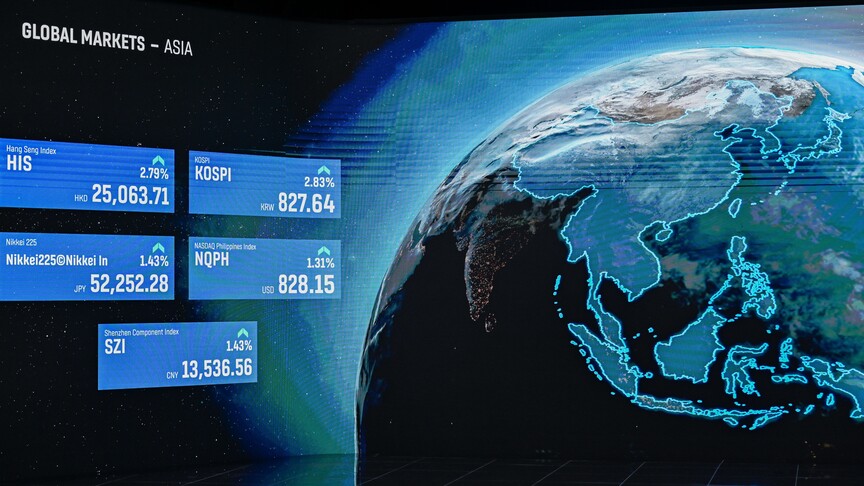
As for Asia, Chinese and South Korean markets reopened after the holiday, while Japanese markets will remain closed on Wednesday.
South Korea’s Kospi Index saw a new record with a near 7% rise, led by Samsung Electronics, whose shares gained over 15%, becoming the second firm in Asia to surpass $1 trillion market value.
China’s RatingDog services PMI for April stood at 52.6 and the composite PMI at 53.1 on Wednesday, pointing to accelerating economic activity.
The Kospi rose 6.6%, the Hang Seng Index 0.7%, and the Shanghai Composite Index 1.3% near the close.
*Writing by Emir Yildirim