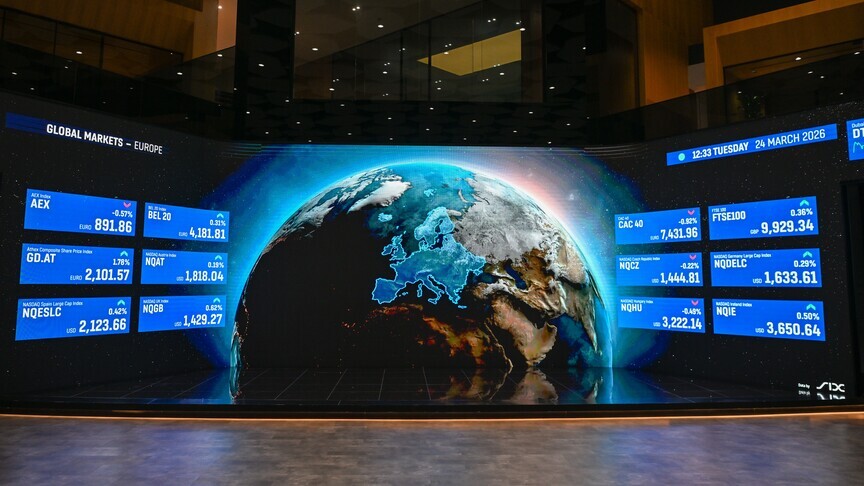
Global markets are searching for direction amid mounting inflation concerns in the US and some optimism in the tech sector fueled by chipmaker Nvidia’s better-than-expected earnings.
The US economy grew 1.5% in the second quarter, in line with estimates, while personal consumption expenditures (PCE) in the country climbed 0.2% on a monthly basis, above expectations.
The US core PCE index, excluding food and energy, rose 0.2% month-on-month and 3.3% on an annual basis.
The US 10-year Treasury yield climbed two basis points to 4.65% on Wednesday before trading around 4.66% on Thursday.
The likelihood of the Fed hiking rates in October rose from 57% to 62% in money market estimates.
The US Dollar Index climbed 0.2% to 99.1 on Wednesday and continued to trade flat on Thursday.
Macroeconomic data released in the US indicated that inflationary pressures remained strong, driving up risk aversion.
All eyes were on Fed chair Kevin Warsh’s remarks, due Friday at Jackson Hole in Wyoming.
Concerns over whether the US Treasury’s decision to double its long-term bond buyback operations is sustainable also kept investors cautious.
Chipmaker Nvidia’s revenue surged 106% on an annual basis to $96.2 billion in the latest three-month period, above estimates. The chipmaker’s net income also jumped 126% year-on-year to $59.7 billion.
Jensen Huang, founder and CEO of Nvidia, said tokens used in artificial intelligence (AI) generation have become more efficient and profitable amid rising demand, renewing investor confidence in tech firms.
At the same time, expectations that the Strait of Hormuz may reopen are improving the inflation outlook and risk appetite, increasing selling pressure on oil prices.
Tehran said it had reached certain agreements during talks with Oman over the Strait of Hormuz, including the revenue share, but the reopening of the energy chokepoint will depend on whether Washington accepts Iran’s conditions.
US President Donald Trump said Washington has full control over the Strait of Hormuz and that the war with Iran would end very soon.
The Qatari prime minister and the country’s foreign minister will reportedly visit Tehran, potentially easing geopolitical concerns.
October-delivery Brent crude oil dropped 0.4% to $87.5 a barrel amid these developments.
Meanwhile, Russia is reportedly preparing to escalate the war in Ukraine, potentially fueling volatility in oil prices.
Gold fell 1.4% on Wednesday to $4,594 per ounce, but was trading 0.6% above the previous close at $4,621 on Thursday as rising expectations that the Fed will hike rates supported gains in the US dollar and Treasury bonds, while weighing on gold prices.
Central bank gold purchases and financial concerns over the US economy drove up the price of gold, analysts say.
Tech giant Meta reached a settlement in a lawsuit about social media platforms allegedly harming children, agreeing to pay $18 billion. The firm’s shares closed Wednesday up 1%.
The New York Stock Exchange traded negatively on Wednesday, as the Dow Jones Industrial Average fell 0.21%, the S&P 500 dropped 0.02%, and the Nasdaq was down 0.08%. US indexes opened Thursday on a positive note.
European stock markets were dominated by buying activity on Wednesday as the continued decline in oil prices supported positive sentiment in the bloc.
Falling oil prices also boosted optimism that airline balance sheets would improve, driving up airline stocks.
Isabel Schnabel, an executive board member at the European Central Bank (ECB), said interest rates need to be at higher levels, fueling rate hike expectations for next month, while forecasts suggest a second rate hike may come in March next year.
Germany’s ifo Institute said its industrial export expectations rose from minus 2.8 points in July to 9.6 points in August, marking the index's highest level since Feb. 22, when Russia invaded Ukraine.
France's CAC 40 gained 0.27%, Germany's DAX 40 rose 0.08%, and Italy's FTSE MIB 30 increased 0.31%, while the UK's FTSE 100 fell 0.07% on Wednesday. European indexes opened Thursday mixed.
Asian equity markets were mixed near Thursday’s close due to concerns that chip costs will rise and broader concerns over the Chinese economy.
The Bank of Korea raised its policy interest rate by 25 basis points to 3%, in line with estimates. The decision marked the second consecutive meeting at which the bank hiked rates in its efforts to counter inflationary pressures from the Middle East conflict.
The trajectory of interest rates in South Korea also depends on potential government measures aimed at curbing rising housing prices and easing concerns about financial stability, analysts say.
China’s industrial profits rose 11.2% in July, marking the slowest growth since December 2025.
Analysts say Chinese authorities may increase support to stabilize corporate profitability.
Fitch Ratings said deflationary pressures in China eased, but weak domestic demand continues to put downward pressure on prices.
At the same time, the South Korean stock market was dominated by tech optimism with SK Hynix shares rising 2.6% and Samsung Electronics gaining 1.5%.
Near Thursday’s close, China's Shanghai Composite rose 0.6% and South Korea’s Kospi surged 1.4%, while Japan’s Nikkei 225 fell 0.1% and Hong Kong’s Hang Seng dropped 0.4%.