By Selen Tonkus
ANKARA
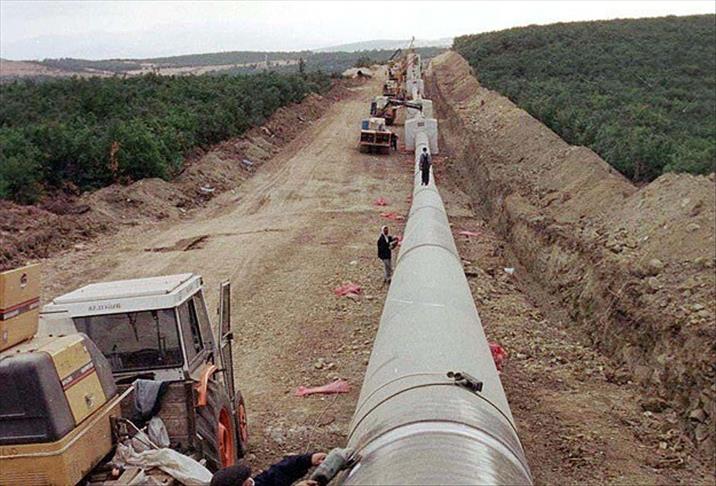
Russian President Vladimir Putin’s plan to provide an alternative to the South Stream gas pipeline will increase Turkey's bargaining chips, experts say.
Putin announced the cancellation of the original South Stream natural gas project through Bulgaria and declared the redirection through Turkey during his visit to Ankara on Monday.
The project plans to provide natural gas to Balkan countries, but it did not get an approval from the EU. The project’s original planned route was over Ukraine's offshore territory, which was rejected by the Ukrainian government.
Stephen Fortescue, an Associate Professor at Sydney's University of New South Wales, said Putin scored a victory in getting the Turkish president provide an alternative to the South Stream pipeline, which the EU opposed.
Fortescue said Russia would give a six percent discount on natural gas sales to Turkey from January 2015.
"The idea of a new pipeline through Turkey will increase its bargaining position vis-a-vis Russia for further gas deals," he said.
The professor said Putin's actions would have been based on the belief that the West was weak, politically, economically and morally. "But at the moment it looks as if he underestimated the West's strength or at least its determination. I don't think the deal with Turkey significantly shifts the balance," he added.
Sergey Glebov, Professor of International Relations at the Center for International Studies in Ukraine’s Odessa Mechnikov National University, said Putin actually had to make a retreat and his very important South Stream was now a total failure because he could not convince the EU to support it.
Glebov said Putin was now looking for a substitute to turn his defeat into victory by launching a new pipeline to reach Europe without Ukraine’s help.
"A lot will depend on the position of Turkey and Greece since both, the Trans-Anatolian Pipeline Project that will carry Azerbaijani gas to Europe via Turkey and the Trans Adriatic Pipeline, are also in their hands," he said.
When completed, the Trans-Anatolian Pipeline Project will carry around 16 billion cubic meters of gas per year to Europe via the Trans Adriatic Pipeline.
About whether the EU would buy Russian gas via the new pipeline and if Ukraine would feel the pinch, Glebov said, "If the new pipeline will be profitable for the EU politically, geopolitically and economically, the EU will let Ukraine down.”
But, he said that such a scenario was unlikely because the new pipeline would not be able to compete with the Trans-Anatolian Pipeline Project and Trans Adriatic Pipeline.
www.aa.com.tr/en