Silva: Credibility needed to lure back Brazil investors
Marina Silva, Dilma Rousseff's main rival at the upcoming Brazil presidential elections, criticized the government over the country's sluggish economy, and says "intangibles" are required, including confidence and credibility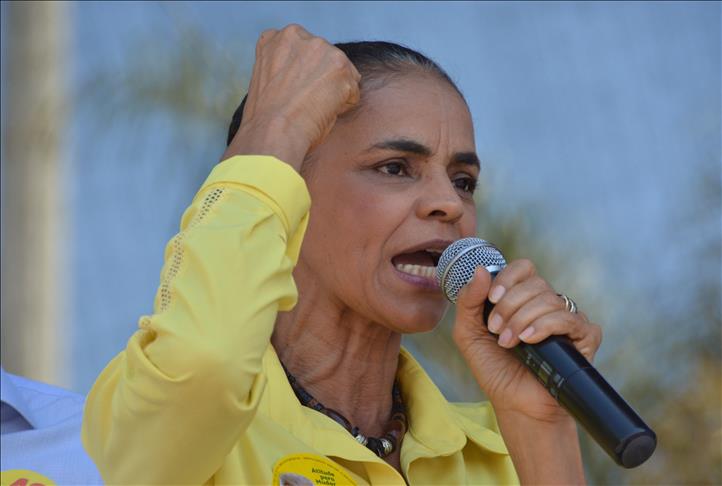
By Ben Tavener
SAO PAULO
Brazilian presidential candidate Marina Silva criticized the president's handling of the economy Thursday and said certain "intangible" factors are required to restore economic growth and investor confidence in Brazil.
In an interview with the breakfast TV show “Bom Dia Brasil,” Silva said low credibility and high interest rates had stifled investments, and vowed to reverse the situation.
"We are going to make Brazil grow again. Much of the capital that Brazil needs is ... intangible. It's confidence, credibility, respecting contracts, creating an atmosphere that encourage investors to invest again in Brazil," Silva said, adding that the government had to show it would not "take risks with fiscal policy."
The Brazilian Socialist Party (PSB) candidate is currently posing the greatest threat to President Dilma Rousseff's bid for re-election, and is seen as the new market favorite, after polls suggest pro-business candidate Aécio Neves would be eliminated in the first round of the vote on Oct. 5.
Inflation, which recently breached the upper limit of the government's 4.5 percent target, is one of Rousseff's main concerns in the lead-up to the election. Silva accused the president of "manipulating administered prices" to attain better results on inflation, and voiced concern that the annualized rate had stubbornly remained at the 6.5 percent upper limit.
However, contradicting policy set out by Eduardo Campos, the PSB's original candidate who died in a plane crash in August, Silva said she would not lower the target, but instead aim to bring inflation back down to it.
Silva also proposed installing an independent watchdog to oversee government spending and promote efficiency.
The presidential hopeful dismissed concerns that pro-environment stances, with which she is traditionally associated, were in any way incompatible with successful agribusiness, and instead pointed to a substantial lack of infrastructure as the key obstacle to growth in the area.
Silva and Rousseff differ on a number of points on the economy, including whether the country's central bank should be independent. Silva defends full autonomy, whereas Rousseff prefers the current "quasi independence" granted to the monetary authority.
The comments came as Brazil's office for national statistics, the IBGE, released figures on unemployment Thursday for the last three months, delayed due to strike action. The new figures showed that joblessness had risen slightly to 5 percent in August, and although it was still the best result for August since 2002, the rise is likely to be used by rivals against Rousseff in political advertising campaigns.
Price rises and unemployment are seen as the most relevant economic data to most middle- and working-class voters, most of whom have been broadly unaffected by the significant cooling-off witnessed in the wider economy.
The Brazilian economy, the largest in Latin America, has slowly considerably in recent years. After a growth of 2.5 percent in 2013, the government now forecasts growth of just 0.9 percent in 2014, while market analysts suggest Brazil will grow a paltry 0.3 percent this year.