06 May 2016•Update: 23 May 2016
ANTALYA, Turkey
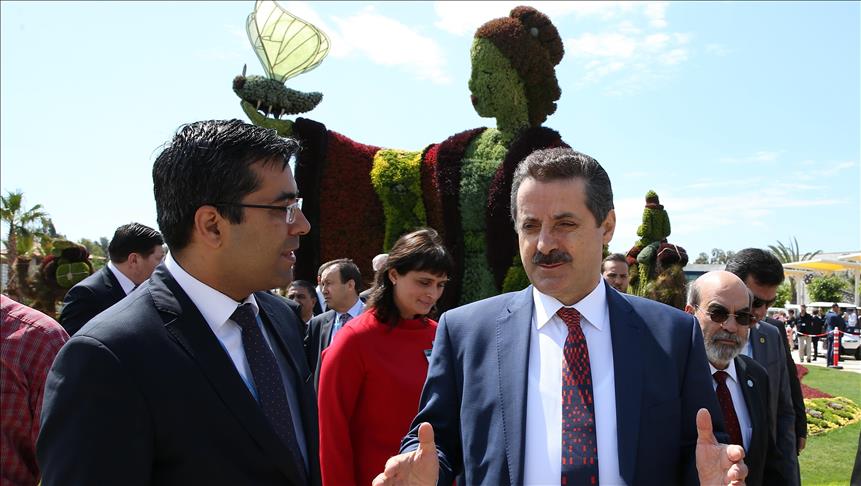
The world may face new massive flows of human migration if a sustainable supply of food for future generations is not guaranteed, Turkish Minister for Food, Agriculture and Livestock Faruk Celik warned Friday.
Addressing a press conference on the last day of the UN Food and Agriculture Organization’s Regional Conference for Europe in the Mediterranean resort city of Antalya, Celik highlighted the need for stronger national and international cooperation to meet the challenges of food security, sustainable agriculture, poverty elimination and tackling climate change over the next 15 years.
“Today, when 500 million adults are obese and some 800 million people do not have enough food in the world, no one is safe," he said.
He called for rapidly increasing global agricultural production.
“According to projections, agricultural production should be increased by 60 percent by 2050 in order to feed [the global population]. However, the agricultural land in the world is being destroyed.
“Every second, seven acres or football field sized agricultural lands are losing their agricultural value," Celik said.
The minister warned the world was on the precipice of another massive human migration flow "if we do not build a sustainable supply of food for future generations."
He also noted that global agricultural production was increasingly becoming harder.
"When difficulties induced by climate change are added to issues related to food access, [one can observe that the] problem is growing. So, efficiency in agriculture and alternative products are important," Celik said, adding that this was a common problem for countries around the world.
"Therefore, it is beneficial for everyone to look at solutions together," he said.
In his speech, Food and Agriculture Organization Director-General Jose Graziano da Silva thanked the Turkish government for its support and hospitality extended during the regional conference.
Graziano da Silva termed the conference a great success. "The numbers show it. We had the attendance of 42 countries, plus the European Union, out of the 53 countries in the region," he said.
He noted that delegates from 42 countries agreed that the agricultural sector would play a main role in achieving sustainability, especially in dealing with climate change challenges.
Improved nutrition and the promotion of pulses as food crops and as a dietary choice were also underscored at the conference.
"While hunger has essentially been eradicated in Europe and Central Asia, all countries have alarming rates of malnutrition in various forms: micronutrient deficiencies, stunted growth, overweight and obesity," Graziano da Silva added.
He praised Turkey's initiative on reducing food loss and waste, saying that other countries and organizations could learn from its example.
Graziano da Silva also highlighted pulses as important staple foods. "It is important to highlight this, because sometimes we are only concerned about the four big commodities. We don’t eat only commodities. We eat vegetable foods and pulses are among the most nutritious foods that are available locally in the region," he said.
The regional conference in Antalya was jointly organized by the Turkish government and the FAO. It concluded Friday with members calling on the organization to work with them on growing food for expanding populations and international markets while using more sustainable practices.
The FAO is promoting what it calls “climate-smart agriculture,” which emphasizes on productivity, adaptation and reducing greenhouse gas emissions.
Policies and other forms of support for family-run farms, strengthening of agri-food trade, combating illegal fishing, and support to women and youth were also emphasized at the conference.
Various civil society groups also focused on the importance of promoting agro-ecology, access to natural resources, local and territorial markets, and decent work at the event.