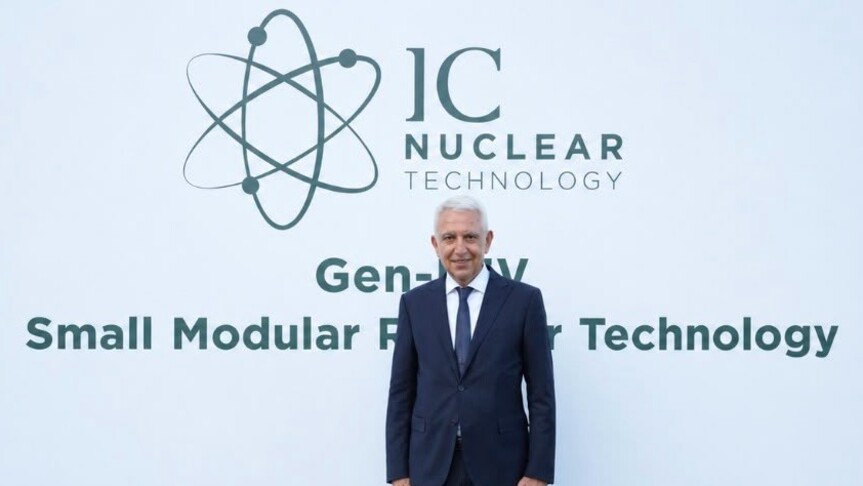
Mücahithan Avcıoğlu
02 July 2026•Update: 02 July 2026
Turkish conglomerate IC Holding is working toward deploying up to 20 small modular reactors, or SMRs, in Türkiye and the wider region under a strategic partnership with US-based ARC Clean Technology, IC Nuclear Technology Chair Murad Bayar said.
Speaking at the 12th Nuclear Power Plants Summit (NPPES) in Istanbul on June 30-July 1, Bayar said IC's long-term plans include up to 10 reactors in Türkiye, with a wider regional total that could reach 20.
"Our goal is to establish an engineering and industrial ecosystem around reactor technology in Türkiye," Bayar said.
IC Nuclear Technology is working with ARC Clean Technology on sodium-cooled 4th-generation reactor technology, covering technical, economic and regulatory feasibility studies, localization, licensing preparation, supply chain development and commercialization.
"This is not a project to take a ready technology and install it in Türkiye," Bayar said. "Our cooperation with ARC should be seen as a process of jointly maturing this technology from its current development stage, adapting it to different application areas, developing the supply chain, localizing equipment and making it suitable for the expectations of regulatory institutions."
The ARC-100 is a 100-megawatt-electric-class advanced SMR design based on sodium-cooled fast reactor technology. Bayar said the technology could support not only electricity generation but also industrial applications requiring high-temperature process heat.
Bayar said Türkiye's nuclear vision should be viewed not only as an installed-capacity target but also as an opportunity for technology development, domestic supply chains, regulation, human resources and industrial competitiveness.
Türkiye aims to reach 20 gigawatts of nuclear capacity by 2050, including 5,000 megawatts from SMRs, according to Bayar.
He said later SMR applications could approach around $3,000 per kilowatt, implying a cost of about $300 million for a 100-megawatt-class reactor, though final costs would depend on technology maturity, licensing, location, supply chain and project model.
Bayar also pointed to data centers, energy-intensive industry, organized industrial zones, petrochemical facilities, mining sites, desalination and regions with limited grid capacity as potential application areas.