ANKARA
By Ovunc Kutlu
The U.S. shale oil production will be severely affected by declining oil prices and increased production from Saudi Arabia if oil prices starts falling below $80 per barrel, say experts.
The oil prices has reached a two-year low at a cost of mid-$80s per barrel. The prices have been affected by the rise of the U.S. dollar that constrains oil buyers, decelerates growth of oil-dependent Asian economies and slows recovery of the European markets.
"We may see some corporate failures with prices trading below $80 dollars," said Ed Hirs, an energy economist at the University of Houston.
"The U.S. shale oil producers will not continue to drill if they cannot recover their capital expenses," he added.
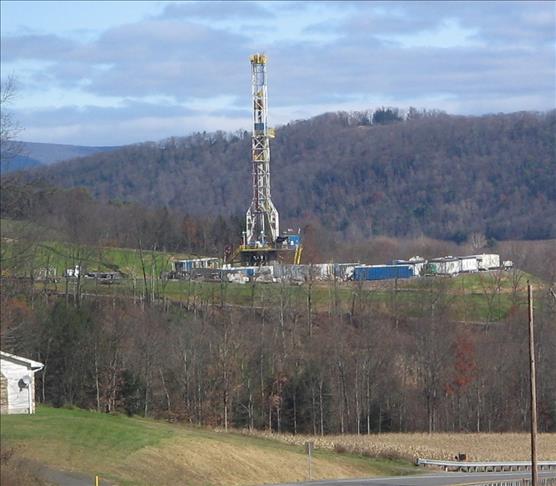
The shale oil, also known as light or tight oil, is produced from shale rock formations by unconventional methods, such as hydraulic fracturing and horizontal drilling.
"If oil prices start to fall below $80, then we might see some pullback in drilling activities, which may impact production," said Thomas Pugh, a commodities economist at Capital Economics, a London-based independent research company.
Pugh said that the companies who were first into the shale oil business would be fine, but those who got in later might find themselves in financial trouble if they are not making a profit while oil prices are falling, since they have loaded themselves up with high debt.
The shale boom in 2008 led the U.S. to increase its crude oil production significantly over the years, reaching 7.9 million barrels per day in December 2013, according to the U.S. Energy Information Administration.
"American producers are more sensitive to the price change than the big producers in the Middle East," said Andrew Holland, an energy expert at the Washington-based American Security Project.
Holland stated that Saudi Arabia can turn on and off its oil production with a single decision under its state-owned oil company Saudi Aramco, but the U.S. is different as each individual producer has to make their own decision on prices.
"There won’t be one decision made. It’s going to be a whole range of decisions made by many different companies," he added.
Hirs said that while Saudi Arabia has the lowest cost production in the world, shale oil in the U.S. is more expensive to produce.
"The U.S. tight oil is the most expensive oil to produce in the world, because horizontal drilling is an expensive technology. Strategically, you don’t want to be the high-cost producer," Hirs added.
The break-even price, the minimum price level that a producer has to sell its product in order to cover his production costs, becomes an important threshold to determine whether U.S. producers will sink or swim in the face of high oil prices.
"The break-even price is around $70 for most of the shale oil producers in the U.S, while for Saudi Arabia it is much much lower," Pugh said.
www.aa.com.tr/en