By A. Humeyra Atilgan
ISTANBUL
The excitement of the millions of Turkish children who returned to school across the country this week has overshadowed the enthusiasm of Turkey’s legion of school teachers – many of whom have been preparing for weeks for the 'back to school' rush.
Anadolu Agency spoke to teachers both in public and private schools in Istanbul to examine their weeks of preparations for the new school term.
Around 17 million students aged between 6 and 18 said ‘merhaba (hello)’ to their teachers on Monday, after three months of summer holidays.
Teachers, on the other hand, started the new education year weeks before their pupils. Those in private schools went through a six-week schedule to get prepared while public school teachers had only two weeks in order to be completely ready for the new term.
"I’m happy about coming together with the children again; I love them, and teaching," says Serap Sengun, just one of an estimated 800,000 teachers who have started the 2014-2015 term across primary, secondary and high school institutions.
"We, like the students, keep learning something new every day, which, in fact, makes me feel so excited about this job," said the 23-year-old who teaches at a private ASFA school.
It will be her second year at a primary school teaching first graders, who start their compulsory education life at the age of six – the same as in France, Germany and many other Western countries.
She stressed her willingness to meet new students, although she only had a summer holiday of six weeks – much shorter than that of a public school teacher, who has two months off.
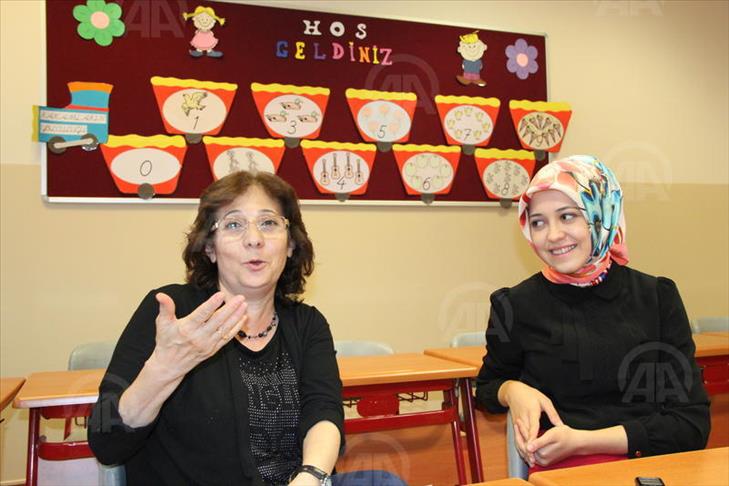
Her colleague Nebile Unlu, with her 34 years of experience in primary school teaching, admits to some tiredness after six weeks of preparation work ahead of the school opening.
This included arranging classrooms, making an academic program, training teachers on digital smart boards and planning a year-long schedule of social and cultural activities according to the age and interest of the students, Nebile tells the AA.
"All the planning is student-based," she stresses, saying their teachers put the child at the center of education with the aim of improving their 'discovery learning' techniques.
The number of public schools in the country is around 46,000, according to Turkey's National Education Statistics body – a number that is much more than the 3,000 or so private schools.
Both offer the same curriculum determined by Turkish Ministry of National Education and employ teachers with four years of university training; mandatory for all Turkey's teachers.
Teaching literature at a public vocational high school located in the Fatih district of Istanbul, Cemaleddin Mesken told the AA how he gets prepared for the new year.
"I first started with some small changes in my wardrobe," he says, laughing. "I have replaced the casual clothes with more formal ones, which I must wear at school...
“Such physical changes bring about a process of psychological preparation, which I find the most exciting phase of this occupation."
The 30-year-old has been teaching with "great pleasure" for eight years now. "Each new year means new students, and exploring new talents," he says.
Mesken, together with around 625,000 public school teachers, is looking ahead "impatiently" to what this school year holds.
As a literature teacher, he said he felt excited about discovering which students would have the literary skill for writing novels or poetry.
Mesken described the "official preparation process" of two weeks, during which teachers have to attend seminars on updated regulations and the school curriculum.
Pointing to the developments in Turkish education system, he says:
"It is perfect that constructivism has been well established since 2005, encouraging students to learn and try new things.
“However, the problem is that there is still some conflicts over its practice between the supporters of parrot-fashion education and the relatively new approach of constructivism, which argues that learning is an active, constructive process."
Differences in approaches to learning were also explained by English teacher Burcu Toprak from ASFA schools: "Another problem is the gap between private school and state schools, especially in terms of language teaching."
In private schools, all the teachers are open to learning new techniques and approaches, she says, claiming the situation is different in state schools.
Toprak – who has been teaching for 15 years – says: "Most teachers in public schools do not have enough energy, as they have many technical and physical problems such as making a photocopy, or finding needed materials."
She said the job was a tough one, sapping most of her energy but added:
"Nevertheless, I am ready to welcome another year of teaching and inspiring another group of students."
www.aa.com.tr/en