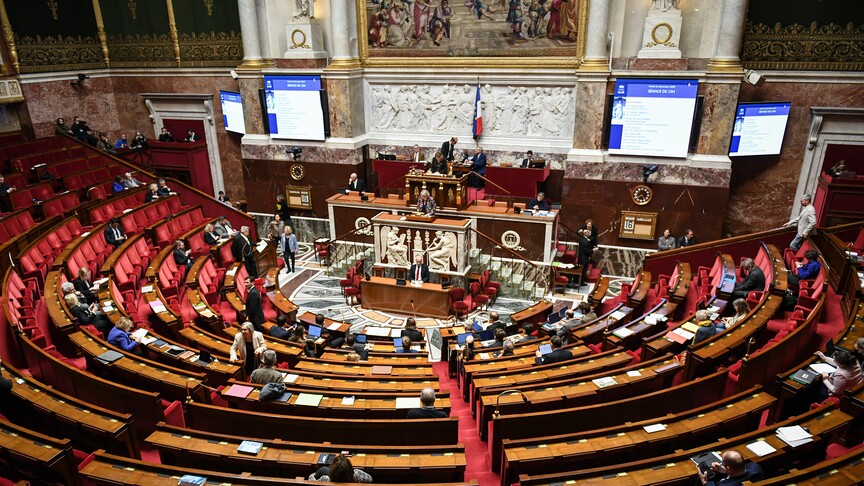
France is set to vote on a controversial draft law that aims to combat rising antisemitism, but critics warn it could redefine the limits of political speech.
The draft legislation, introduced by lawmaker Caroline Yadan, was presented in November 2024 as a response to what officials describe as “new forms” of antisemitism following Oct. 7, 2023, when Hamas attacked Israel, triggering the war in Gaza.
At its core, the proposal rests on the idea that hostility toward Israel is increasingly inseparable from hostility toward Jews, a view openly embraced by Prime Minister Sebastien Lecornu, who has described contemporary anti-Zionism as the “mask” of antisemitism.
The draft does not invent entirely new crimes, and instead, stretches existing ones.
The offense of “apology for terrorism,” already widely used under French law, would be extended beyond direct incitement to include statements that could be interpreted as implicitly justifying or endorsing terrorist acts.
In other words, meaning becomes negotiable, and interpretation becomes central.
The bill goes further. It introduces a new offense targeting anyone who publicly calls for the destruction of a state recognized by France, punishable by up to five years in prison and a fine of up to €45,000 (nearly $53,000).
Yet, the text itself is carefully neutral.
It does not name any country. However, its explanatory notes make it clear that Israel is at the center of the concern.
“This hatred of the State of Israel is now inextricably linked to hatred of Jews. Calls for the destruction of this state, because it constitutes a collective of Jewish citizens, are a veiled way of attacking the Jewish community as a whole,” it reads.
This interpretation extends to political language as well.
Prime Minister Lecornu has argued that slogans such as “From the river to the sea,” widely used by pro-Palestinian activists, amount to an explicit call for Israel’s destruction, as they refer to the entirety of Israeli territory.
In its current form, the bill also expands Holocaust denial legislation, extending it beyond outright denial to include “minimization” or “gross trivialization” of crimes against humanity, terms that, while morally weighty, remain legally open-ended.
Earlier drafts were even more explicit. One version sought to criminalize comparisons between Israel and Nazi Germany; another aimed to penalize denial of a state’s existence. Both were ultimately removed after legal objections.
The bill also expands procedural tools.
Article 3 allows anti-racist associations broader rights to initiate legal proceedings, including in cases linked to the new offenses.
Politically, the bill has done something unusual: unite parts of the presidential camp with the far-right, while dividing the center.
Support for the proposal comes primarily from the presidential camp, including lawmakers from the Renaissance party, as well as backing from the right and the far-right.
The far-right National Rally has openly supported the text, helping push it through committee, where it passed narrowly with government backing.
Former French President Francois Hollande also supported the bill, saying: “I am in favor of amending it, and if it is amended, it must be passed."
Indeed, in the Law Committee, the proposal was narrowly adopted by 18 votes to 14.
But that support stops short of unanimity, even within the center.
The center-right Democratic Movement (MoDem), a key ally of President Emmanuel Macron, has distanced itself from the bill.
MP Perrine Goulet, MoDem’s spokesperson, warned that the text risks “undermining the cause it claims to defend.”
"Today, there is a division in our country regarding this bill, which, in our opinion, undermines the cause it claims to defend. That is why, despite our strong commitment to fighting antisemitism, we will not vote for this bill," she said.
Another centrist bloc, the Liot group, has gone further, openly calling for the bill’s withdrawal.
On the left, opposition is more direct.
The Socialist Party, France Unbowed, and the Europe Ecology, The Greens have all rejected the bill, arguing that it risks criminalizing political expression, particularly in relation to the Israeli-Palestinian conflict.
Meanwhile, the government has shown little hesitation.
Aurore Berge, minister delegate for the fight against discrimination, has reiterated her “determination” to see the law adopted.
Yadan also strongly defended the bill by claiming: “For 15 years, Jews have been killed in France in the name of Gaza.”
Yadan broke with Emmanuel Macron over his recognition of the right of a Palestinian state to exist, and again in October 2024 when she criticized his call to halt weapons deliveries to Israel during the war in Gaza.
Outside parliament, the backlash has been louder.
A petition opposing the bill has gathered nearly 700,000 signatures, while protests have spread across France, with demonstrators warning that supporting Palestine is being recast as a potential offense.
The Human Rights League (France) has called on lawmakers to reject what it describes as a “dangerous” text that risks turning the fight against antisemitism into a tool for censorship.
Critics argue the bill’s vague language, particularly around “implicit” incitement and “trivialization,” risks criminalizing not just support for violence, but analysis, context, or dissent.
Reporters Without Borders has also warned the bill could have a “chilling effect” on journalism, cautioning that reporters covering armed groups or political violence could find themselves treated as authors of the statements they are reporting.
“The broad and imprecise definitions… risk conflating journalism with a criminal offence,” the organization said.
Legal professionals have echoed those concerns.
France’s lawyers’ union has warned that expanding terrorism-related offences without clear intent requirements risks turning courts into arbiters not just of speech, but of thought.
The group cautioned that the law introduces “more subjectivity where more objectivity is needed,” blurring the line between legal and illegal expression.
Meanwhile, the European Civic Forum has warned the bill could be used to suppress solidarity with Palestinians and conflate criticism of Israel with antisemitism.
The bill comes at a time of heightened tension in France.
According to the French Interior Ministry, 320 antisemitic acts were officially recorded in 2025, averaging more than three incidents per day.
Jews, who represent less than 1% of the population, were targeted in 53% of all anti-religious acts, with the majority of incidents directed at individuals and involving, in some cases, physical violence.
Around one-third of these acts referenced the Israeli-Palestinian conflict.
At the same time, France itself has become more directly involved in that geopolitical debate.
On Sept. 22, 2025, President Emmanuel Macron announced at the UN General Assembly that France would formally recognize the State of Palestine, describing it as a step toward preserving the two-state solution.
While welcomed by Palestinian officials, the decision also sharpened divisions within France, feeding into an already polarized public debate.
news_share_descriptionsubscription_contact