- French government promises action with initial decisions to be presented before end of October
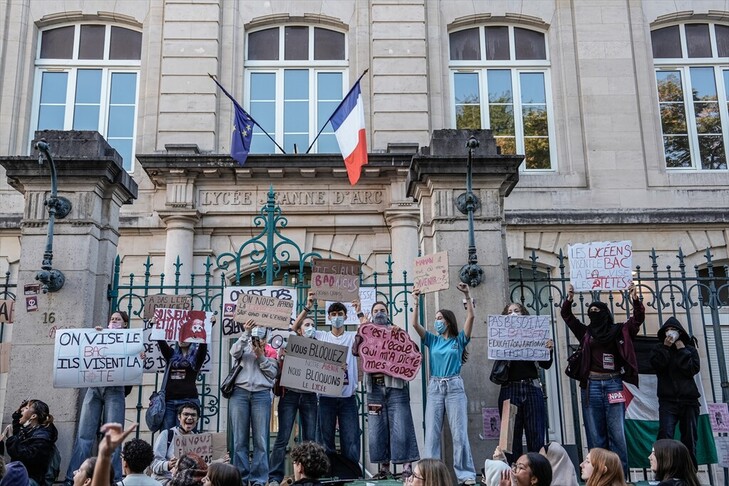
A student-led movement in France led to the full or partial closure of up to 500 schools on Monday.
The students, aged between 15 and 18, say their schools are understaffed and classrooms are overcrowded. In some cases, the buildings are inadequately equipped.
Blockades and demonstrations have spread from the Paris suburbs to cities including Marseille, Lyon, Lille, Nantes, Montpellier, Bordeaux, Toulouse and Rennes.
Student organizations have called for another nationwide mobilization Tuesday, with university students and several education and labor unions joining the action.
How did the protests begin?
The movement is traced to Lycee Saint-Exupery in Creteil, southeast of Paris, where students, teachers and parents gathered outside the school on Sept. 21 to protest unfilled teaching positions and insufficient resources.
Similar complaints were already present in other schools, particularly in lower-income suburbs where teacher absences, staff turnover and aging buildings are longstanding problems.
Protests were reported at about 60 high schools in the Paris region later that week.
The Union Syndicale Lyceenne (USL), a high school student union, subsequently called for blockades nationwide on Sept. 29, coinciding with a wider public-sector protest.
Within eight days of the Creteil action, demonstrations or blockades were reported at about 410 high schools.
The number of affected institutions continued to rise, reaching more than 1,000 on Oct. 1 before falling to 735 on Oct. 2, according to government figures.
What are students demanding?
The movement does not have a single list of demands shared by every school, but several complaints are common.
Students want vacant teaching positions filled and absent teachers replaced more quickly.
They are also demanding smaller class sizes, additional education and support staff, safer and better-maintained buildings and less demanding daily schedules.
Some schools have reported long gaps between lessons because of timetable and staffing problems, while students say teacher absences can leave them preparing for national examinations without completing parts of the curriculum.
The movement has also taken aim at Parcoursup, France’s university admissions platform. Critics argue that the system lacks transparency, increases anxiety and disadvantages students from less affluent schools.
The USL and Union Etudiante, another student union, have broadened the campaign to include university funding, student poverty and social and racial inequalities within education.
Who is being affected?
France has approximately 3,700 high schools.
But the disruption has extended beyond high schools.
Around 100 middle schools were affected last Friday, largely because they were situated within the same educational complexes or near protesting high schools.
Some universities have also experienced blockades.
Closures have forced students to miss lessons or move temporarily to remote learning, a measure teachers’ unions say can deepen inequality because pupils do not have equal access to equipment or suitable study environments at home.
Education staff have also been caught in the unrest.
Education Minister Edouard Geffray said 78 employees had been injured and 24 institutions had been burned or ransacked since the protests began.
Why has the movement grown so quickly?
Student unions transformed scattered local actions into coordinated blockade days, while videos and messages circulated rapidly through social media.
Interior Minister Laurent Nunez has identified online mobilization as one reason for the movement’s unexpected scale.
Support from parents and organized labor has given the campaign additional momentum.
France’s largest parents’ federation, the FCPE, said the protests reflected concerns families had raised for years.
Several labor and education unions have called on members to join Tuesday’s demonstrations or strike in solidarity.
The movement also expanded after a Friday meeting between student representatives and the education minister.
Organizers said they left without sufficiently concrete commitments and announced what they called a third stage of mobilization for Tuesday.
Are the protests becoming more violent?
The movement is mostly peaceful, but some violent incidents have been reported.
Authorities recorded urban violence near 158 schools last Friday.
Incidents have included fires, attempts to force entry into schools, property damage and attacks on staff and police.
Over the past week, police arrested more than 5,000 protesters.
Nunez said about 85% of those detained were minors.
The government says far-left activists and other outside groups have infiltrated and hijacked the student movement.
Student and teachers’ unions acknowledge that outsiders have been involved in violence at some locations but reject attempts to portray the entire campaign as rioting.
Police tactics have also become part of the dispute.
Amnesty International has documented allegations of excessive force against minors and called for the suspension of rubber-ball launchers during the protests.
How is the government responding?
Prime Minister Sebastien Lecornu has ordered work on five areas: replacing absent teachers, renovating buildings with regional authorities, improving timetables, making Parcoursup more transparent and ensuring student proposals receive formal responses.
The government says initial decisions, including funding and implementation schedules, will be presented before the end of October.
It is also accelerating proposed legislation intended to make those responsible for vandalism pay for the damage they cause.