
European lawmakers are warning that the EU should use its economic leverage over Israel or risk undermining its credibility on human rights.
The call comes as pressure mounts following a record-breaking petition demanding the suspension of the EU–Israel Association Agreement, which has gathered 1 million signatures.
Launched in January 2026 under the banner “Justice for Palestine,” the European Citizens’ Initiative has exceeded thresholds in at least 10 EU member states – well above the required seven – making it the fastest initiative to reach the benchmark since the mechanism was introduced.
Led by the European Left Alliance, with the support of civil society organizations and Palestinian-led movements across Europe, the initiative calls on the EU to suspend its long-standing trade and cooperation framework with Israel.
Under EU rules, once a European Citizens’ Initiative surpasses one million verified signatures and meets geographic requirements, the EU Commission must formally examine the proposal, though it is not obliged to enact legislation.
With the required signatures collected in just three months, the initiative is already exerting pressure not only on EU institutions but also on national governments, which remain divided in their positions on Israel.
Signatures have come from across the bloc, highlighting what organizers describe as a pan-European movement demanding change.
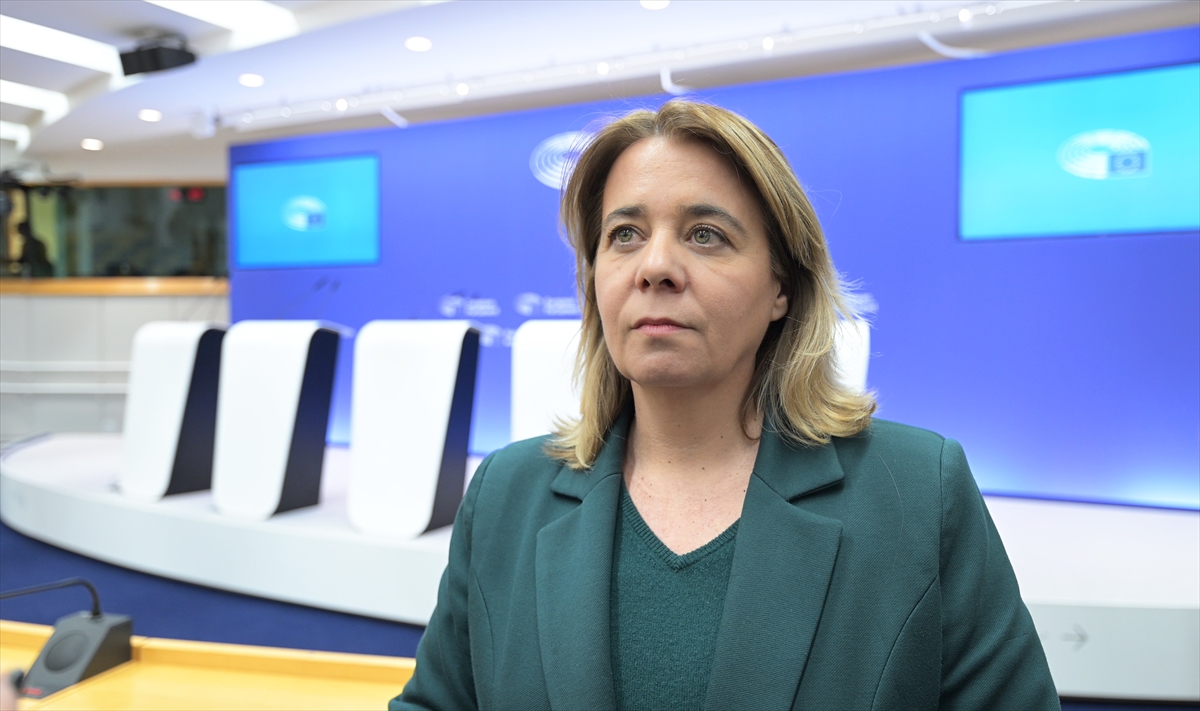
Speaking to Anadolu, Catarina Martins, co-chair of the European Left Alliance, framed the initiative as an attempt to transform widespread public mobilization into concrete political action.
"European people want to stop the war," she said, arguing that many citizens see the actions of the Israeli government as "intolerable."
Martins also pointed to what she described as a disconnect between EU leadership and public opinion.
"There's of course a huge gap between what the European Commission thinks and what European people think," she said, criticizing the EU Commission for acting "too little and too late."
She compared the EU's response to Israel with its swift sanctions against Russia following the start of the war in Ukraine, stressing that consistency is essential for credibility.
"If we can do it when we say to Russia they cannot invade Ukraine, and I'm glad we did it then, we need to do it also now to stop the genocide and to stop the war in Lebanon and to give some chance of peace to the Middle East," Martins said.
Martins stressed that the EU is uniquely positioned to influence Israeli policy due to its economic weight.
"Europe does not have to be powerless in a world where war is everywhere. We can act more... We are the most important commercial partner for Israel. So we do have a leverage. And if we stop the trade agreement, the government of Israel will need to change," she said.
The EU remains Israel's largest trading partner, with trade reaching €42.6 billion (about $50.2 billion) in 2024.
Martins argued that continuing the agreement undermines the EU's own legal framework, particularly the human rights clause embedded in the EU-Israel Association Agreement, which entered into force in 2000.
"European money is being used to fund the genocide and the occupation of the West Bank or the war in Lebanon. And that is not what European people want.”
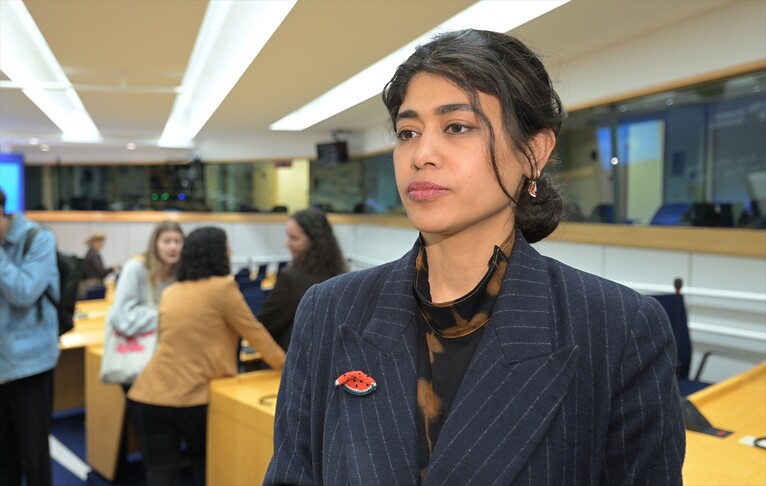
Echoing these concerns, Rima Hassan, a member of the European Parliament from the Left Group, told Anadolu that the initiative highlights a clear divide between citizens and EU institutions.
She pointed to polling data in countries like France and Germany showing majorities in favor of sanctions on Israel and recognition of a Palestinian state.
Hassan expressed hope that the Commission would “at least listen” to the growing public demand reflected in the initiative.
Organizers are now aiming to reach 1.5 million signatures to ensure a margin of safety during the verification process and strengthen political pressure during the EU Commission's six-month review period.
During that time, Hassan said, lawmakers plan to mobilize "all political levers," including parliamentary questions, debates, and continued civil society engagement.
"To ensure that we obtain a response that is simply adequate and also to that we do not once again find ourselves in a situation of mere announcements," she said.
For Hassan, the issue goes beyond policy -- it is about the EU's global credibility.
She contrasted the EU's firm stance on Russia with what she described as inaction regarding Israel, referencing allegations of war crimes, occupation, and apartheid.
"EU has lost its credibility at the international level.”
Hassan also raised the legal concept of complicity under the Genocide Convention, noting that states providing material support could face consequences if international courts determine that genocide has occurred.
"If Israel is found guilty of crimes of genocide by international courts, all states that have given military and material support to Israel will fall under this article as complicit actors in this crime," she said.
According to Hassan, two elements are "at stake" for the EU: the question of credibility and consistency in the defense of human rights, and complicity in the crimes committed by Israel.
"The European Union cannot position itself as an actor defending international law and human rights if it is not consistent on this issue," she said.