Beyza Binnur Dönmez
17 July 2026•Update: 17 July 2026
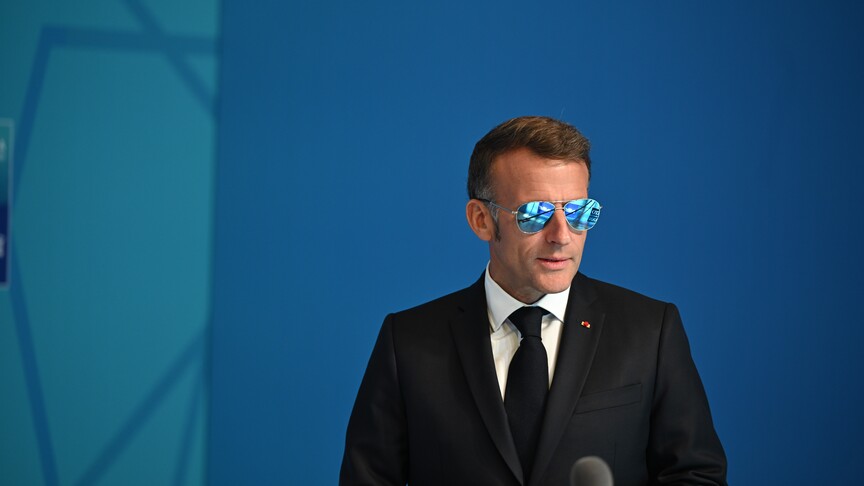
French President Emmanuel Macron said Friday that France and Germany have "never been so closely aligned" on China, warning that Europe faces a €1 billion (nearly $1.15 billion) daily trade deficit with Beijing that costs thousands of jobs every day.
Speaking after a joint Franco-German Cabinet meeting, Macron said Paris and Berlin now share a common assessment of China's economic impact while stressing they are "not anti-China."
"Every day, we have a €1 billion trade deficit with China. Every day, tens of thousands of jobs are destroyed," he said.
The president added that Europe should seek greater technology transfers from China rather than simply importing Chinese products while protecting its industries from unfair competition.
He said: "We want to engage with China to have technology transfers to our countries, not just import products, but transfers that are respected and create jobs here so we can benefit from them."
Macron said China subsidizes its companies on average eight times more than Organization for Economic Co-operation and Development countries, urging the European Commission to move "much faster" in deploying trade defense instruments.
He also announced that France and Germany had asked their economy, finance and foreign ministers to prepare a joint roadmap on China by September, including dialogue with Beijing on exchange rates and financial market access.
On Europe's competitiveness, Macron said Paris and Berlin agreed to continue simplifying EU regulations, deepen the single market and complete the Capital Markets Union, or the Savings and Investment Union, during the current semester.
"We've agreed that this semester must be the time to finalize the Capital Markets Union, or the Savings and Finance Union. This is fundamental because if we want a Europe that can finance its disruptive projects and, ultimately, have the private financial component of what I just mentioned regarding AI, quantum computing, and other areas, we must see this project through," he said. "There's a genuine Franco-German agreement."
He underlined that the period from October to December is "really the time for action" on the industrial projects, the Capital Markets Union, and the strategy towards China.
France alone to fund its nuclear deterrent
On security, Macron reiterated that France's proposal to extend its nuclear deterrence to European partners was intended to strengthen the continent's security rather than seek financial contributions for France's nuclear arsenal.
"In no way does it aim at co-financing the French nuclear deterrent. In no way," he said.
Macron said the initiative aims "to improve the security of the European continent," "create greater uncertainty for our adversaries," and build "greater strategic intimacy" with allies through closer exchanges between military experts, joint exercises and deeper operational cooperation with Germany.
"France's nuclear deterrent will always be financed by France," he said.
The president also said France and Germany would back work on a European savings label and advance the digital euro.
He said the two countries had reaffirmed a common approach to the EU's next long-term budget, backing ambitious European policies while insisting spending remain efficient.
"We cannot have an unrealistic trajectory of increasing our national contributions," he said, adding that the two countries would jointly respond to the European Commission's proposals on new sources of EU revenue.
Macron said the two governments shared the same roadmap on EU enlargement and internal reforms, and had tasked ministers with preparing a Franco-German agreement on key EU industrial and climate policies.
"We believe in a decarbonized industry, but at the right pace, with the right protections and with pragmatism when we look at international competition," he said.