Jo Harper
08 May 2026•Update: 08 May 2026
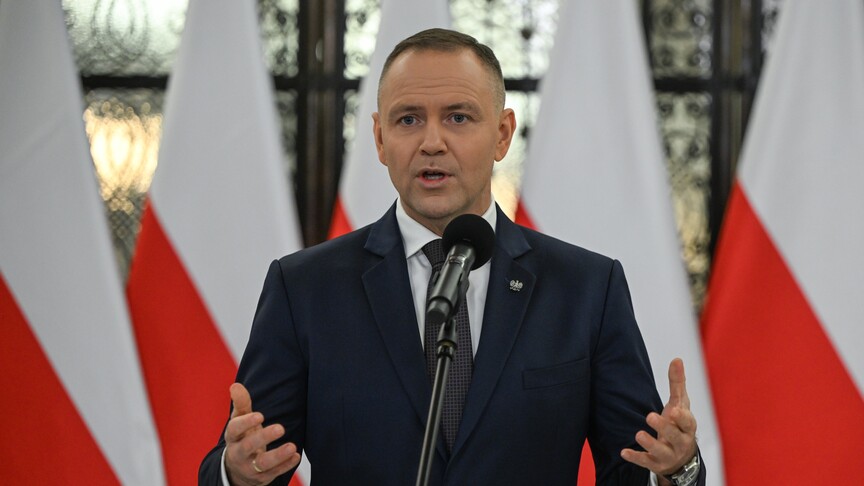
Polish President Karol Nawrocki on Thursday proposed holding a national referendum on Poland’s implementation of EU climate policies, arguing the measures have increased energy, business and agricultural costs.
Nawrocki said he would formally ask the Senate to approve a referendum on Sept. 27 asking voters whether they support continuing EU climate measures.
The proposal is unlikely to pass, as Poland’s constitution requires Senate approval for presidential referendums and the upper chamber is controlled by the pro-EU governing coalition led by Prime Minister Donald Tusk.
“This proposal will end up where it belongs: in the trash,” Senate Deputy Speaker Magdalena Biejat said on social media, arguing that fossil fuel dependence rather than EU policy is responsible for rising prices.
Nawrocki said the initiative is not directed against the EU or environmental protection but concerns “the pace, scope and cost” of the energy transition.
He criticized key EU policies including the Green Deal and the Emissions Trading System (ETS), which places costs on carbon emissions.
The referendum proposal reflects a broader strategy by the opposition Law and Justice party (PiS), which supports Nawrocki and has recently called for Poland to unilaterally withdraw from the ETS. The government says such a move would violate EU law and expose Poland to heavy fines.
Even if approved, the referendum would face further challenges because results are only legally binding if turnout exceeds 50 percent — a threshold previous Polish referendums have repeatedly failed to meet.
A 2015 referendum on electoral reform recorded turnout of only 7.8 percent , while a 2023 referendum held alongside parliamentary elections drew 40.9 percent participation despite high election turnout.
Poland remains one of the EU’s most carbon-intensive economies. About half of the country’s electricity generation still comes from coal, while roughly one-third of households use coal for heating.
Supporters of Nawrocki’s position argue that ETS-related costs directly increase electricity prices and that rapid decarbonization could harm industry and agriculture.
Critics argue that Poland’s coal mining sector is among the world’s most expensive and heavily subsidized, and say dependence on fossil fuels has increased the country’s vulnerability to external shocks, including the Russian invasion of Ukraine and volatility in global energy prices.
Taxes and fees, which account for more than 40 percent of electricity bills, are also a major factor behind high consumer costs.
The debate in Poland reflects wider tensions across Europe, where climate policies are increasingly linked to cost-of-living concerns.
In France, fuel taxes triggered the gilets jaunes protests, forcing the government to recalibrate its approach. In Germany, disputes over heating regulations and industrial competitiveness have reshaped coalition politics. In Hungary, Prime Minister Viktor Orban has similarly framed EU climate measures as economically punitive, using veto powers in Brussels negotiations.
What distinguishes Poland is the scale of its coal dependence and the use of a referendum proposal to challenge the direction of EU climate policy.