Aysu Bicer
02 October 2026•Update: 02 October 2026
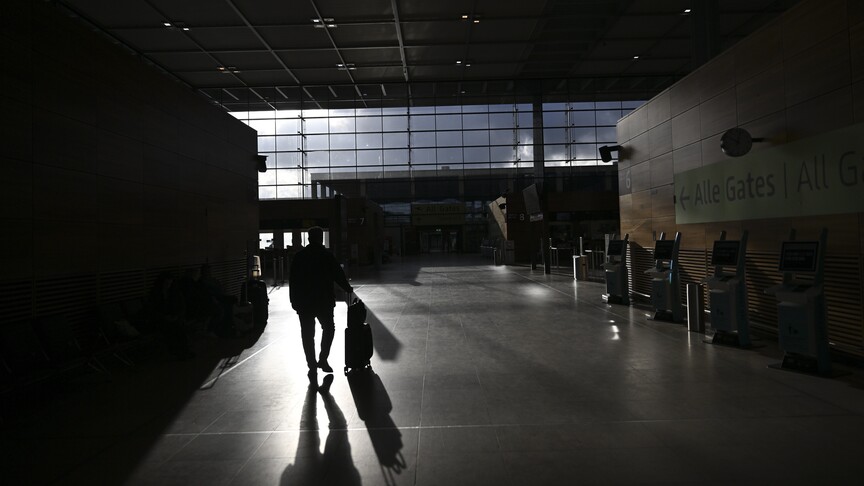
A Russian motorcyclist with alleged links to a senior Russian military intelligence official has been identified as the suspected mastermind behind an attempted sabotage attack at Germany’s Leipzig-Halle airport, according to a joint investigation by The Telegraph and Welt am Sonntag.
The investigation identified Oleg Levushkin as the suspected planner of an operation in which a drone carrying a tin packed with explosives struck the wing of a Ukrainian airliner at Leipzig-Halle airport.
The incident, which occurred in September, could have triggered an explosion and caused severe structural damage to the airport, according to the report.
Classified intelligence documents from Germany, Lithuania and Poland, along with interviews with senior Western intelligence officials, reportedly indicate that Levushkin and a “disposable agent” traveled to Germany to carry out the sabotage operation.
German investigators suspect Levushkin planned the attack and subsequently instructed Andrei Karshakou, a Belarusian proxy agent, to execute it.
Evidence examined by The Telegraph and Welt am Sonntag reportedly showed similarities between the Leipzig incident and a separate foiled Russian sabotage plot involving drones and explosives targeting locations in Poland, Lithuania and Germany.
The explosive device recovered in Leipzig was said to closely resemble devices used in other alleged Russian sabotage operations across Europe.
Levushkin, a Russian passport holder with an interest in motorcycles, has reportedly maintained contact for years with Denis Smolyaninov, who has been described as an alleged chief planner of Russian bomb attacks across Europe.
Smolyaninov was sanctioned by the UK Foreign Office last year.
A December 2025 report by Lithuanian intelligence, reviewed by The Telegraph, said Smolyaninov led the Ukraine department at Russia's military intelligence service, the GRU.
The report said he specialized in psychological operations and was associated with covert sabotage campaigns in Europe using Telegram.
According to information provided to German newspaper Suddeutsche Zeitung by the Dossier Centre, Levushkin and Smolyaninov met in 2007 after Smolyaninov mediated a financial dispute involving Levushkin's business.
The Leipzig incident has also been linked to GRU unit 29155, which German intelligence officials reportedly regard as a key force behind Kremlin-ordered operations.
German security authorities believe Russia is seeking to make Europeans view their support for Ukraine as risky, potentially affecting public debate and support for Kyiv.
Germany is increasingly an “operational theatre” for Russian intelligence services, according to a senior German intelligence official.
“What used to be isolated cases, we are now seeing on a broad scale,” they said.
The Lithuanian intelligence files reportedly also identified links between the Leipzig incident and a wider network of alleged sabotage plots across Europe, which investigators attributed to a hard-line GRU unit.