Alyssa Mcmurtry
25 June 2026•Update: 25 June 2026
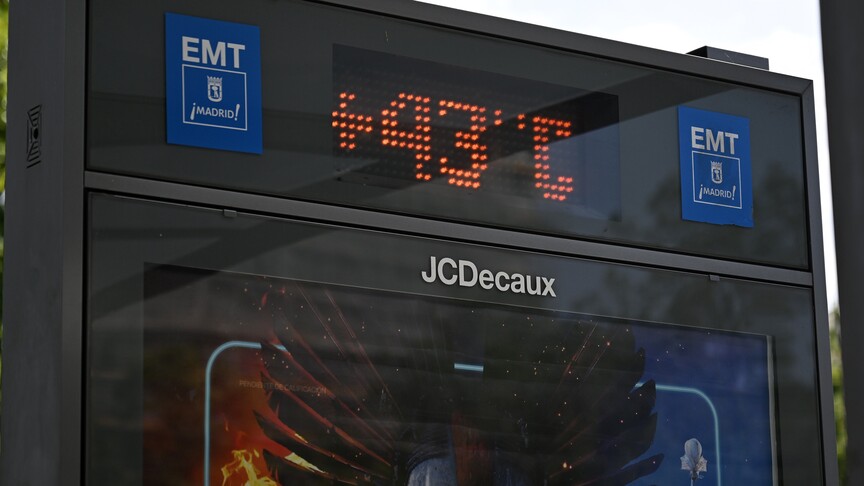
Spain recorded its two hottest June days on record this week, preliminary data showed Thursday, after an exceptional heatwave sent temperatures soaring across the country and shattered records in several regions.
Spain's meteorological agency AEMET said Tuesday was the hottest June day ever recorded across mainland Spain since records began in 1950, with the national average temperature reaching 7.1C (12.8F) above normal.
The agency added that Monday ranked as Spain's second-hottest June day, while Sunday was the eighth hottest since records began.
Temperatures eased across much of Spain on Thursday, but Wednesday remained exceptionally hot, particularly across the country's northern regions, where meteorologists issued red alerts for extraordinary danger.
At Bilbao Airport, temperatures exceeded 40C (104F) on Sunday, Tuesday and Wednesday – the first time since records began that the 40C threshold has been reached three times in a single year.
The northern region of Cantabria also broke its all-time heat record, when temperatures reached 43.7C (110.7F).
Meteorologists said the heatwave was caused by a persistent heat dome over Western Europe, combined with a surge of hot, dry air moving north from the Sahara Desert.
Preliminary excess death data attributed 212 deaths to heat-related causes between Sunday and Wednesday.
A worsening trend
AEMET said the episode reflects a long-term trend of increasingly frequent and intense heatwaves in Spain.
Between 1975 and 1984, Spain averaged just three heatwave days a year. During the past decade, that figure has risen to 22 days annually.
AEMET also noted that summer nights are increasingly sweltering across the country.
At Barcelona Airport, there were historically an average of 19 tropical nights each year, when overnight temperatures do not fall below 20C (68F). Over the past decade, that figure has risen to 80 nights a year, meaning such conditions now persist through much of the summer.
While tropical nights are most common along Spain's Mediterranean coast, AEMET said they are becoming increasingly frequent inland. In Madrid, the average has risen from 16 tropical nights a year between 1960 and 1990 to 52 over the past decade.
The agency attributed the long-term trend primarily to human-induced climate change, noting that Spain's average summer temperature has risen by nearly 2C (3.6F) since 1961.
Under a medium-emissions scenario, Spain could experience an average of 47 heatwave days each year by the end of the century, rising to 77 days under a high-emissions scenario, it said.