
Anadolu Ajansı © 2026


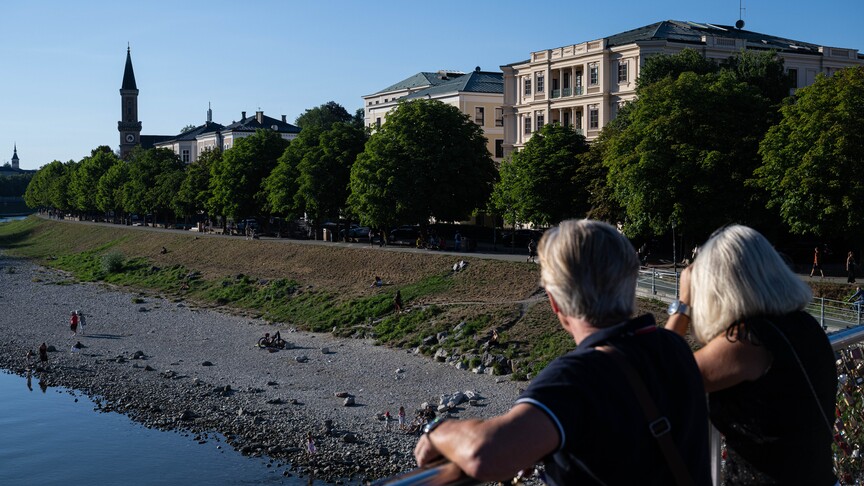
Europe's largest rivers are already at water levels normally seen at the end of summer, weeks ahead of schedule.
At this rate, another month of hot, dry weather could disrupt transport, electricity generation, agriculture and industrial production across the continent.
At this time of year, Alpine snowmelt and rainfall would typically replenish these waterways. But persistent drought and prolonged heat waves have pushed the Rhine, Danube and Po to near-historic lows in August.
Satellite images released by the European Union's Copernicus program between Aug. 1 and Aug. 3 show extensive sandbanks and gravel bars emerging along stretches of the Loire in France, the Rhine near Boppard in Germany, the Danube near Hungary's Paks Nuclear Power Plant and the Po near Cremona in northern Italy.
Areas that are normally submerged have become exposed, illustrating how widespread the hydrological stress has become across western and central Europe.
According to the EU's European Drought Observatory, drought conditions remained severe across much of the continent through July, while worsening further in central-western Europe.
The consequences extend far beyond shrinking rivers.
The Rhine is Europe's busiest inland waterway, stretching about 1,290 kilometers (800 miles) from the Swiss Alps to the North Sea and linking Switzerland, Germany, France and the Netherlands to the Port of Rotterdam.
Germany's Low Water Information System (NIWIS) reported that 44% of Rhine monitoring stations recorded extremely low water levels at the end of July.
At Kaub, the river's most closely watched navigation bottleneck, navigable depth recently dropped to around 25 centimeters, matching the record low reached during the severe drought of 2018 before falling even further in some measurements.
While commercial shipping has not stopped, barges are carrying only a fraction of their normal cargo to avoid running aground.
That has immediate economic consequences.
Instead of transporting one shipment with a single vessel, operators must distribute cargo among several barges or shift freight to rail and trucks, increasing transport costs throughout Europe's industrial heartland.
Freight rates on several Rhine routes have climbed sharply, while cargo volumes moving between Rotterdam and inland Europe have fallen below seasonal averages.
Heavy industries are particularly vulnerable because they depend on reliable inland shipping for both incoming raw materials and outgoing products.
Should river levels continue falling through August, supply chain disruptions are expected to become increasingly severe.
Low Rhine discharge is also creating problems downstream.
For the first time ever, water authorities in the region between Rotterdam and The Hague have closed all locks along the Nieuwe Maas to prevent saltwater from the North Sea from intruding into freshwater systems.
Officials have simultaneously imposed a complete ban on extracting surface water for irrigation and other non-essential uses.
Normally, roughly 1,800 cubic meters of Rhine water enter the Netherlands each second during summer.
This year, flows have fallen to roughly one-third of that level.
Dutch authorities say sustained rainfall will be necessary before restrictions can be lifted.
The Danube, Europe's second-longest river, is facing similar pressures.
Flowing through 10 countries, it supports navigation, hydropower and cooling water supplies for several major thermal and nuclear power stations.
Germany's monitoring network reported that nearly four out of every five Danube measuring stations registered extremely low water levels by the end of July.
The effects are already visible across southeastern Europe.
Hungary's Paks Nuclear Power Plant, which generates more than 40% of the country's electricity, has been forced to progressively reduce output because declining Danube water levels have limited cooling capacity.
Operators narrowly avoided a complete shutdown after river levels rose only slightly overnight, but the plant continues operating well below normal output.
A prolonged reduction could force Hungary to rely more heavily on imported electricity while tightening regional power supplies.
Romania has taken unprecedented action by carrying out a controlled explosion along the Danube to improve water flow toward the Cernavoda Nuclear Power Plant, where cooling water availability has also become a growing concern.
Serbia is facing a dual challenge.
Reduced river flows have lowered production at the Djerdap 1 hydropower station while simultaneously affecting cooling systems at coal-fired power plants, reducing electricity generation from both sources.
Italy's Po River, the country's longest river and the lifeline of its agricultural heartland, has entered another period of acute stress.
Authorities have raised drought alerts across the Po Valley after worsening hydrological conditions and forecasts indicating continued hot weather.
More than 100 municipalities across northern Italy are already experiencing difficulties maintaining drinking water supplies.
The drought is affecting one of Europe's most productive farming regions.
Rice fields between Turin and Milan are experiencing severe water shortages, while lower river discharge has allowed seawater from the Adriatic to push farther inland, increasing salinity and reducing freshwater available for irrigation.
Water released earlier this summer from lakes such as Maggiore and Como helped farmers temporarily but also accelerated declines in lake storage levels.
River shortages are affecting electricity systems even where water remains available.
France's nuclear reactors rely heavily on rivers for cooling.
During periods of extreme heat, environmental regulations restrict how much warmed cooling water plants can discharge back into rivers, forcing reactors to reduce output.
This summer has already seen record heat-related reductions in French nuclear generation.
Those constraints ripple across interconnected European electricity markets, contributing to higher wholesale prices in neighboring countries during periods of peak summer demand.
Hydrologists say the current situation reflects more than simply a lack of rainfall.
Much of Europe's river system depends on gradual releases of Alpine snow and glacier melt during summer.
After an unusually warm spring and repeated heat waves, snow reserves melted earlier than usual, reducing the amount of water available later in the season.
Meanwhile, shrinking Alpine glaciers continue to weaken one of Europe's natural safeguards against prolonged summer drought.
Scientists from the World Weather Attribution initiative note that while rainfall trends across much of Europe have not shown a clear long-term decline, rising temperatures caused by human-induced climate change are increasing evaporation from soils, reservoirs and rivers.
Higher temperatures are also increasing water demand from agriculture, households and industry, compounding pressure on already depleted river systems.
news_share_descriptionsubscription_contact