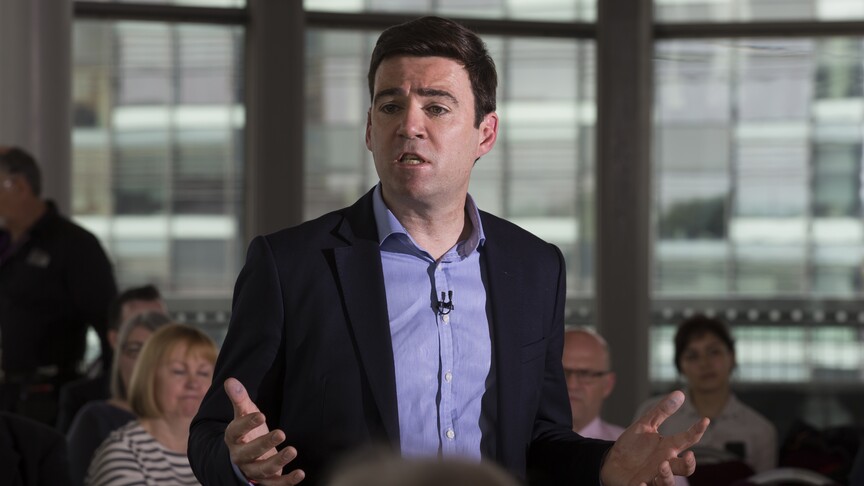
- He participated in 2 leadership contests in 2010, 2015; came 4th, 2nd respectively
- Under his leadership, Greater Manchester became 1st area outside London to bring bus services back under public control
Andy Burnham returned to the British parliament on Friday after winning the Makerfield by-election, a victory that immediately intensified speculation over a possible Labour leadership challenge against Prime Minister Keir Starmer.
Burnham, the mayor of Greater Manchester and one of Labour’s most prominent regional figures, secured a decisive win in the northwestern constituency, taking around 55% of the vote and defeating Reform UK’s Robert Kenyon by more than 9,000 votes.
The result gives Burnham a seat in the House of Commons for the first time since 2017, clearing a key procedural obstacle to any challenge against Starmer, as Labour rules require leadership candidates to be sitting lawmakers.
His victory came after former Labour MP Josh Simons resigned last month to trigger the contest, paving the way for Burnham’s return to Westminster at a time of growing unrest inside the ruling party.
The by-election was closely watched across Britain, not only as a test of Labour’s strength against Nigel Farage’s Reform UK, but also as a potential turning point in Starmer’s premiership following Labour’s heavy losses in last month’s local elections.
Speaking after his win, Burnham cast the result as a mandate for change, saying Labour had a “final chance” to reconnect with voters and offer a clearer alternative to the populist right.
Early career
Burnham was born in 1970 in Aintree, a suburb of Liverpool and joined the Labour Party at the age of 15.
He studied at Fitzwilliam College, Cambridge and held several jobs until his first election as lawmaker. He worked as a researcher for the late Labour politician Tessa Jowell, as a parliamentary officer for the National Health Service (NHS) Confederation and as an administrator with the Football Task Force.
Burnham also served as a special adviser to then Culture Secretary Chris Smith from 1998 to 2001.
He was elected to the House of Commons as member of parliament for Leigh in Greater Manchester in 2001 general elections in which then-Prime Minister Tony Blair was re-elected to serve a second term in government with another landslide victory for Labour Party.
First years in politics, failed leadership challenges
Under Tony Blair and Gordon Brown governments, Burnham had a chance to hold several government roles, including parliamentary private secretary, parliamentary under-secretary of state for the Home Department, minister of state for Health, chief secretary to the Treasury, and secretary of state for Culture, Media and Sport.
In 2009, he was appointed as health secretary, replacing Alan Johnson and expressed opposition to further privatization of NHS. He held the post until May 2010, less than a year.
Following 2010 general elections which resulted in hung parliament after Labour lost parliamentary majority and paved the way for 14 consecutive years of Conservative party rule, he was among candidates in the Labour leadership election.
However, Burnham came fourth out of five candidates in the contest won by Ed Miliband.
Burnham continued to hold several top posts in the party as he served as shadow education secretary and shadow health secretary under Miliband's main opposition Labour Party.
After five years, he once again contested for the party's leadership challenge in 2015 and came second this time, behind Jeremy Corbyn.
Until 2017, he served as shadow home secretary under Corbyn's Labour Party. During this time he backed the nationalization of water and energy and declined to resign in protest at Corbyn's leadership in 2016.
From Westminster to Manchester
In 2017, however, he stood down as a lawmaker to run for mayor of Greater Manchester. He won the race with more than 60% of the vote and was re-elected in the 2021 and 2024 elections.
Under his leadership, Greater Manchester became the first area outside the capital, London, to bring bus services back under public control.
He also integrated them with other modes of transport under the branding of what is called the "Bee Network."
His public profile grew further during the COVID-19 pandemic, when he criticized the Conservative government for what he described as its contempt toward northern England in its handling of regional lockdown measures.
His role in the standoff strengthened his reputation and led to him being called "King of the North."
In January this year, a potential opportunity arose for his return to Westminster when Greater Manchester lawmaker Andrew Gwynne announced he was standing down, triggering a by-election in his Gorton and Denton constituency.
However, Burnham was blocked from standing by Labour Party’s National Executive Committee (NEC).
Crucial by-election
His latest bid to return to Westminster came after Labour Party lawmaker Josh Simons resigned last month to trigger a by-election and pave the way for the Greater Manchester mayor's return to parliament.
The move came amid mounting pressure by Labour Party lawmakers urging the prime minister to leave or set out a timetable to do so after Labour suffered heavy losses in last month's local elections, while Farage's Reform UK surged.
The move also required approval from the Labour Party's ruling body and this time NEC voted to let Burnham stand as the Labour candidate in the Makerfield by-election.
Before launching his campaign in Makerfield, he vowed not to "re-run" Brexit arguments, as he said he was not proposing Britain's considers rejoining the EU.
Meanwhile, since the day after local elections results, Starmer has reiterated that he intends to fight the next general election and rejected speculation that his time in office is nearing an end.
How can a leadership challenge begin?
Under Labour Party rules, a leadership contest can begin either if the leader resigns or if 20% of Labour lawmakers nominate a challenger who must be a lawmaker.
Since Labour currently has 403 lawmakers in parliament, a candidate would need the backing of 81 lawmakers to formally launch a challenge.
If a contest is triggered, additional candidates could also enter the race if they secure support from 81 lawmakers.
As sitting prime minister and Labour leader, Starmer would automatically appear on the ballot if he chose to contest the leadership election.
He would also remain prime minister during the contest.
The timetable for any contest would be set by Labour’s National Executive Committee.