
By Evelyn T. Kpadeh
MONROVIA
When Jerald Dennis left the Ebola treatment center after surviving the deadly virus that has claimed the lives of more than 2,000 of his fellow Liberians, he thought the worst was over.
He was wrong.
Dennis, a 30-year-old non-medical worker at John F. Kennedy Medical Hospital (JFK), Liberia's largest referral hospital, fell prey to the Ebola virus in early September.
"I probably contracted the virus through indirect contact, because you can get it through direct or indirect contact," he told Anadolu Agency in an interview in his home in Monrovia's Matadi district.
Dennis recalled how he began feeling burns on his hands before things became worse, as he experienced severe pain in his head and other parts of his body, later suffering from diarrhea and vomiting as well.
Being aware of the danger of the virus and its symptoms, he decided to get some drugs – but his body temperature kept increasing and sweat kept pouring from his body.
"In the middle of the night, I sweated so much and later began to vomit," Dennis recalled. "I told my girlfriend to get down from the bed and told her not to touch me – or touch anything from my body – without wearing gloves until daybreak."
In the morning, he decided to make his way to JFK's Ebola treatment unit.
"If I had decided to call the ambulance, it would have taken me days for them to have come and taken me to the unit," Dennis said. "I did not want to die at home."
"So I doubled my trousers, t-shirts and jackets… and managed to walk on the road, where I rode a local transport motorbike that took me to JFK," he said.
But Dennis found all the beds at the Ebola center occupied.
"I told them that I was not leaving; if it will cause me to die there, I will," he recalled.
Fortunately for him – and unfortunately for another family – one of the patients died and a bed became available.
"I could see some people crying next to me, while some were almost dying," he remembered.
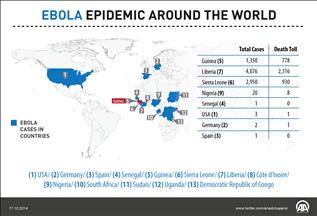
Since the second outbreak of Ebola began in June, the virus has killed over 2,316 people in Liberia, according to health authorities, while just over 200 people have survived the disease thanks to treatment units across the country.
-Ebola man-
With strong faith, constant prayers and regular phone calls to his pastor, Dennis gained strength from the medication and treatment administered to him by health workers.
"I conducted prayer time. Those who had the strength to walk from their beds and join us would come every morning and evening for prayer time, which I believe helped me while I took my drugs," he told AA.
"I believe so much in the power of God and I am a strong Christian," he said.
On the day he was discharged from hospital, Dennis was the happiest man alive.
"I am a proud survivor of the Ebola virus," he told AA, flashing the certificate and in-patient discharge form issued by the Health Ministry to all patients who had tested positive for Ebola before being treated and discharged.
"We were given a certificate and the in-patient discharge card and were told to go back to our community," he said.
The documents are supposed to serve as proof that a person is no longer contagious to their families or communities.
"When I got home and started to celebrate along with my relatives, community people stood with amazement from afar," Dennis recalled.
But his happiness was short-lived. He immediately started feeling stigmatized by his neighbors after his return to the community from the Ebola treatment unit.
Two days later, the trouble began.
"That afternoon, one person was sent to my house asking me to apologize to the entire community because, according to him, when I was taken to hospital, my family told them that I had a cold," said Dennis.
"This means my family wanted to kill them in the community," he added.
He asked his neighbor how many members of the community had fallen victim to Ebola as a result of his illness, that they might demand an apology from him.
The argument later developed into a fight and Dennis was badly hurt.
"When Frank [the neighbor] hurt me on my arm, my brother and other relatives came to intervene," he recalled.
"The rest of the community members were openly insulting me, calling me 'Ebola man.' Some told me they would never come or send their children to my house," Dennis lamented.
Since his return home, he has been shunned by his friends.
"As Ebola survivors, we are being stigmatized; our neighbors look down on us," he said bitterly. "I did not buy the Ebola disease."
At the moment, Dennis is neither working nor doing anything to support his family, merely relying on food assistance from the Emma Smith Recovery Foundation.
"If it had not been for the foundation, I would have had nothing," he said.
Dennis believes that stigma and discrimination against Ebola survivors, if not controlled and handled properly, could aggravate the country's current Ebola crisis.
"As a man, when you are discharged from the Ebola center, you are not to have sex for three months, because the chance of infecting others is very high," he said.
Dennis fears that, if communities continue to stigmatize Ebola survivors, some men could deliberately infect women and other people.
"I fear God and am a Christian, so I cannot do that. But if the stigma against us does not stop, things will get worse with the spread of the virus, because other men will want to pay back," he warned.
The Emma Smith Recovery Foundation is currently working with Dennis in its awareness and outreach programs throughout local communities and on radio talk shows.
Smith, a young musician and the foundation's executive director, said they had heard many stories of stigma and discrimination against Ebola survivors.
"Even me now, people in my community are afraid to come close to me because they have heard that I am working with Ebola survivors and visit Ebola treatment units," she told AA.
"The stigma is too strong; this could be another fight to face," Smith said.
englishnews@aa.com.tr
news_share_descriptionsubscription_contact

contact_the_ombudsman
is_there_an_error_in_this_story