GAZA CITY
Mohamed Hejazi, 13, could not believe himself when he discovered that the falafel shop next door had opened for the first time in 30 days.
He hurried to the shop to buy a falafel sandwich, a favored staple for the people of the blockaded Gaza Strip.
Hejazi had missed the smell of falafel, a deep-fried ball made from ground chickpeas, fava beans or both.
Like thousands of fellow children, he breathed a sigh of relief after a 72-hour humanitarian ceasefire was declared in the devastated coastal enclave.
The ceasefire gave him comfort, having allowed people to be back on the deserted streets.
By the time he reached the falafel shop, Hejazi found other children waiting in a long line.
They all wanted to buy the delicious hot balls and race home to envoy with their families.
Palestinian factions and Israel have endorsed an Egyptian proposal for a three-day ceasefire starting Tuesday.
Israel has since completely withdrawn its forces from the besieged Palestinian territory.
According to the Palestinian Health Ministry, at least 1867 Palestinians, mostly civilians, were killed and 9470 wounded in unrelenting Israeli attacks since July 7.
The onslaught has left 5510 residential units completely destroyed and 30920 units partially damaged – including 4600 units no longer fit for living.
-Back to normal-
A sense of normalcy started to be felt as soon as the ceasefire came into effect.
Shops started opening up their doors after 30 days of complete closure and commercial paralysis.
Thousands of Gazans flocked to the markets to buy their needs.
Long queues of customers started to form outside bakeries, water desalination stations and other outlets in the tiny Palestinian territory.
"People went out to search for life, one that scrambled for space beside death," Rasha al-Bayoumi, one of the Gaza residents, told Anadolu Agency.
Checking tomatoes placed on a cart in a busy market, al-Bayoumi said Gazans would continue to go out of their homes every day.
"Death has already become part and parcel of our lives," she noted.
Behind her, the voices of vegetable and fruit sellers were rising up yet again for the first time in a month trying to draw long-awaited customers.
-Out of shelters-
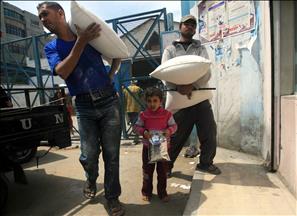
Many of the Palestinians who had sought shelter inside U.N. schools; hospitals; churches, and mosques were trickling out.
Many were taken aback by the scale of devastation left behind by the Israeli war machine.
Emerging from her shelter, Samar Habib hoped she would find her home still standing amidst thousands of others flattened by Israeli strikes.
"We are tired and have paid a heavy price already," she told AA. "We only want to lead a normal life."
By Ola Attalah
englishnews@aa.com.tr
http://www.aa.com.tr/en