Anadolu Ajansı © 2026


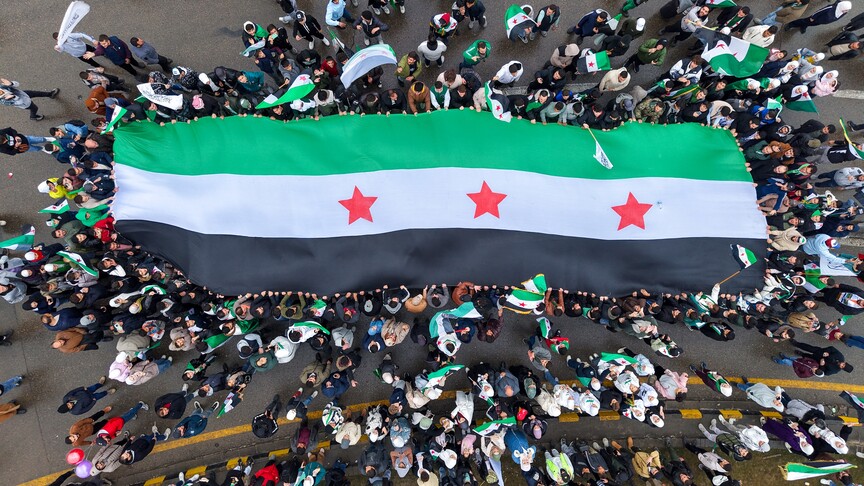
The US on Monday formally removed Syria from its list of state sponsors of terrorism, closing a nearly half-century chapter of isolation and marking one of the final legal steps in dismantling restrictions that had cut Damascus off from global trade and finance.
"These actions were all taken in recognition of the positive actions taken and further commitments by the Syrian government under President Ahmed al-Sharaa to fully distance Syria from acts of international terrorism," Secretary of State Marco Rubio said in a statement Monday.
Rubio said the delisting gives Syrians "a path to prosperity" and "eliminates the final major barriers for private sector investment."
Syrian President Ahmad al-Sharaa hailed the development in a video posted on social media.
“Today, Syria is shedding a dark stain from its shoulders and tearing up with its own hands a page from its painful past, to move into a new space of development, reconstruction and building,” he said.
Syria was placed on the list on Dec. 29, 1979, accused of supporting international terrorism under then-President Hafez al-Assad.
The delisting took effect after a 45-day congressional review period expired without lawmakers blocking the move. The review was triggered on July 8, when President Donald Trump formally notified Congress of his intent to rescind the designation.
Cuba, Iran and North Korea are now the only countries remaining on the US list.
Washington on Monday also revoked the designation of Hayat Tahrir al-Sham (HTS) as a Specially Designated Global Terrorist organization and removed it from the Treasury Department's Specially Designated Nationals and Blocked Persons List. The US had already revoked HTS's separate designation as a Foreign Terrorist Organization in July 2025.
HTS, led by al-Sharaa, was a major armed group fighting the Assad government during Syria's civil war and played a leading role in the offensive that ousted Assad in December 2024.
Monday's delisting removes what analysts described as the last significant legal obstacle standing between Syria and full participation in the international economy.
Being designated a state sponsor of terrorism subjected Syria to a range of US legal restrictions on foreign assistance and exports.
Under US law, the designation required Washington to oppose loans to Syria from the World Bank and other international lenders. It also imposed a near-total US arms sales ban and triggered export licensing controls on dual-use goods.
It also stripped Syria of sovereign immunity in US courts, exposing the state to lawsuits.
Those restrictions were layered on top of a broad sanctions program that targeted Syria since the Assad government's 2011 crackdown on protests, which was already dismantled as part of a broader effort by the Trump administration to normalize economic ties with Damascus following the fall of Assad.
Last year, Trump issued an executive order revoking six executive orders that had formed the legal basis of the Syria sanctions program and terminating the national emergency underlying them, effective July 1, 2025.
Congress later repealed the Caesar Syria Civilian Protection Act, a 2019 law that had threatened secondary sanctions on any foreign entity dealing with the Syrian government, energy sector or reconstruction industry.
Syria's banking sector had been almost entirely severed from the global financial system since 2011, forcing businesses and the Syrian diaspora to rely on informal money transfer networks.
International banks faced severe secondary legal liability for processing transactions linked to the Syrian state, which effectively cut the nation off from global banking networks like SWIFT.
Washington had already significantly opened the door to financial transactions when it ended comprehensive Syria sanctions last year.
At the time, OFAC said US financial institutions could provide services to Syria and establish correspondent banking relationships with Syrian financial institutions, including the Central Bank of Syria, provided the transactions did not involve separately sanctioned parties.
The Central Bank of Syria was also removed from the EU and UK sanctions lists last year.
Even after those restrictions were eased, however, the terrorism designation remained another source of legal and reputational risk for companies considering entering the Syrian market.
“Lifting Syria's designation as a state sponsor of terrorism is a historic step that returns it to its natural place within the global economic system,” Syria’s Central Bank Governor Safwat Raslan said on US social media platform X.
US Secretary of State Marco Rubio said the decision removes the last major obstacle to private sector investment in Syria and “promotes Syria’s economic recovery and reintegration into the global economy.”
That matters for a country with enormous reconstruction needs.
The World Bank estimates Syria needs roughly $216 billion to rebuild after 14 years of war – about 10 times the country's current annual economic output.
Al-Sharaa said in October that Syria had attracted $28 billion in investment pledges since Assad's fall, led by Saudi Arabia, the United Arab Emirates and Qatar, which have promised multibillion-dollar commitments in energy, transport and banking.
Removing the terrorism designation eliminates another layer of US restrictions, potentially making it easier for investors, banks and companies to assess projects in projects in energy, infrastructure and other areas of reconstruction.
Removal from the state sponsors of terrorism list also eliminates restrictions directly tied to that designation, including specific controls on defense exports and sales.
But that does not mean Syria can now freely purchase US weapons or sensitive military technology.
Defense exports remain subject to other US export control and licensing requirements, as well as national security and foreign policy considerations.
For dual-use goods – civilian products and technologies that can also have military applications – the picture is more open, but remains controlled.
Washington had already eased restrictions on civilian and dual-use exports to Syria last year.
The US Commerce Department eased export controls on Syria in September 2025. With the change, US-origin goods, software, and technology that have purely civilian uses can generally be exported without an individual license.
Certain exports supporting telecommunications, sanitation, power generation and civil aviation also receive more favorable licensing treatment, while items with more sensitive commercial or military applications still require case-by-case authorization.
While Syria is no longer under a comprehensive US sanctions program, some Syrian individuals and entities remain sanctioned.
Sanctions remain in place against Bashar Assad and his inner circle, individuals and entities tied to human rights abuses, captagon trafficking and Syria's past chemical weapons proliferation activities, and groups linked to Daesh/ISIS, al-Qaeda, Iran and its regional proxies.
Those parties remain on the Treasury's Specially Designated Nationals list under separate legal authorities not affected by the latest action.
Indeed, as Washington removed HTS's designation Monday, it simultaneously imposed sanctions on two former HTS affiliates it said continued to support al-Qaeda and the linked Hurras al-Din.
news_share_descriptionsubscription_contact