Anadolu Ajansı © 2026


Ali Bahreini warned, however, that any new Israeli attacks on Lebanon would constitute a serious violation of the recently signed memorandum of understanding.
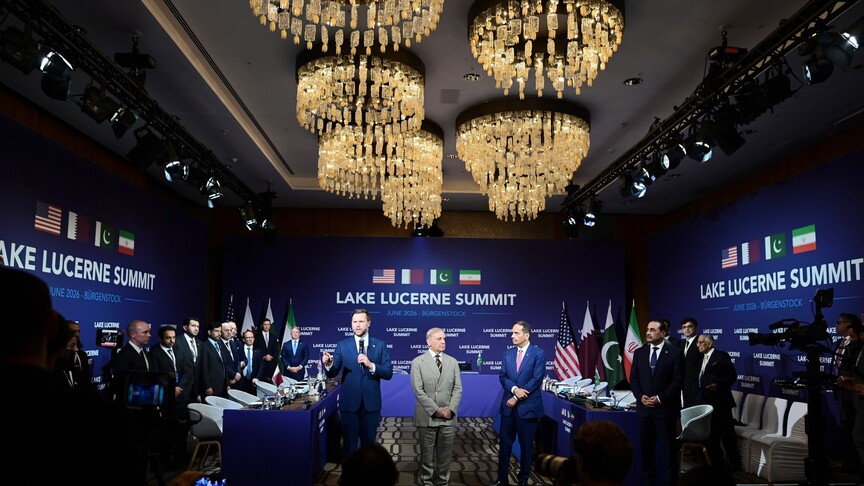
Speaking at an ACANU, the UN-accredited journalists association of reporters, press briefing in Geneva, Bahreini said talks Sunday in Burgenstock continued until midnight and produced advances on several key provisions of the agreement.
"There was, I think, some good progress in the negotiations," he said, citing discussions on Lebanon, sanctions relief, the Strait of Hormuz and the release of frozen Iranian assets.
-Lebanon: Iran's 'red line'
The envoy said Tehran made clear that "Lebanon is an unquestionable part of the agreement" and stressed that the country's security and territorial integrity must be respected. He said Iran considers the cessation of hostilities to include the withdrawal of Israeli forces from Lebanese territory and an end to what it described as occupation.
"This ceasefire includes a stop of firing, stop of attacking, and also withdrawing forces from the southern part of Lebanon," he said, adding that it was the responsibility of the US to ensure that provision is fulfilled.
He warned that any attack against Lebanon and Hezbollah would amount to a violation of the memorandum of understanding.
"If there is any attack against Hezbollah, it means that the memorandum of understanding has been seriously violated," he said. "Iran's red line is any attack against Lebanon."
He noted that Iran already made it clear that in case of an attack, it would "definitely respond." The envoy added that Iran would also raise the matter through the mechanism established under the agreement, but would retain "its right to respond to any kind of attack against Hezbollah in Lebanon."
On the Strait of Hormuz, the ambassador said the waterway is open to commercial shipping under a 60-day arrangement agreed by the parties. He said both sides established a communication mechanism to address any problems that may arise while broader discussions continue on a future framework governing the strategic passage.
The blockade has been lifted and will be removed completely within 30 days, according to the envoy,
But he said the pre-war situation would not return.
"Definitely, the situation in the Strait of Hormuz will not be the same as it was before the war," he said, and that future arrangements for the passage of vessels would differ from previous practices.
Bahreini said Iran was not seeking to use the strategic waterway as leverage or as a source of revenue, but argued that Tehran had concluded new controls were necessary because the strait had been used by its adversaries to support military operations against Iran during the war.
He said Iran believes the strait should remain open for global trade and the world economy, but Tehran "decided to exert a kind of control" over the waterway to prevent what it sees as the future militarization of the region against Iran.
The envoy also said Iran has not authorized military vessels to pass through the strait during the current 60-day period.
"There would be no permission for the military vessels," he said, adding that any future arrangements would depend on the outcome of negotiations.
Bahreini said Washington has already issued waivers covering the sale of Iranian oil and petrochemical products.
The waivers include banking transactions, transportation and other activities necessary for exports, he said.
"At least for 60 days, Iran would be able to sell its oil and petrochemical products to any country, then Iran shall be able to receive the money, and the transactions and transportation and insurance should be not affected by any kind of sanction," he said.
He described the arrangement as a "test" for broader sanctions relief but stressed that Tehran ultimately seeks the complete lifting of sanctions rather than a waiver-based mechanism.
"Issuing waivers is not a good choice down the road because we need our economy to be predictable," he said.
Bahreini also said the process of unfreezing Iranian assets has already begun.
"Some parts of the defreezing have been done, and the rest is going to be done in a few days," he said.
Bahreini stressed that Iran alone “will decide freely and independently how to, what to do with those assets.”
Bahreini said discussions are continuing on establishing at least two working groups -- one focused on sanctions removal and another on Iran's nuclear activities -- and are expected to be finalized soon.
He dismissed reports that Iran had already agreed to allow international nuclear inspectors back into the country.
"There hasn't been such a decision, or even such a discussion," he said.
The envoy said it was too early to discuss the issue, arguing that talks on Iran's nuclear activities would only begin after the initial provisions of the memorandum of understanding are fully implemented.
Discussions on the nuclear issue would take place in a future phase through dedicated working groups tasked with examining different aspects of Iran's nuclear dossier, according to Bahreini.
With regard to the International Atomic Energy Agency (IAEA), Bahreini said the working group would initially involve only Iran and the US, although the agency could eventually play a role in technical matters. He said the future role of the IAEA and its inspectors would form part of the negotiations, but stressed that no substantive discussions had taken place.
"Any information provided by different sources about the possibility of allowing inspectors to come to Iran is incorrect," he said.
He also said the memorandum foresees the down blending of enriched uranium, but insisted that Iran would not allow its enriched uranium stockpile to be transferred outside the country.
Addressing criticism within Iran about renewed engagement with Washington, Bahreini acknowledged widespread skepticism.
"There is no reason to trust the United States," he said.
He said many Iranians question the wisdom of negotiating with a country that attacked Iran during previous rounds of diplomacy.
Nevertheless, Bahreini said Tehran agreed to resume negotiations in response to requests from regional partners, particularly Pakistan, and to avoid further disruption to the global economy.
"We are ready for negotiation because we respected the demands of our friends in our region, but at the same time, we keep our preparedness to respond to any scenario," he said.
The Iranian technical group is "negotiating with caution with full mistrust of the United States,” , he said. “We understand that the other side is unreliable."
news_share_descriptionsubscription_contact