Tugba Altun and Fatma Zehra Solmaz
24 July 2026•Update: 24 July 2026
- 'We cannot hand over our people to the political ambitions of the RSF. At the same time, we cannot accept partition like the Libya scenario'
Sudan's political leadership rejects any proposal that could legitimize territorial control by the paramilitary Rapid Support Forces (RSF), a senior presidential adviser said.
"We cannot hand over our people to the political ambitions of the RSF. At the same time, we cannot accept partition like the Libya scenario," Amgad Fareid Eltayeb, political and foreign affairs adviser to the chairman of Sudan's Sovereignty Council, told Anadolu.
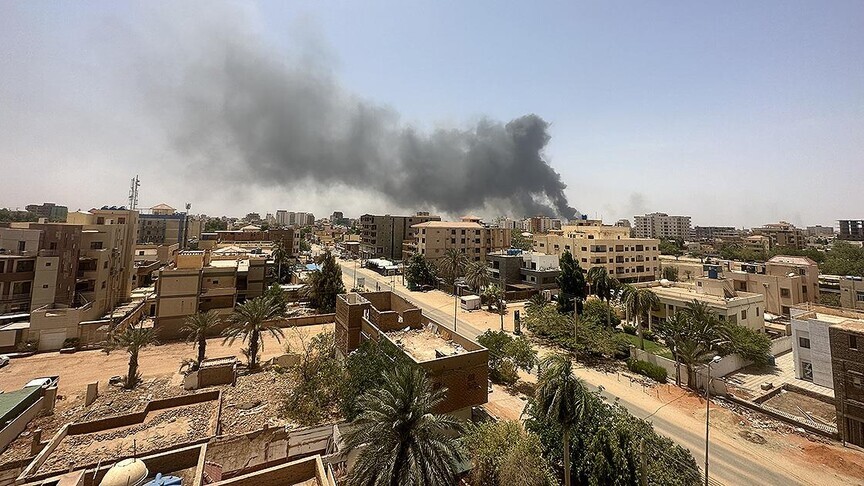
Speaking about the latest developments in Sudan, Eltayeb said the city of El Obeid, the capital of North Kordofan state, has become the focal point of the conflict, and accused the RSF of attempting to repeat the massacres it carried out in El Fasher, the capital of North Darfur, in October 2025.
He said El Obeid is three times larger than El Fasher and argued that a similar massacre had been prevented only because Sudanese government forces had repelled RSF attacks.
Rejecting descriptions of the conflict as a civil war or a struggle between equal parties, Eltayeb said the fighting was "an attack by fascist militias against the Sudanese state, its government, its people and its sovereignty."
"Our people are resilient, and they are resisting," he added.
RSF siege attempt on El Obeid fails
Eltayeb said the Sudanese army had successfully repelled attacks on El Obeid and remained in control of the city.
Beyond conventional fighting, he accused the RSF of using advanced drones supplied by certain countries in the region to target civilians.
He also urged the international community to begin recognizing the RSF as a terrorist organization.
Sudan rejects proposals to freeze current front lines
Commenting on a US-backed peace proposal, Eltayeb said Sudan's Defense and Security Council had made its position clear.
He argued that some regional countries were seeking to "freeze" the current military situation, a move that would effectively legitimize RSF control over civilian areas.
"We cannot accept proposals that would legitimize the RSF's occupation of civilian areas because that would mean leaving the Sudanese people hostage to the RSF," he said.
Eltayeb said Sudan would only consider a ceasefire or peace initiative that ensured the complete withdrawal of RSF forces from civilian areas, reiterating that any scenario involving the country's partition was unacceptable.
Praises Türkiye's principled position
Eltayeb described Türkiye as one of the few countries to adopt a principled stance on Sudan, saying Ankara had consistently supported the country's legitimate authorities.
"The Turkish government has acted on principle. They understand that Sudan's internal political future is a matter for the Sudanese people to decide," he said.
He also noted that after the Sudanese army recaptured Khartoum from the RSF, around 2.5 million people had returned to the capital following reconstruction efforts, according to the latest figures from the International Organization for Migration (IOM).
On humanitarian assistance, Eltayeb said the main challenge was not access but insufficient funding.
He said the UN humanitarian response plan for Sudan received less than 50% of required funding in 2025, after receiving less than 30% in 2024.
Most humanitarian aid, he added, has instead come from countries including Türkiye, Saudi Arabia and Qatar.
"The international community needs to rethink, redesign and change its humanitarian approach to what is happening in Sudan," Eltayeb said.