Three years after Israel launched its war on Gaza, the consequences extend beyond the devastated territory, reshaping Israeli society, its political debate and its relationship with the world.
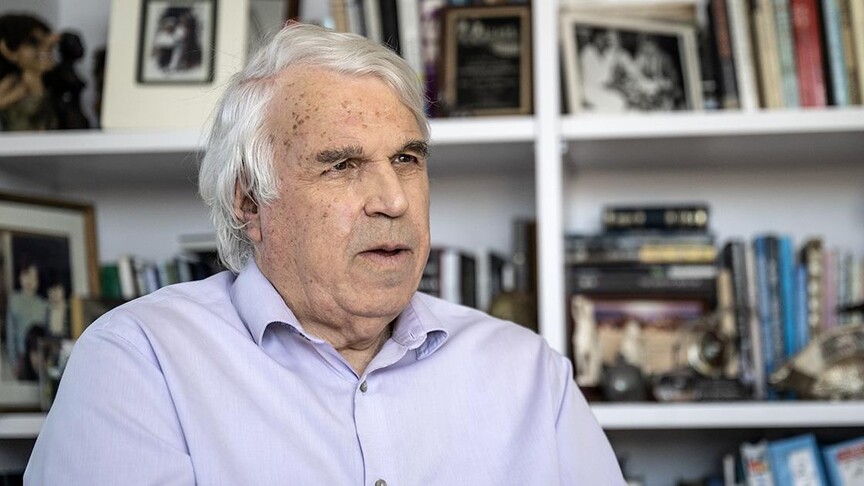
Former Israeli diplomat Alon Liel told Anadolu the war has hardened attitudes toward Palestinians and pushed peace further from mainstream politics, with implications that could outlast Prime Minister Benjamin Netanyahu’s government.
“The Israeli public, especially the Jewish public, moved towards nationalistic attitude. More hatred, more fear, more feelings of revenge,” he said.
For Liel, a former director general of Israel’s Foreign Ministry and ambassador to South Africa, the transformation is reflected in both public attitudes and what politicians are prepared to discuss.
Beyond the immediate consequences, Liel sees a deeper change in the prospects for peace with Palestinians.
“The word peace disappeared ... Nobody is speaking about the peace today among the Israeli politicians,” he said.
A Pew Research Center report published Sept. 15 found that only 17% of Israelis believed Israel and an independent Palestinian state could coexist peacefully. For the first time in Pew’s polling, a majority, 56%, considered it impossible.
Liel believes that pessimism limits the prospects for a negotiated settlement, even under a different government.
“I don't see the future coalition working for peace because this is the public attitude and politicians do not speak about peace because they feel that the public doesn't want and doesn't believe in peace.”
“So politicians who speak in the election campaign about peace are in danger of losing votes.”
Israel’s rightward shift predates the war. An Israel Democracy Institute survey in 2022 found that 62% of Israelis identified with the right.
Before October 2023, the government’s proposed judicial overhaul had also exposed deep political divisions, bringing huge crowds onto the streets.
However, Liel believes the war has reinforced the rightward shift.
“In terms of left and right, the Israeli public moved in the last 3 years more to the right.”
The fallout from Oct. 2023 remains central to electoral politics.
An Israel Democracy Institute survey published in September found that 68% of Israelis considered the attacks a central factor in deciding how to vote, with foreign affairs and security narrowly outranking the economy and living costs among their priorities.
Yet this does not necessarily mean stronger support for Netanyahu.
Polls ahead of the Oct. 27 election have pointed to losses for his coalition, with former military chief Gadi Eisenkot emerging as a leading rival.
The conflict has spread beyond Gaza, drawing Israel into renewed fighting with Hezbollah in Lebanon and direct war with Iran.
Israeli forces have also occupied areas of southern Lebanon, while fighting has continued despite ceasefire efforts.
An Israel Democracy Institute poll in early March found that 82% of Israelis supported the military operation against Iran.
Liel fears the rightward shift will sustain confrontation across the region.
“If this trend to the right will continue, we will go on with wars ... not only with the Palestinians, also with Lebanon and Syria and Iran and the Yemenites.”
The election campaign has exposed tensions over Palestinian political participation in Israel.
Balad leader Sami Abu Shehadeh withdrew his candidacy after the Supreme Court indicated it would likely uphold his disqualification.
Adalah, the legal rights organization representing him, said he withdrew to avoid a ruling that could set a damaging precedent for Palestinian political participation.
Four Arab parties also faced exclusion from the election until Israel’s Supreme Court last week overturned the Central Elections Committee’s September decision to bar them.
The war has also sharpened divisions between Israel’s Jewish and Arab citizens.
Human Rights Watch reported in January 2024 that Israeli authorities held thousands of workers from Gaza incommunicado for weeks after the Oct. 2023, subjecting some to inhumane and degrading conditions.
Christian communities in Israel and surrounding communities have also reported a spike in violence and hate incidents.
The Rossing Center, an Israeli nonprofit, documented 155 incidents against Christians in Israel and occupied East Jerusalem in 2025, including 61 physical attacks. Recorded incidents included spitting, verbal harassment and attacks on church property.
Artists critical of the Gaza war have also faced pressure.
In September, Culture Minister Miki Zohar threatened to seek the revocation of Israeli filmmakers Yuval Abraham and Rachel Szor’s citizenship, accusing them of betraying their country through their documentary ‘NAZA.’
The film, which won the Special Jury Prize at the Venice Film Festival, draws on testimony from 24 Israeli military and intelligence personnel about the Gaza campaign.
Speaking to Spanish daily El Pais, Abraham described hostility toward their work and the difficulty of confronting public attitudes.
“It’s painful to see so many people losing the most basic moral and human principles,” he said.
The consequences of the Gaza war have also extended into the occupied West Bank, where rising occupier violence and Israeli military operations have intensified pressure on Palestinian communities.
The UN Office for the Coordination of Humanitarian Affairs recorded more than 1,600 attacks by Israeli occupiers causing Palestinian casualties or property damage between January and August 2026.
The attacks affected 275 Palestinian communities, averaging 6.7 a day, up from five in 2025. Damage included water supplies, farmland, homes and other infrastructure.
Military operations have displaced tens of thousands more.
A UN human rights report released in September said more than 33,000 Palestinians had been displaced from the Jenin, Nur Shams and Tulkarem refugee camps during an Israeli operation launched in early 2025 and remained barred from returning.
The war has also raised questions about Israel’s ability to retain its younger and highly educated population.
Figures presented at a Knesset hearing in June showed that about 40,500 Israelis emigrated annually on average between 2009 and 2021.
The number rose sharply to 59,400 in 2022, 82,800 in 2023 and 69,500 in 2024.
About 18,800 Israelis returned in 2024, the lowest figure in recent years.
The report found emigrants were more highly educated than the population overall, with an average age of about 32.5 in 2023.
The hearing reflected growing concern about the long-term demographic and economic consequences of increased emigration.
The changes inside Israel have also coincided with a deterioration in the country's international standing.
Pew polling this year found unfavorable views among 78% of respondents in Spain, 73% in Germany and 65% in Canada. In the US, 60% viewed Israel unfavorably, up from 53% in 2025 and 42% in 2022.
An Israel Democracy Institute survey marking two years since October 2023 also found that 73% of Israelis believed their country’s international standing had worsened.
Liel believes the damage extends particularly to Israel’s image as a democracy and its association with the pursuit of peace.
“Israel is much weaker now internationally,” he said.
news_share_descriptionsubscription_contact

contact_the_ombudsman
is_there_an_error_in_this_story