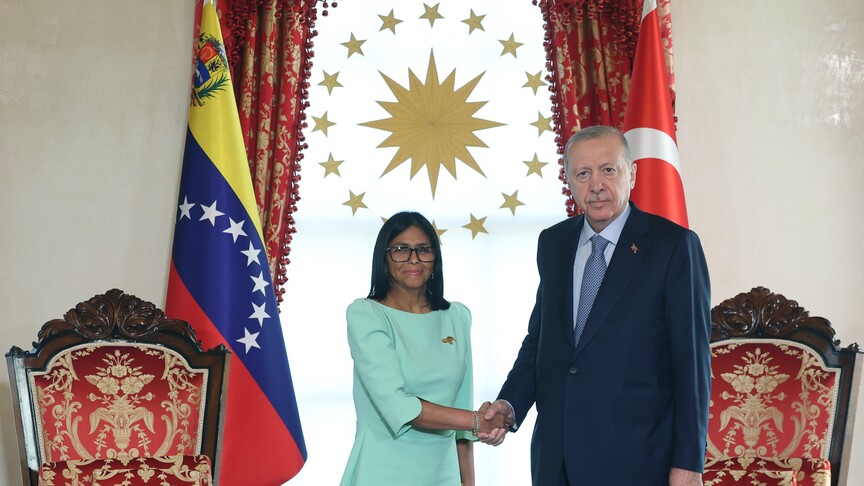
Although Venezuela's acting President Delcy Rodriguez's visit to Türkiye on June 8, 2026, may seem at first glance like a routine continuation of Türkiye-Venezuela relations, it should actually be interpreted as a strategic response by both Ankara and Caracas to shifting international dynamics. Rodriguez's arrival in Türkiye with a large ministerial delegation indicates that, beyond merely maintaining existing ties, the two countries are seeking to adapt to emerging geopolitical realities. In particular, recent transformations in energy markets, the shift in the US global energy strategy, and Venezuela's efforts to reintegrate into the international system enhance the significance of this visit.
How should the visit be interpreted?
First of all, it should be noted that the significance of this visit needs to be evaluated separately from the perspectives of Türkiye and Venezuela. From Türkiye's point of view, one of the primary objectives is to adapt to the new political era emerging in Venezuela and to redefine its relationship. Over the past decade, Türkiye-Venezuela relations were largely shaped by the close political ties established with the Maduro administration. Türkiye was one of the countries that developed economic and diplomatic relations with Venezuela during a period when a significant portion of the Western world kept its distance from Caracas. However, today, both regional and global conditions are changing. Therefore, Ankara needs to update its Venezuela policy in accordance with these new realities.
Energy lies at the heart of this update. Although Venezuela holds one of the world's largest oil reserves, it has been unable to play its expected role in global energy markets for many years due to sanctions, political crises, and a decline in production capacity. However, the recent recovery in production and the growing prospect of its return to international markets present new opportunities for Türkiye. As a country seeking to diversify its energy supply, Ankara is closely monitoring developments in Venezuela. The strong representation of the energy bureaucracy in Rodriguez's delegation also indicates that energy will be at the forefront of the discussions. Türkiye's objective is to lay the groundwork for energy investments, refinery collaborations, and long-term strategic partnerships.
Another crucial dimension of the visit is its diplomatic and geopolitical nature. The fact that it is taking place just ahead of the NATO Summit, coupled with US President Donald Trump once again becoming a decisive actor in international politics, makes it difficult to evaluate these talks solely within the context of bilateral relations. The Caracas administration may view President Recep Tayyip Erdogan's ability to maintain direct channels of communication with Trump as a significant diplomatic advantage. Therefore, it would not be surprising if Rodriguez's agenda includes not only energy and trade but also certain messages intended to be relayed to Washington. In particular, the facilitating role Türkiye could play regarding the future of Venezuela's ongoing normalization process with the US is likely being carefully considered by Caracas.
For Ankara, another significance of this visit is that it signals the evolution of its Latin America policy. In recent years, political dynamics in Latin America have shifted considerably. The leftist wave that once dominated the region is increasingly giving way to center-right and right-leaning governments. This landscape presents new opportunities for Türkiye. Sustaining relations with Venezuela, while restructuring them to adapt to these new political realities, could allow Ankara to send a crucial message to other actors in Latin America. This message is quite clear: Türkiye's Latin America policy is not ideological, but pragmatic. Ankara seeks to build relations based on economic and strategic interests, regardless of the political identities of the governments in the region. Therefore, Rodriguez's visit is not solely about Venezuela; it also carries symbolic importance for the future of Türkiye's entire Latin America policy.
From Venezuela's perspective, however, the significance of the visit takes shape within a different framework. The Caracas administration is currently attempting to transform the recent normalization in its relations with the US into a broader diplomatic and economic opening. In particular, the new atmosphere that emerged after January 3, 2026, has enabled Venezuela to transition from being an actor excluded from the international system to projecting the image of a country striving to reintegrate into the global economy. In this process, Caracas's priority is not solely to mend ties with Washington but also to open new diplomatic channels through countries that maintain good relations with the US.
At this juncture, Türkiye stands out as a crucial partner for Venezuela. Ankara is positioned as an actor capable of communicating with Washington while having cultivated ties with Caracas over many years. Therefore, the Venezuelan administration views Türkiye not only as an economic partner but also as a strategic bridge in its reintegration process into the international system.
The will to adapt to a changing world
Energy geopolitics also lies at the center of this transformation. Tensions surrounding Iran, risks in the Strait of Hormuz, and vulnerabilities in global energy markets have elevated Venezuela's importance. As the global economy searches for new energy sources, Venezuela has once again begun to attract attention. Particularly considering the energy dimension of the US-Russia rivalry, Venezuela's return to global markets is viewed as a development that serves the interests not only of Caracas but also of Washington. The Trump administration has long advocated that its allies reduce their dependence on Russian energy resources. Within this framework, the return of Venezuelan oil to the international market could contribute to the diversification of energy supplies while also limiting Russia's influence in the energy sector.
Rodriguez's visit to India prior to arriving in Türkiye is also an important piece of this energy geopolitics puzzle. Today, India is positioned as one of the world's largest energy consumers and continues its quest to diversify its energy sources. While Venezuela offers India a new energy alternative beyond the Middle East, it also presents an option that aligns with Washington's preference for India to reduce its dependence on Russian oil. Viewed from this perspective, the visits to India and Türkiye should not be considered independent of one another but rather as components of the same strategic framework.
Furthermore, the fact that both Türkiye and India are countries capable of establishing functional and positive relations with the Trump administration carries distinct importance for Caracas. The Venezuelan administration is attempting to expand its room for maneuver within the international system by strengthening its ties with capitals close to Washington, alongside its direct contacts with the US.
Ultimately, Rodriguez's visit to Türkiye serves less as a reaffirmation of past friendship and more as a preparation for the geopolitical dynamics of the future. While Ankara seeks a position that will safeguard its economic and strategic interests during this new era in Venezuela, Caracas is looking for ways to make a stronger return to the international system by playing its energy card. Therefore, the true significance of the visit lies not so much in bilateral relations but rather in the efforts of both Türkiye and Venezuela to carve out a new space for themselves within the changing global order. This meeting should be interpreted as a concrete manifestation of both countries' will to adapt to a changing world.
*Opinions expressed in this article are the author's own and do not necessarily reflect the editorial policy of Anadolu.
news_share_descriptionsubscription_contact