By Todd Crowell
TOKYO
The Treaty of Basic Relations between Japan and South Korea -- signed June 22, 1965 -- was born in controversy and, 50 years later, it remains in controversy.
Thousands of Koreans and Japanese took to the streets of Seoul and Tokyo to protest the treaty from different perspectives. The Koreans protested what they considered a “giveaway” to Japan; the Japanese leftists called it a U.S.-engineered move to prevent reunification with North Korea.
The treaty was designed to “normalize” relations between Japan, which had ruled Korea as a colony from 1910 to 1945, with the aim of settling all outstanding issues between the two countries once and for all with a one-time payment of approximately $800 million in reparations.
The figure of $800 million seems fairly trivial by today’s standards, but at the time it was roughly equal to the entire South Korean national budget.
Fifty years on, many of those outstanding issues still fester. Indeed, relations between the two neighbors are probably more strained than they have ever been since the end of World War II brought independence to South Korea.
Most of these issues have to do with history.
At the moment, Seoul is opposing Japan’s designation of about 23 Meiji era industrial sites as potential World Heritage Sites, because of the part they played in turning Japan into the world’s first non-Western industrial power.
South Korea opposes the designation, saying many of these industrial institutions depended on forced labor from Korea during the war and during the colonial period.
The issue of the “comfort women” -- the Japanese euphemism for women forced into army-run brothels during the war -- is a continuing open sore.
Korea has accelerated its demand that Japan apologize and grant compensation to the estimated 55 still-living Korean comfort women, now averaging 90 in age.
Other irritants include conflicting claims to a group of rocks in the Sea of Japan known to Koreans as the Dokdo and claimed by Japan as the Takeshima, plus Korea’s continuing ban on food imports from eight prefectures near the disabled Fukushima Daiichi nuclear power plant.
The current leaders of the two countries have never held a one-on-one meeting, although they have met on the sidelines of some international conferences -- pressured to be civil to each other by U.S. President Barak Obama, who views the two allies’ disputes with concern.
Both leaders also have complicated family histories that seem to mirror the tortured relationship between the two countries.
Prime Minister Shinzo Abe is the grandson of former premier Nobusuke Kishi, who served as Minister of Munitions during the war and was briefly imprisoned as a war criminal.
President Park Geun-hye is the daughter of Korea’s former dictator Park Chung-hee (1961-1979), who was a commissioned officer in the Imperial Japanese Army and thus open to charges by some that he was a Japanese collaborator.
The two leaders also suffer from declining public approval numbers, although Park’s decline seems more pronounced as she is held responsible for the country’s response to the disastrous ferry sinking disaster a year ago and the handling of the current outbreak of the MERS disease.
Abe suffers from the unpopularity of the two security-related bills that he is determined to pass through parliament before the end of the year.
In 1965, the late President Park was focused exclusively on jump-starting the Korean economy, and he was happy to take the offered reparations, spend them on steel mills and expressways, while signing agreements stating that all compensation issues were settled “completely and finally”.
His successors in a more democratic Korea now say Park gave away too much. In particular, the Koreans seek more compensation for Korean comfort women. Some compensation was made through a private Asian Women Organization, but Koreans say the money should come directly from the Japanese government.
In Aug. 2011, the South Korean Supreme court ordered the government to begin negotiations for further compensation for comfort women, unpaid laborers and Korean survivors of the Hiroshima and Nagasaki atomics bombings. Tokyo considers the matter closed.
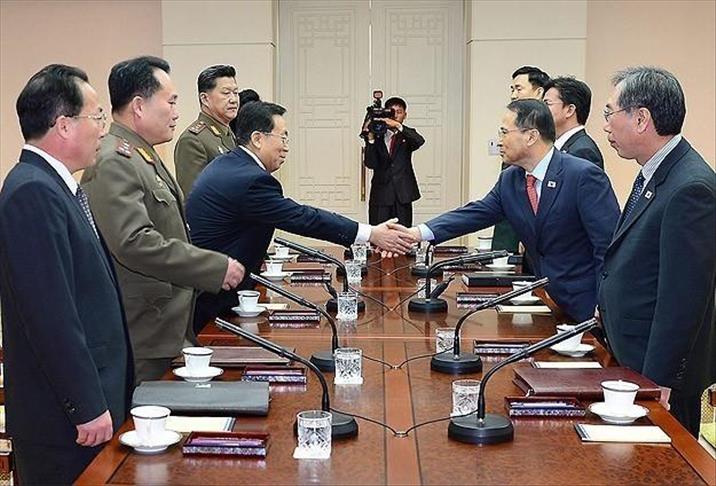
Although Abe and Park have yet to meet outside of larger venues, dialogue at the subcabinet level has not completely halted. And recently South Korea’s Foreign Minister Yun Byung-se travelled to Japan for the anniversary and met with his Japanese counterpart and Abe. It was Yun’s first visit to Japan.
Both Abe and Park issued conciliatory statements on the anniversary.
“Let’s build a new era for both our countries… reflecting on the past 50 years of friendship, said Abe. Park said, “We should make this year a turning point.” The foreign ministers also promised to step up efforts to set up a summit meeting “at an appropriate time”.