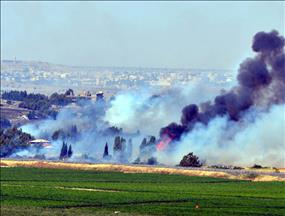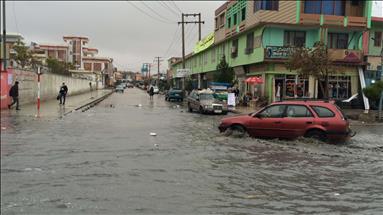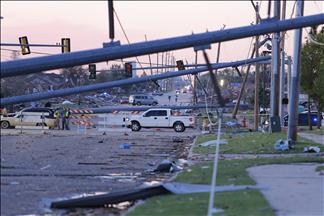
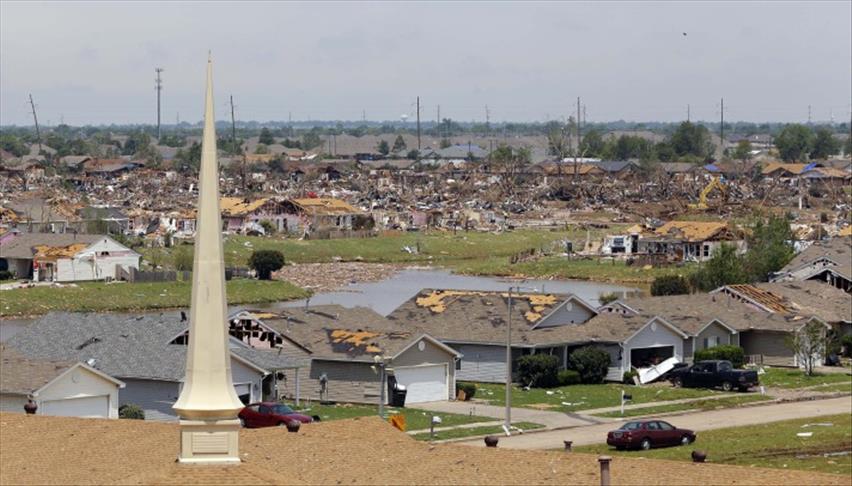
Taking place between two oceans, the US has to deal with all kinds of natural disasters like hurricanes, earthquakes, tornadoes, floods, blizzards, heat waves, wildfires and draught throughout its history, which have claimed the lives of myriads of people, wiped out its major cities including Chicago and San Francisco, destroying their economic groundwork, which took decades and cost the federal budget hundreds of billion dollars to reconstruct.
According to data provided by PreventionWeb.net, between 1980 and 2012, 640 natural catastrophes cost 544 billion dollars damage to US economy, killing 12,366 people while affecting around 26 million. As the damage given by October 2012’s Hurricane Sandy hitting 24 states along the Eastern coast costing at least 60 billion dollars, and 132 lives as the National Weather Service notes, could not be cured yet, Oklahoma was hit by series of tornadoes and the subsequent flooding since May 20, killing 38 people at total, costing approximately 2 to 3.5 billion dollars damage.
While the US entered “hurricane season” by June 1st, the rising temperatures carry the risk of fires in the dry-regions, while rise in the waters of Mississippi creates the possibility of another series of floods.
During the last week, Obama paid visits to Sandy-hit New Jersey and Oklahoma, promising to be by the survivors’ side in reconstructing their lives. In line with the President`s focus on natural disasters, Washington is highly concerned, albeit divided over the causes of the increasing number of natural disasters, particularly whether they originate from global warming or not.
-Is the reason global warming?
The rise in number and impact of the natural disasters created general view of global warming as the driving force and the prediction that those influences will increase in the coming years, though a number of American experts, as well as politicians question that conclusion. While some of the experts, speaking to Anadolu Agency (AA), believe it is the global warming causing the weather catastrophes in an increasing fashion, others warn against establishing a direct link in between.
“US is already experiencing more extreme weather events as a result of climate change, and it will become worse over the coming decades,” said Professor Ed Maibach, Director of the Center for Climate Change Communication at George Mason University.
Similarly David Pyle, Professor of Earth Sciences from University of Oxford, argues global warming will increase human exposure to extreme events, and unless measures are taken to improve people’s resilience to such events, there will be an increase in the human and economic losses.
On the other hand, some experts believe that more data is needed to explain whether there is a direct link between natural disasters and global warming or not. Professor Carl Botan, member of the Center for Climate Change Communication, expressed that it was not reasonable to attribute one single weather disaster to global warming because “there are too many other variables involved in short term specific weather events.” A NASA scientist George Tselioudis also told that it was not possible to make direct connections between any one natural disaster and global warming, adding, “The issue is whether disasters like that become more frequent as the climate warms. In the case of tornadoes in the US there is no trend in the data that shows that tornadoes are becoming more frequent or stronger with climate warming.”
Attributing the increase in costs to population growth contrary to the statements by many officials defining the disasters as “most destructive”, Professor Emeritus of the Department of Atmospheric Science at Colorado State University Meteorologist Roger Pielke said, “US had not seen an increase in disasters that might be attributed to human-caused climate change, it has in fact seen a decrease in the most powerful tornadoes over the past 60+ years,” and claimed that the costs are increasing due to more people and property in harm’s way.
-Importance of early and long-term measures-
Although the experts have different approaches on the causes of the increasing number of natural disasters, they generally agree that US should take steps on counter-global warming.
Speaking to AA, Professor Chris Field, Founding Director of the Carnegie Institution's Department of Global Ecology, emphasized the importance of disaster warning and recovery systems. Field said, “Government has to establish and enforce building codes that increase the probability of getting through an extreme without damage, as well as establishing rules about defensible zones so that people and structures are not inappropriately in harm's way.”
Professor Botan of Center for Climate Change Communication also focused on the necessity of long-term measures, referring the expression- "an ounce of prevention is worth a pound of cure." He suggested that the government had to prioritize public education about disaster preparation, as well as scientific programs to protect the “climate” but not through short-term programs to change the “weather”.
Bringing a different approach, “The US will not ratify Kyoto,” said Meteorologist Pielke, who does not attribute the increasing disasters to human-caused global warming. He rather suggested focusing on “what we build, where we build, and how we build,” instead of reducing the carbon emissions.
-Washington divided over the “link”-
On political platform, situation is more complicated than the academic area as politicians are clearly divided on the extent of addressing global warming and developing clean energy to deal with it.
Columbia University’s Professor James E. Hansen’s well-known testimony to the Senate, attributing "the abnormally hot weather plaguing American nation" to global warming following the drought in 1988, was the first time the political circles in the US were faced with the debate. Nevertheless the debate remained at scientific level in the US. While many European countries took counter-action such as reducing greenhouse gas emissions before 1990, and all European Union countries ratified the 1997 Kyoto Protocol, the US signed it in 1998, but not ratified it so far.
However, American inaction on Kyoto protocol and the counter-global warming is mainly because the issue has become part of partisan politics.
Republicans, known as being close to oil lobby, opposes counter-global warming mainly because of economic reasons. According to Republicans, action, namely restrictions on the use of fossil fuels to reduce carbon-dioxide emissions, could have significant economic impacts.
Contrary to Republicans, Democrats blame natural disasters on global warming, which they regard as man-made indeed. Therefore they advocate policies that they believe would reduce global warming and its influences through controlling greenhouse gas emissions, in addition to avoiding greater economic costs in the future, as well as decreasing the vehemence of natural disasters.
Therefore while Democrats demand Republicans give more money to government to combat mankind’s pollution, the latter thinks, even if global warming is behind the recent natural disasters in an increasing way, and the warming is caused by burning of fossil fuels, restricting their use would make cost more the economy than the increases in global temperature would do.
Now, after the tornado in Oklahoma, the debate is sparked once again in Washington between the two political sections. While the Democrat Senator Sheldon Whitehouse rallied against the Republicans for denying the theory of man-made global warming, Republican Senators Jim Inhofe and Tob Coburn took an opposite position.
Pointing at the political rupture, April 2013 report by Center for Climate Change Communication based on a poll conducted among congress members suggests, while 59 percent of Democrats say global warming should be a high priority for President Obama and Congress, only 22 percent of the Republicans agree.
-Dilemma of Obama-
The Obama administration during the first term, with global warming high on its agenda, sought to fight against fossil fuel companies, closing oil drilling and coal mining, the principal sources of energy for the US.
However he was obstructed by not only the resistance of Republicans in the Congress but also conventional energy industries providing cheap energy and Washington’s powerful lobbies.
Obama gave a fresh start in fight with global warming in his second State of the Union Address in 2013, saying “If Congress doesn’t act soon to protect future generations, I will.”
However with a majority of Republicans in the House, and many state governors being Republican and eager to protect employment in coal industries which ensure cheap electricity for consumers and businesses, his plans to crack down on power plants and quest for jobs in the wind and solar sector seems under question.
Nevertheless Obama's new steps are worth mentioning. After completing his tour to Sandy-hit New Jersey and Oklahoma, speaking at the briefing meeting on the occasion of start of 2013 hurricane season, he stated that they would take all necessary steps to prepare ahead of severe weather, applying lessons learned from last year's Hurricane Sandy.
-Public expects more action on global warming-
As there is no American state immune to natural disasters, the public is highly sensitive on the issue to the extent that the way to deal with the disasters might change public opinion about a leader. It was illustrated by polls that showed lower approval ratings of President Bush following the Katrina in 2005. On the other hand, Sandy in 2012 was framed for the victory of Obama over his Republican rival Mitt Romney, who looked down on Obama’s focus on global warming during the election propaganda.
The April 2013 report of the Center for Climate Change Communication reveals that vast majority of the Americans say the president and the congress should make global warming and developing sources of clean energy a high priority.
As the political disaccords obstruct the adaptation of a sustainable environmental policy, regardless of the cause, increasing global warming and its effects on natural disasters will be one of the main debates in coming years, especially after every natural disaster which has been labeled as “the most” or “historic”.
- Costliest natural disasters in US history-
As National Hurricane Center sets forth, the 2000s already became the most expensive decade ever, owing most to the Hurricane Katrina on the Gulf Coast in 2005, which cost $146 billion and 1,836 lives, and to Hurricane Sandy, the second costliest ever. Here are some of the costliest natural disasters in US history:
-To name a few of well-known and costliest natural catastrophes, in 1871 the so-called “Great Chicago Fire” caused $200 million in damage, and claimed some 300 lives.
-A decade after, Galveston, a Texas town was hit by a hurricane often cited as the deadliest disaster in U.S. history, an estimated 6,000 to 12,000 people perished in its wake, costing $20 million.
-In 1906 “Great San Francisco Earthquake and Fire” caused the loss of 3,000-6,000 lives, and damage accounted as $480 million.
-A decade-long drought during 1930's, the so-called “Dust Bowl” turned once fertile Great Plains into “Great American Desert”, costing an estimated number of $1 billion to depression-ridden American economy, as well as leaving 7,000 deaths.
-In 1980s, the most destructive natural disasters were the heat waves and draught on the heartland costing $156 billion damage and killed an estimated 10,000 and 20,000 from heat exhaustion and ensuing fires.
-1990s were relatively quiet with Hurricane Andrew in 1992 catching South Florida off guard and costing $44 billion and resulting in 65 deaths, while the following year’s Midwest flood accounted $33 billion, causing 50 lives.
Reporting and writing by Selen Tonkus / Bariskan Unal
englishnews@aa.com.tr
news_share_descriptionsubscription_contact

contact_the_ombudsman
is_there_an_error_in_this_story