VIENNA
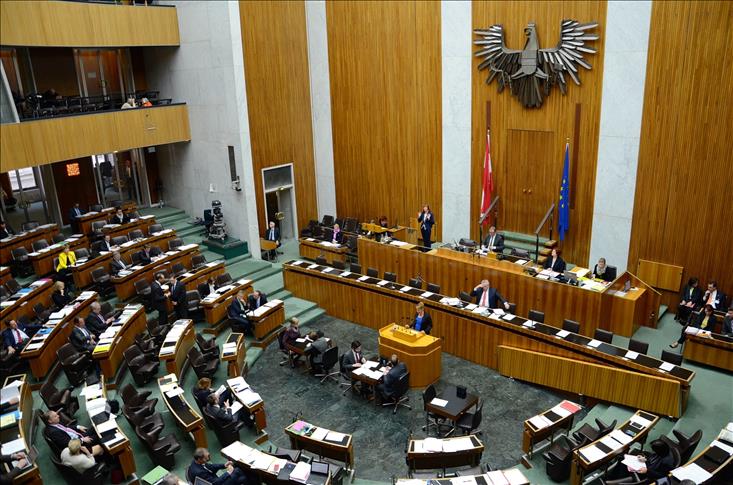
A controversial bill, which aims to revise a historic law on the status of Muslims in Austria, is set to be debated and voted on in parliament Wednesday.
Islam has been an official religion in Austria since 1912. The Islam law, known as Islam Gesetz, was introduced by Austria's last emperor, Franz Josef, after the Austro-Hungarian Empire annexed Bosnia-Herzegovina.
The law guarantees Muslims numerous rights, including religious education in public schools.
However, the bill, prepared by Austria's coalition of Social Democratic Party and People's Party, aims to prohibit foreign funding for Islamic organizations in the country and impose a standardized German translation of the Quran and other religious texts.
It also regulates the teaching of Islam in the country.
Under the proposed legislation, employing preachers from abroad would be prohibited and imams must instead be trained at Austrian universities. Currently, 65 Turkish imams work in Austria, where there are 300 imams in total.
The Islamic community wants to have the authority to choose instructors who will educate the imams and to plan their own curricula.
The bill also allows authorities to cancel some religious activities because of possible security concerns. According to the bill, mosques that do not have a legal entity will also be closed.
Opponents say the government wants to have more control over mosques by not accepting association-statue mosques, which is said to be against the right to form an association.
The Austrian Islamic community has offered revisions to the bill and voiced concerns over the unequal treatment between religious communities. It has also objected to the prohibition of foreign funding for Islamic organizations in Austria.
The bill has drawn criticism from Muslims across the world.
The proposed legislation, however, does contain provisions that will benefit the roughly 500,000 Muslims living in Austria, including the right for Muslims to take time off during Friday prayer and to go on holiday during certain religious festivals.
In addition, schools and other public institutions, including hospitals, the army and prisons will have to offer halal food in line with Muslim dietary rules.