STRASBOURG, France
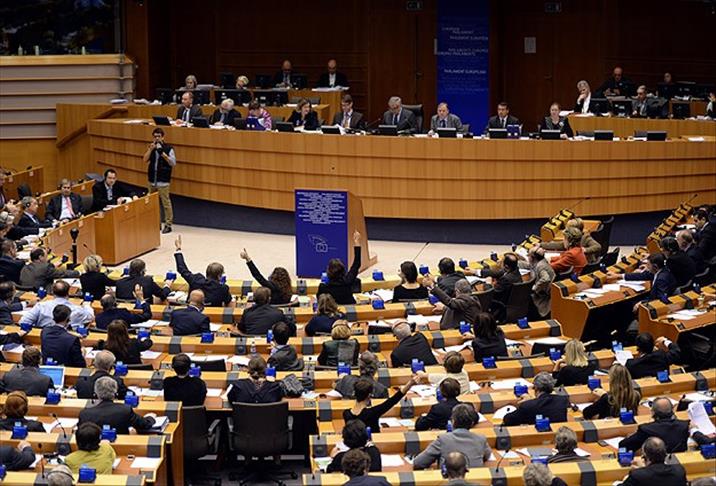
The European Parliament voted Wednesday for a nonbinding resolution calling for recognition of Palestinian statehood to take place as a result of peace talks with Israel.
The resolution was approved by a vote of 498 to 88, with 111 abstentions.
The joint resolution backs "in principle" the recognition of Palestinian statehood and the two-state solution to the Palestine-Israeli conflict.
The European Parliament supports "in principle recognition of Palestinian statehood and the two state solution, and believes these should go hand in hand with the development of peace talks, which should be advanced", reads the resolution.
The original text, submitted by the Green Party, the Socialists and other groups, had urged EU countries to recognize a Palestinian state without conditions.
However, members of the European Parliament failed to agree on a joint text, and the resolution that passed Wednesday calls for recognition as a result of peace talks.
The European Parliament supports "in principle recognition of Palestinian statehood and the two state solution, and believes these should go hand in hand with the development of peace talks, which should be advanced", it says in a resolution passed on Wednesday.
The resolution also reiterates that Israeli settlements " are illegal under international law" , calling on the EU to become a " genuine facilitator in the Middle East peace process and asks the EU’s foreign policy High Representative to facilitate a common EU position to this end."
MEPs also announced to launching a " Parliamentarians for Peace" initiative to bring together MEPs and members of Palestinian and Israeli Parliaments, "to help advance an agenda for peace and to complement EU diplomatic efforts."
Wave of recognition in Europe
Europe has been swept lately by a wave of support for Palestinian statehood, as the peace process between Palestinian and Israeli sides remains deadlocked.
In October, Sweden became the first EU country to recognize Palestine.
Recently, both French Assembly and Senate have adopted resolutions calling French government to recognize Palestinian State.
The U.K. , Spanish, Portuguese parliaments, as well as the Irish Senate, have also all delivered non-binding endorsements, reflecting growing frustration with the sputtering Israel-Palestine peace process.
Italian and Slovenian parliaments are expected to vote on similar resolutions in the coming weeks.
More than 130 countries have now recognized Palestine as a state.
Fatah hails EU Parliament resolution on Palestine
A senior Fatah member has hailed as "historic" a non-binding resolution adopted by the European Parliament on Wednesday calling for recognition of Palestinian statehood based on the results of peace talks with Israel.
"This resolution is historic. It reflects a sea change in the European stance regarding key Palestinian issues," Nabil Shaath said in statements carried by Palestine's official Wafa news agency.
The resolution "supports the notion of recognizing a Palestinian state and the two-state solution," Shaath added, voicing hope that the move would serve as a "strong incentive" for other European governments to recognize Palestine.
On Wednesday, the European Parliament adopted a nonbinding resolution calling for the recognition of Palestinian statehood and the resumption of Palestine-Israel peace talks.
Meanwhile, Palestine is preparing to present – via Jordan – a UN Security Council resolution setting a two-year deadline for an Israeli withdrawal from territory occupied since 1967.
Peace talks between Israeli and Palestinian negotiators broke down in April over the self-proclaimed Jewish state's refusal to release a group of Palestinian prisoners despite earlier pledges to do so.
The roots of the conflict date back to 1917, when the British government called for "the establishment in Palestine of a national home for the Jewish people."
UN resolution ending the Israeli occupation
Meanwhile, Palestine is preparing to present, through Jordan, a Security Council resolution setting a two-year deadline to return the territory taken by Israel in 1967. The resolution could be put to a vote as early as Wednesday.
Peace talks between Israeli and Palestinian negotiators broke down in April over Israel's refusal to release a group of Palestinian prisoners despite earlier pledges to do so.
The talks were aimed at finding a solution to the perennial Palestinian-Israeli conflict, the roots of which date back to 1917, when the British government called for "the establishment in Palestine of a national home for the Jewish people."
Israel occupied East Jerusalem and the West Bank during the 1967 Middle East War. It later annexed the holy city in 1980, claiming it as the capital of the self-proclaimed Jewish state in a move never recognized by the international community.
www.aa.com.tr/en