By Jill Fraser
MELBOURNE, Australia
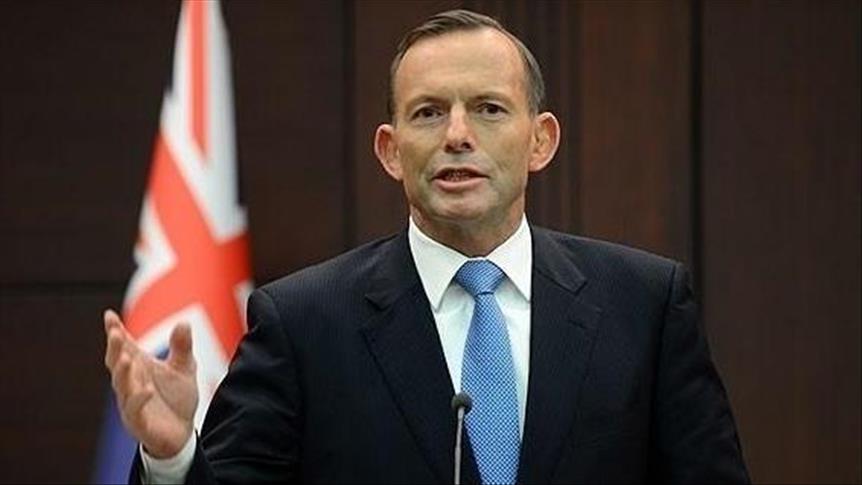
Former Prime Minister Tony Abbott has weighed back into Australia’s foreign affairs, warning during a trip to Japan that China is putting the stability of the South China Sea at risk.
On Friday, Beijing said it was "seriously concerned" by an Australian Defense White Paper on areas of the sea claimed by several different countries, officials warning Australia against compromising the stability of the Asia-Pacific region.
The strategic document said Australia was "particularly concerned by the unprecedented pace and scale of China's land reclamation activities" in the sea.
Speaking in Japan's capital Tokyo overnight, Abbott said that China’s actions in the contested region are jeopardizing regional security and stability.
Tensions have increased between claimants after China began turning reefs into islands, installing airstrips for fighter and surveillance jets, and placing what the US has claimed was missile launches on the shore.
Adding to the dynamic is the US backing of other claimants, and the sailing of US destroyers near islands claimed by China.
In his speech reported by Australian media Saturday, Abbott accused China of going against international protocol, for which there should be consequences.
“There should be consequences when countries, even very powerful ones, don't play by the rules,” Abbott told the Japan Institute of National Affairs in Tokyo.
He went on to reveal that Australia was building up air and naval patrols in the area.
"Over the past 18 months, Australia has quietly increased our own air and naval patrols in the South China Sea," he said.
"We should be prepared to exercise our rights to freedom of navigation wherever international law permits because this is not something that the United States should have to police on its own.”
The Australian federal government has declined to back a previous call by Abbott to conduct a freedom-of-navigation exercise in the disputed area.
"We support and practise freedom of navigation in accordance with international law, but we are not going to canvass, forecast, future ADF operations," Prime Minister Malcolm Turnbull told reporters Thursday.
Abbott’s comments follow concern from China about the characterisation of the South China Sea as a maritime dispute in the Thursday's, which revealed a 20-year plan to bolster its naval strength with more submarines and warships as part of a military buildup it said was needed to maintain peace in the region.
Following the release of the paper China accused Australia of harbouring a "cold war" mentality in its alliance with the United States, which has criticised Beijing's island building activities.
"We urge the Australian side to cherish the hard-won good momentum of development in bilateral relations, and don't take part in or conduct any activities that may compromise the stability in the region," a Chinese Ministry of National Defence spokesman told a briefing in Beijing on Thursday.
Defence Minister Marise Payne attempted to smooth Bejing’s ruffled feathers by advocating a “cooperative approach” to managing territorial disputes in the Sea.
In the meantime, former PM Abbott, who has joined the global speakers’ circuit, represented by the Washington Speakers Bureau and charges upwards of $40,000 per speaking engagement, was in Tokyo rebuking Beijing for its bullying tactics.
"China should use its strength to guarantee freedom of navigation, not to challenge it. We deplore all unilateral alterations to the status quo; and we expect to exercise freedom of navigation in accordance with the well-understood rules," Abbott said.
Abbott’s view is shared by Australia's most recent ambassador to Washington, Kim Beazley.
On Friday Beazley told the ABC that Australia must take a stand against China.
"Nothing is as provocative as building military facilities on islands that the rest of your globe does not accept as being automatically within your ambit," he said, in reference to the artificial islands China has constructed.
"That is very, very provocative."
Beazley said maritime and air operations should be carried out routinely in the South China Sea.
"The Chinese react worse when their noses are being rubbed in it, when things are routine, they tend to live with it," he said.
“The best way of doing this is to do it routine. So you're not making announcements, you just do it."
In his speech Abbott went on to say that Japan and Australia share values, while China does not.
Later Saturday, opposition leader Bill Shorten called on Malcolm Turnbull to "do something about his backbench", saying Abbott is acting like both prime minister and foreign minister.