EXPLAINER - What to know about Brazil's 2026 presidential election
President Luiz Inacio Lula da Silva is seeking a fourth non-consecutive term against 11 other candidates, including Senator Flavio Bolsonaro, son of former President Jair Bolsonaro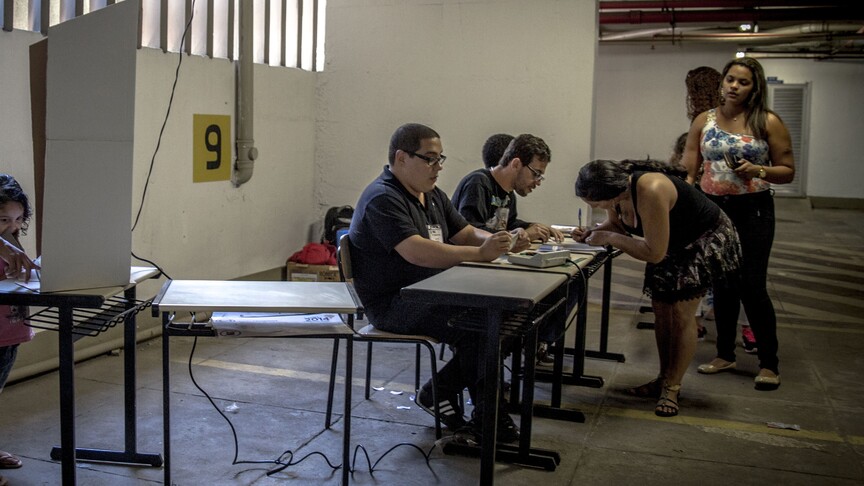
- Lula and Flavio Bolsonaro lead the race, with recent polls showing varying gaps in the first round and ties in several runoff scenarios
- Brazil will hold the first round on Oct. 4, with a runoff scheduled for Oct. 25 if no presidential candidate receives more than half of valid votes
Brazil heads to the polls on Sunday to choose its next president.
The election is dominated by a closely fought contest between President Luiz Inacio Lula da Silva and Senator Flavio Bolsonaro, the son of former President Jair Bolsonaro.
A total of 12 presidential tickets are registered for the election, according to Brazil's Superior Electoral Court.
More than 158 million people are registered to vote in the general elections, including over 918,000 Brazilians living abroad.
The election comes amid deep political polarization, with Lula representing the left-wing Workers' Party (PT) and Flavio Bolsonaro the right-wing Liberal Party (PL).
When is the election?
The first round will take place on Oct. 4.
If no presidential candidate receives more than half of the valid votes, a second round between the two leading candidates will be held on Oct. 25, according to the Superior Electoral Court.
Voting will take place using Brazil's electronic voting system. Polls will open at 8 a.m. and close at 5 p.m. local time.
The presidential election is part of a broader general election. Voters will also elect 27 governors, 54 senators, all 513 federal deputies and state or district deputies.
Each voter will cast six votes: one for president, one for governor, two for senators, one for federal deputy and one for state or district deputy.
Voting is compulsory for Brazilians aged 18 to 70, while citizens aged 16 and 17 can vote voluntarily.
Who are the main candidates?
Lula is seeking a fourth non-consecutive presidential term. He returned to the presidency in 2023 after previously serving from 2003 to 2010.
He is running for reelection with Vice President Geraldo Alckmin as his running mate. His campaign emphasizes social programs, reducing inequality, economic growth and combating organized crime.
His main opponent is Flavio Bolsonaro, 45, a senator and the eldest son of former President Jair Bolsonaro.
The junior Bolsonaro is running for president for the first time and has received the backing of his father, who is serving a prison sentence after being convicted over a coup attempt.
His campaign has emphasized public security, conservative social values, a smaller state and market-oriented economic policies.
Beyond Lula and Flavio Bolsonaro, the other candidates have different political profiles.
Augusto Cury, a writer and psychiatrist, is running for Avante party. Ronaldo Caiado, governor of Goias, is the candidate of the Social Democratic Party (PSD), while former Sao Paulo Gov. Romeu Zema is running for Novo.
Renan Santos is running for the Missao party. The remaining candidates are Hertz Dias of PSTU, Edmilson Costa of PCB, Clariana Barao of Democracia Crista, Rui Costa Pimenta of PCO, Wilson Grassi of Democrata and Samara Martins of Unidade Popular.
What do the polls show?
Recent polls show Lula and Flavio Bolsonaro leading the first-round race, although surveys differ on the size of the gap.
A Datafolha poll conducted Sept. 22-24 gave Lula 40% and Flavio Bolsonaro 36% in the first round. Augusto Cury had 5%, Caiado 4% and Renan Santos 3%.
Another poll by Quaest conducted from Sept. 24-28 showed Lula at 39% and Flavio at 34% in the first round. Cury and Caiado had 4% each, followed by Renan Santos with 3% and Zema with 1%.
A poll by AtlasIntel, a Brazilian polling and data intelligence firm, released on Sept. 29 showed Lula at 45.3% and Flavio Bolsonaro at 42.2%. Renan Santos followed with 5.2%, while Cury had 2%, Caiado 1.8% and Zema 0.9%.
Another Palver poll released on Sept. 29 put Lula and Flavio Bolsonaro at 44% each in the first round, with Renan Santos at 8%.
The differences reflect variations in methodology, sample size and fieldwork dates, meaning individual polls should not be treated as directly interchangeable.
What happens in the second round?
Several polls predict a tie between Lula and Flavio Bolsonaro.
Datafolha's latest poll showed Lula with 47% and Flavio with 45%, with the difference within the poll's two-point margin of error.
An AtlasIntel poll showed Flavio at 47.7% and Lula at 47.6%, with a one-point margin of error.
A Quaest poll also showed the two candidates tied at 42% in a hypothetical second round.
The close numbers make the distribution of votes among candidates outside the two main camps an important factor in potential runoff scenarios.
Datafolha found that 80% of voters who have already chosen a first-round candidate said they were certain about their decision.
The poll also showed that Lula and Flavio Bolsonaro had the highest rejection rates, with 45% of respondents saying they would not vote for either candidate under any circumstances.
What are the main issues?
Public security, the economy, corruption, health, social issues and education are among the main concerns of Brazilian voters.
Public security is a central issue for Flavio Bolsonaro. His campaign has proposed creating 500,000 prison places, building five maximum-security prisons and taking tougher measures against organized crime.
Lula's campaign has focused on reducing inequality, maintaining social programs and combating organized crime. His 84-page program also emphasizes national sovereignty and economic growth.
Fiscal policy is another major point of difference. Lula has proposed a gradual fiscal adjustment while seeking to preserve social spending.
Flavio Bolsonaro's platform calls for a faster adjustment of public finances, changes to spending rules, privatization and measures to reduce bureaucracy.
Environmental policy is also significant. Brazil is a major agricultural producer and holds vast natural resources, including the Amazon rainforest, water resources, oil and rare earth minerals.
Lula's program calls for an end to deforestation by 2030 and greater environmental monitoring and conservation measures.
The election is also taking place amid continued political polarization between supporters of Bolsonaro's movement and Lula's Workers' Party.
What is the regional and international context?
Brazil is South America's largest country and one of the world's major agricultural and commodity producers. It is also rich in natural resources, including oil, water and rare earth minerals, giving the election significance beyond domestic politics.
The election is being watched across Latin America as Lula remains one of the region's most prominent left-wing leaders, while Flavio Bolsonaro represents the political movement associated with his father.
The result could affect Brazil's relations with the US, China and European countries, as well as its role in regional politics.
The election is also being watched in neighboring Argentina, where President Javier Milei has publicly supported Flavio Bolsonaro, adding a regional dimension to the contest.
What is happening in the final days of the campaign?
The final days of the campaign have been marked by efforts by the leading candidates to consolidate support before the Oct. 4 vote.
Flavio Bolsonaro has challenged Lula to participate in a televised debate on Globo scheduled for Oct. 1, three days before the election.
The debate comes during the final stretch of campaigning, as candidates seek to reach undecided voters and consolidate support among their political bases.
Why does the election matter?
The election will determine who leads Brazil for the next presidential term and could shape the country's economic, social, environmental and foreign policies.
The result will also influence the composition of Congress and state governments, which will affect the next administration's ability to implement its agenda.
Brazil's position as South America's largest economy and a major agricultural and commodity producer gives the election broader regional and international significance.
The next government will also determine Brazil's approach to relations with the US, China, Europe and neighboring countries, as well as policies involving the Amazon, energy, trade and strategic minerals.