By Andrew Jay Rosenbaum
ANKARA
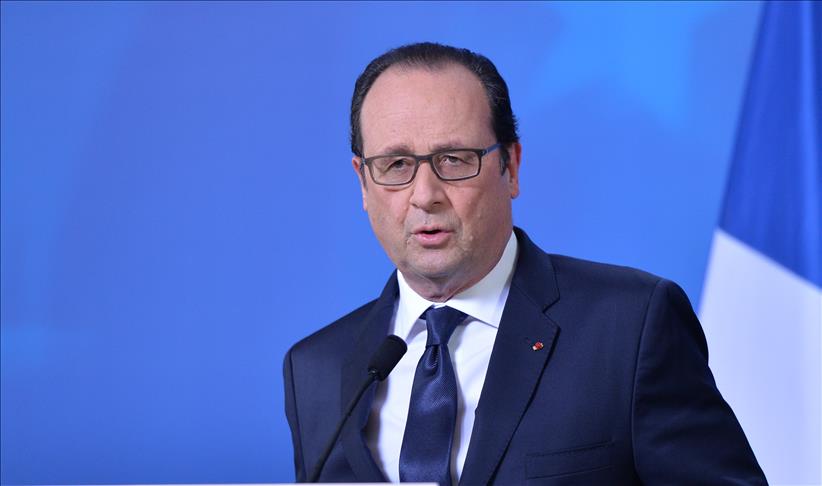
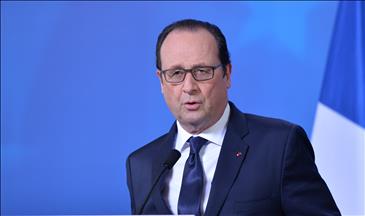
French President Francois Hollande is trying to push through a reform package that touches sore spots in Gallic sensibilities.
The French government on Tuesday used special decree powers to pass a controversial economic reform package. It may still face a legislative challenge before becoming law.
Experts on Wednesday pointed out that the package touched on politically sensitive areas of the economy. The most controversial was the liberalizing of work on Sunday, but lawyers and other professionals objected strongly to opening access to professions like that of the notary, the public auctioneer and the bailiff. Many of the other reforms aroused the ire of specialists in those specific areas as well.
“The move was a kind of provocation, so it is not surprising that it has aroused considerable opposition even within the ruling Socialist party,” said French economist Benjamin Coriat.
Indeed, the so-called Socialist “fronde,” members of the party who feel it has betrayed its leftist heritage, have strongly opposed the bill – the term dates from 17th century nobles who opposed the King of France.
Such was the opposition to the bill in the French parliament, that French President Francois Hollande made use of special decree powers to pass the package of legislation.
Hollande and Prime Minister Manuel Valls applied French Constitution Article 49.3. This law which permits the government to pass legislation by decree, subject to the condition that a no-confidence vote, proposed by at least 58 lawmakers, does not pass the parliament and knock the government out of power altogether.
The French conservative UMP party has already made such a motion, and is trying to gather support for a vote.
- Gallic ire
Why should the government take such an extraordinary step as 49.3 for this bill?
Paris has, for some time, been in the bad books of the European Commission, which has repeatedly complained that the French government is not working hard enough at structural reforms.
The Commission, on Dec. 11, published a survey in which it stated that France “has made little progress in its attempts to boost competitiveness and restore the viability of its public finances.”
The commission wants France to tackle its deteriorating trade balance and competitiveness. French exports have fallen by 13 percent over the last five years, a problem which, the report says, “is rooted in both the low cost and non-cost competitiveness of French exports.”
The EU executive also wants Paris to halt its ever-rising public debt burden which now stands above 90 percent of GDP, and is forecast to hit 98 percent in 2016. But the report expresses frustration that little progress had been made so far.
Needless to say, this kind of comment raises Gallic ire, and the government’s reaction has been to take this first step, Coriat pointed out.
But it has also raised a different kind of ire. “This bill is the result of an anti-social tendency displayed by the European Commission,” said a statement by an ad-hoc group of more than 50 economists and politicians who oppose the bill. “This bill is just a way for the rich to maximize profit and dividends,” the statement says. “Pour nous, Macron c’est non.”
- Gallic spleen
No aspect of the bill has provoked greater discharges of Gallic spleen than the liberalization of work on Sunday. It changes the previous allowance for retailers to open their stores five Sundays a year. Now the local authorities will rule on how many Sundays businesses may operate – up to a total of 12. Special dispensation is given to tourist cities like Nice where businesses can stay open as often as they like on Sunday.
“It’s an attack on decent working conditions,” the ad-hoc group said.
Those who oppose the bill also complain about the changes in the justice system for claims in the workplace. France had a special, separate system for labor law which is now being merged with the country’s regular judicial system. Again, this is seen as a way of attacking workers by opponents to the bill.
Making it easier for anyone to become a notary public, or a bailiff, has sparked public demonstrations by the French legal profession. French lawyers say that the government is “commercializing their profession.”
And much spleen has been vented over the new obligation for those who work in the construction industry to register for professional identification.
- Gallic phlegm
Yet, surprisingly, overall support for the bill among the general public is strong.
According to a poll by Paris-based Odoxa-FTI Consulting sponsored by the newspaper Les Echos and Radio Classique released at the end of January, 61 percent of French voters support the bill. Political analysts say many French people are tired of the restrictions on the economy, and are happy to see even these few disappear.
Analysts agree that this is not a massive reform effort. “It’s a start,” said Stefan Seidendorf, a European political analyst at the French-German Institute at Ludwigsburg, Germany, in a television interview.
“But it’s no French Revolution.”