By Hamza Takeen
BEIRUT
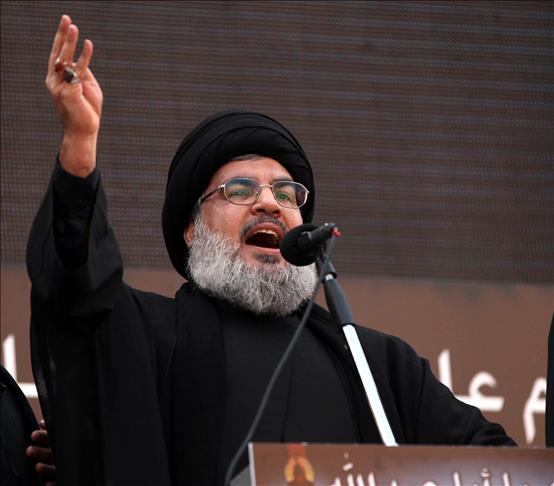
In a rare appearance on Tuesday, Hassan Nasrallah, leader of the Shiite Hezbollah group, threatened that Hezbollah would respond fiercely if Israel attacked Lebanon.
"In any future war on Lebanon, your airports will be forced to close; there will be no place that the rockets of the resistance won't be able to reach," Nasrallah said in a speech shown on a massive screen in southern Beirut's Dahieh neighborhood, a Hezbollah stronghold.
Nasrallah, who addressed supporters on the occasion of the Shiite Ashura holiday, warned Israel against taking advantage of the ongoing civil war in neighboring Syria – in which Hezbollah is involved – to strike Lebanon.
"What's stopping Israel from… waging war on Lebanon is that they [the Israelis] know we are keeping an eye on the [northern] border," he said.
"Israel is exploiting the current disarray in the Islamic world to achieve its dream," he added, criticizing the ongoing "Judaization" of Jerusalem and continued Israeli settlement building.
Nasrallah defended Hezbollah's policy of fighting alongside Syrian government forces, saying the emergence of the Islamic State in Iraq and the Levant (ISIL) militant group – which recently seized parts of Syria and Iraq – had proven that Hezbollah had made "the right choice of battle."
Hezbollah in no position to fightIsrael: Official
A senior Israeli military official has said that Lebanon's Hezbollah movement was not in a position to enter a full confrontation with Israel despite recent threats by group leader Hassan Nasrallah to target Israeli military positions.
"It is unlikely that any dramatic change will take place along Lebanon's border with Israel in coming months," an official from the Israeli army's Northern Command told Israel's National Radio.
"By planting explosives in the Jabal al-Rous area [adjacent to the Lebanese-Israeli border], Hezbollah is playing with fire," he added. "Nasrallah is not aware of how dangerous his actions are and how quickly the situation could escalate."
Israel's Northern Command is said to be responsible for the border area between Israel and Lebanon.
"Israel's northern front [near the Syrian and Lebanese borders] is volatile," Israeli Army Chief of General Staff Benny Gantz said.
"Currently, Hezbollah is not in a position for a confrontation on Israel's northern borders," an unnamed senior Israeli military official was quoted as saying on Army Radio.
The official expects Hezbollah to use civilians as "human shields" in future confrontations with Israel – the same tactics, he claimed, as those employed by Palestinian resistance faction Hamas.
In the summer of 2006, Israel and Hezbollah engaged in a 33-day war that featured a massive Israeli military offensive on a number of Lebanese towns following the ambush of several Israeli soldiers – three of whom were killed and two kidnapped – by Hezbollah.
The Shiite group responded to the assault by launching barrages of rockets at several Israeli cities, including Haifa, northern Israel's largest city.
The conflict ended with a U.N.-backed cease-fire after 33 days of deadly hostilities that left 121 Israeli soldiers and 44 civilians dead, according to Israeli government figures.
According to a 2007 Amnesty International report, more than a thousand Lebanese were killed in the conflict.
www.aa.com.tr/en