ANKARA
The crises in Iraq and Syria have thrown up many unexpected alliances but perhaps the most unlikely is the merging of U.S. and Iranian interests.
Relations between the two countries – sworn enemies since Iran’s 1979 Islamic revolution deposed U.S. ally Shah Mohammad Reza Pahlavi – have grown warmer as the Islamic State Iraq and the Levant (ISIL) has advanced through Syria and Iraq opposed by, among others, Shia Muslim fighters.
In Syria, the Sunni extremists of ISIL have been poised against Iran’s ally President Bashar al-Assad while in Iraq the terror group has massacred ethnic and religious groups that do not conform to their own vision of Islam, including Iran’s fellow Shia.
According to experts on the region, however, American relations with Gulf Arab states, which have joined the U.S.-led coalition against ISIL, are limiting U.S.-Iranian cooperation to a covert level.
The Gulf states have long-opposed regional power Iran and the exclusion of Iran from the September 15 Paris meeting to discuss opposition to ISIL reflects the influence of Saudi Arabia, Iran’s biggest regional rival.
“What Washington expects from Tehran is that it continues its existing covert support through its Shia militias in ground operations,” Professor Nursin Guney Atesoglu of Istanbul’s Yildiz Teknik University said, referring to Iran’s opposition to ISIL in Iraq where it has supported Iraqi Shia militias but also, according to press reports, provided military advisors.
Despite Arab Sunni unease at Iran’s involvement, the diplomatic thaw between the U.S. and Iran demonstrates the former’s recognition of Iran’s status as an influential power in both Iraq and Syria, where Iranian-backed Hezbollah has been fighting alongside Assad’s regime.
On Wednesday David Cameron, prime minister of America’s staunchest ally Britain, was due to meet Hassan Rouhani, the first meeting between a British premier and an Iranian president since 1979. Last week, U.S. Secretary of State John Kerry meet Iranian Foreign Minister Javad Zarif to discuss tackling ISIL.
Bayram Sinkaya of Ankara’s Yildirim Beyazit University told the Anadolu Agency that the West’s awareness of Iranian power in Iraq was brought into sharp focus after the 2003 U.S.-led invasion of Iraq and the subsequent occupation, when Iranian-backed Shia fighters formed strong opposition Western coalition.
"Several Shia militias were directly linked to Iran," he said. "And also there were former militias integrated into Iraqi security forces and intelligence. Iran may also have had an influence in the early mobilization of Shia groups against ISIL since June."
As ISIL moved into Iraq in June, Iranian proxies such as Asaib Ahl al-Haqq, a 2,000-strong Iraqi militia that had been fighting alongside Assad’s forces, and Kataib Hezbollah, another Iraqi Shia group that supported Assad, redeployed their forces back into their homeland.
Both groups have strong links to the elite Quds force, part of Iran’s Revolutionary Guards.
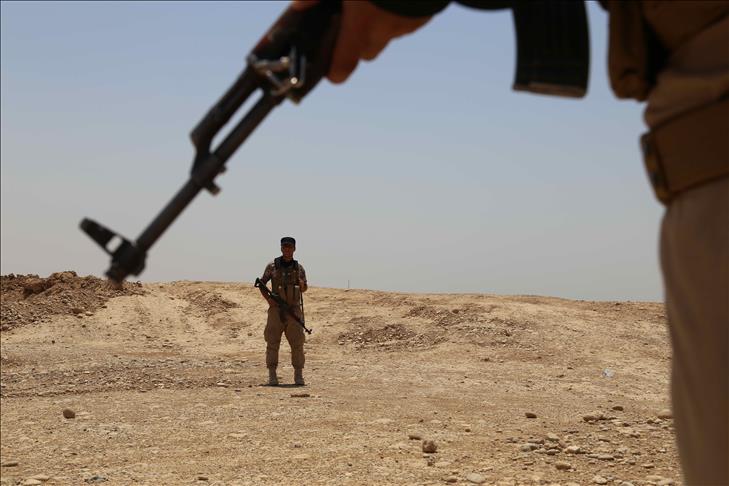
Overcoming a further hurdle to its involvement in Iraq, Iran’s supply of arms to the Kurdish Peshmerga has improved relations with the Kurdish Regional Government in Irbil, northern Iraq.
Iran was the first country to send military aid to President Massoud Barzani’s administration, Kurdish officials said last month.
Previous tension between Iran and Barzani’s Kurdistan Democratic Party was founded on Iran’s support for Barzani’s rival, the Patriotic Union of Kurdistan.
However, the tension largely disappeared when the two Kurdish parties agreed to share power after the U.S.-led invasion, although there is still a degree of distrust between them.
“All these grounds play into the hands of Iran for becoming an influence in Iraq,” Sinkaya said.
Further impetus to improving U.S.-Iranian relations came from within Iran with the rise to power of moderate Rouhani in 2013 after the rule of stridently anti-Western President Mahmoud Ahmadinejad, even though hardliners surrounding Supreme Leader Ali Khamanei are still opposed to rapprochement with the West.
Iran enjoys influence across an “axis of resistance” spanning Beirut, and Baghdad.
“Although Iran cannot build an hegemony on these territories alone, its power could block the way of every country that has an influence in the region,” Mehmet Sahin, a foreign policy and international relations coordinator at the Ankara-based Strategic Thinking Institute, said.
“Iran is not a stabilizing power but is a destabilizing power in the region. That’s why calculations made without taking Iran into account do not yield any results.”
The increasing ‘cooperation’ between the U.S. and Iran remains a tightrope for both sides. It is likely that coordination will prove useful in Iraq but the same does not apply to Syria, where Iran sees ISIL’s attacks on other opposition groups as helpful to Assad.
Also, the U.S. policy of arming the ‘moderate’ Syrian rebel groups concerns Iran because of its support for Assad.
“If the power taken from ISIL was granted to the armed opposition and ends up weakening al-Assad, that would mean a big blow to Iran and U.S. relations,” Sahin predicted.
www.aa.com.tr/en