GENEVA
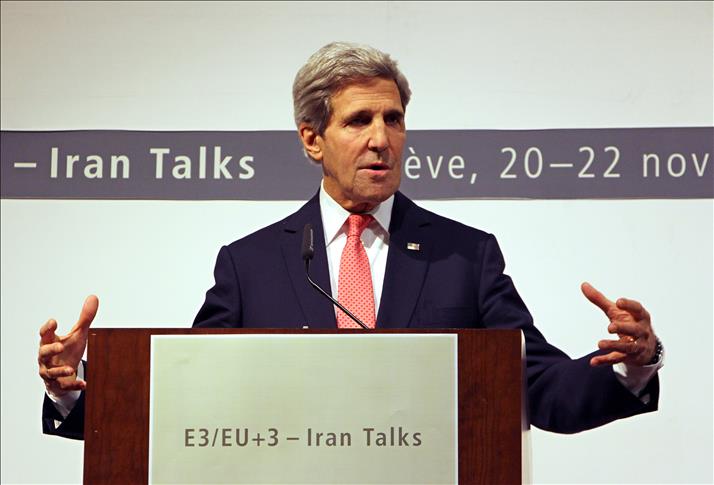
US Secretary of State John Kerry said on early Sunday that the nuclear agreement with Iran to temporarily freeze the Islamic republic's nuclear program would make America's regional allies in the Middle East, including Israel, safer.
Speaking at a press conference after the signing of the historic nuke deal with Iran, Kerry stated that the deal "enlarges the breakout time" Iran would need to develop fissile material for a nuclear device.
Kerry said the nuclear deal with Iran was a "good first step."
"The purpose of this is very simple: to require Iran to prove the peaceful nature of its program and to ensure that it cannot build a nuclear weapon."
"I'm not going to stand in some triumphal moment and suggest to you that this is an end in itself," he told the press conference.
Kerry noted that he believed the Obama administration's tightening of Iranian sanctions was part of what brought Tehran to the negotiating table.
"Don't interpret that the sanctions were an end unto themselves," he said.
US Secretary added that "The goal of the sanctions was always to have a negotiation" and to ultimately "secure a strong and verifiable agreement that guarantees the peacefulness of Iran's nuclear program."
Kerry also delivered a message for critics of the deal, including members of Congress, saying "They too bear a responsibility … to tell people what the better alternative is."
The historic agreement, inked in the early hours of Sunday morning at a penning ceremony in Geneva’s Palace of Nations, requires Iran to halt or scale back parts of its nuclear infrastructure, the first such pause in more than a decade.
The agreement foresees an initial six-month period that brings boundaries to Tehran’s nuclear program and it address concerns about Iran’s enrichment capabilities, existing stockpiles, centrifuges and ability to produce weapons-grade nuclear material with the Arak reactor.
The main aim of the accord is to give international negotiators time to pursue a more comprehensive pact to roll back much of Iran’s nuclear program and ensure that it could be used only for peaceful purposes.
Tehran's next-generation centrifuges and the Arak reactor, which could begin to produce plutonium as early as 2014, would be halted, along with new international inspections to be implemented throughout the nuclear program.
The inspections would allow the International Atomic Energy Agency (IAEA) daily access to the Natanz and Fordow nuclear facilities, and would allow more frequent access to the Arak reactor, according to a fact sheet released by the White House.
In exchange, Tehran would receive limited sanctions relief, which would add roughly $1.5 billion in revenue from suspended sanctions "on gold and precious metals, Iran's auto sector, and Iran's petrochemical exports", according to the fact sheet. An additional $4.2 billion would be transferred to Iran in installments from Iranian oil sales.
In total, $7 billion would be freed up, including allowing Iran to transfer $400 million in tuition assistance for Iranian students to international educational institutions, and would allow repairs and inspections of various airline aircraft within Iran.
englishnews@aa.com.tr