14 March 2016•Update: 19 March 2016
BERLIN
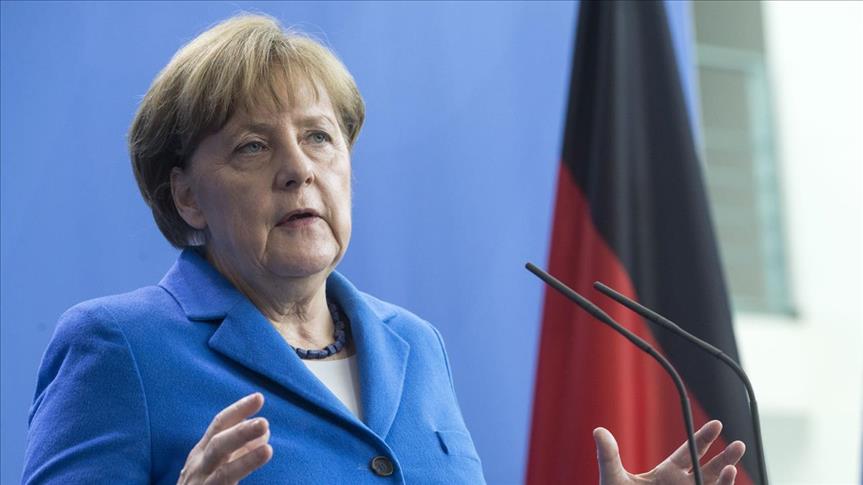
German Chancellor Angela Merkel has said her government will not change its open-door policy for refugees, a day after it suffered big losses in regional elections.
Addressing a press conference in Berlin after meeting her party leaders to discuss the outcome of the elections Monday, Merkel said: “Yesterday [Sunday] was a difficult day for the Christian Democratic Union.
“I firmly believe, and today it was not put into question, that we need a collective European solution. And this solution needs time,” she said.
The German chancellor has so far turned down calls for closing doors to refugees who flee civil war in Syria, and argued that refugee numbers can only be decreased through EU-Turkey cooperation, and by EU states sharing the burden.
Merkel’s Christian Democratic Union (CDU) suffered heavy losses in Sunday’s regional elections, which was seen as a test of support for her handling of refugee crisis.
CDU lost elections in two of the three states that went to polls Sunday, while right-wing populist Alternative for Germany (AfD) achieved record support with its anti-refugee campaign.
Merkel acknowledged Monday that in the eyes of many voters, her government could not deliver a satisfactory solution to the refugee crisis so far.
But she argued that they achieved major progress and need some more time to bring a sustainable solution to the problem.
Merkel’s Christian Democrats received their worst election result in 60 years in their traditional stronghold Baden Wuerttemberg, wining 27 percent votes, down from 39 percent in 2011, according to official results.
AfD sees record gains
Germany’s anti-immigration party AfD, gained a record 24.2 percent in the eastern state of Saxony-Anhalt, and became the second largest political group in the region’s parliament.
In Baden Wuerttemberg, AfD won 15.1 percent votes and it won 12.6 percent in the southern state of Rhine-Palatinate, according to official results.
Merkel said increased support for AfD was mainly due to the “protest behavior” of the electorate, which saw the lack of a comprehensive solution to the refugee crisis.
She said some voters may have had fears about Islam and could be concerned about domestic security.
Germany took in a record 1.1 million refugees last year, majority of them were Syrians, Iraqis and Afghans.