By Dilrukshi Handunnetti
COLOMBO
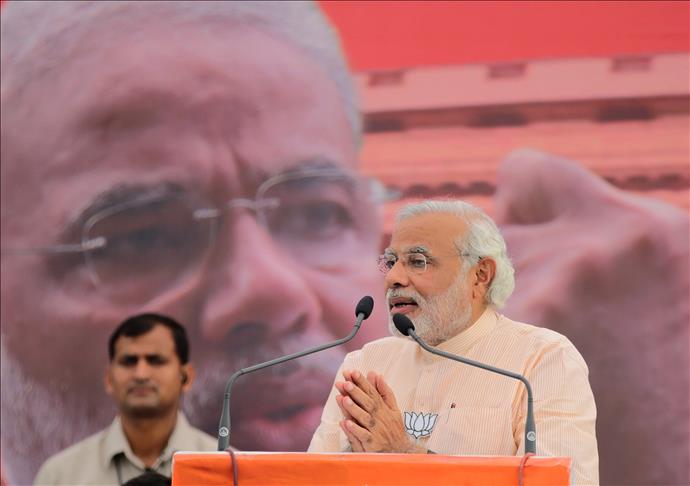
After a lapse of 28 years, Narendra Modi will be the first Indian Prime Minster to make an official visit to Sri Lanka when he arrives for a three-day visit on Friday.
Modi visits the nation to India's south on the final leg of a tour of Indian Ocean island nations which saw him visit the Seychelles and Mauritius; a move analysts perceive to be a strategic move to China’s growing influence in the region.
The visit to Sri Lanka is also seen as an effort to cement a historic relationship that was damaged during the rule of former President Mahinda Rajapaksa.
Rajapaksa not only held a very close relationship with India's neighbor and rival China but also allegedly failed to deliver on a series of commitments made to India on devolving power under the Sri Lanka Constitution.
Syed Akbarruddin, Spokesman for India’s Ministry of External Affairs, told The Anadolu Agency that the visit marks “an important step in Indo-Lanka relations and will seek to address the key question of power devolution in Sri Lanka.”
Since the end of Sri Lanka’s war against ethnic Tamil separatist rebels, known as the Tamil Tigers, in 2009, India has, to no avail, demanded the island nation fulfils its pledges to India and the international community to address the ethnic question through a viable political solution.
Sri Lanka’s State Minister for Foreign Affairs, Ajith Perera said the visit would prove an excellent opportunity to “forge closer links and pursue areas of common interest.”
“Sri Lanka needs to renew its friendship with India, our closest neighbour,” Perera added.
Unlike its predecessor, the current government headed by new President Maithripala Sirisena, is considered India-friendly and the visit is viewed as an opportunity to improve the understanding between both countries.
"While the relations with India deteriorated during Rajapaksa’s tenure, the new president, Sirisena, has shown a keenness to mend them again," wrote political analyst C Uday Bhaskar on Indian news website Scroll.in. "Colombo offers Delhi an opportunity to burnish its profile as an empathetic alternative to what China brings to the regional calculus."
"The challenge for India will be to arrive at a cooperative multilateral framework wherein the smaller nations are not forced into a binary cul-de-sac that pits India against China," wrote Bhaskar.
An Indian premier has not visited Sri Lanka since the 1987 visit of the late Rajiv Gandhi, when he was assaulted by a sailor using the butt of his rifle.
The highlight of Modi's visit is expected to be a visit to the island's Tamil-speaking north, which shares ethnic ties with southern India's Tamil Nadu and was the focus of the decades-long civil war. Modi is also expected to hold discussions with Northern Chief Minister, C. V. Wigneswaran.
However, there is growing concern in both countries about the contentious issue of ongoing arrests, on both sides, of fishermen accused of violating territorial waters.
To mark the event, both countries will be releasing fishermen in their custody but such gestures have been made before and followed later with more arrests.
Bilateral relations apart, Modi is scheduled to visit Anuradhapura, the capital of Sri Lanka’s North West, which was a fabled kingdom where Buddhism flourished.
Modi has demonstrated significant interest in Buddhism and has spearheaded the development of a Buddhist circuit in his home state of Gujarat in Western India.
The Indian Premier will visit the Mahabodhi Society of Sri Lanka before taking wing to the historic city of Anuradhaura, followed by a visit to the northern capital of Jaffna.
During his visit to Jaffna, Modi will lay the foundation stone for a new cultural centre, in close proximity to the Jaffna Public Library which had to be completely rebuilt after it was burnt to the ground during riots in 1981.