ANKARA
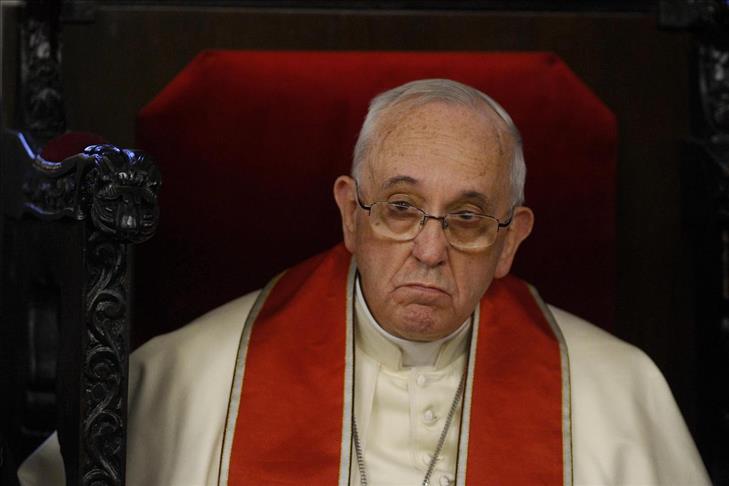
After saying "The first 'genocide' of the 20th century" struck Armenians, Pope Francis prayed Sunday for “reconciliation” between Armenians and Turks.
“May God grant that the people of Armenia and Turkey take up again the path of reconciliation, and may peace also spring forth in Nagorno Karabakh,” Pope said in his message delivered to all Armenians on Sunday, after the liturgy.
“Despite conflicts and tensions, Armenians and Turks have lived long periods of peaceful coexistence in the past and, even in the midst of violence, they have experienced times of solidarity and mutual help,” Pope said.
“Only in this way will new generations open themselves to a better future and will the sacrifice of so many become seeds of justice and peace.”
Earlier on Sunday, Pope said at the St. Peter Basilica: "In the past century, our human family has lived through three massive and unprecedented tragedies.
"The first, which is widely considered the first genocide of the twentieth century, struck your own Armenian people, the first Christian nation, as well as Catholic and Orthodox Syrians, Assyrians, Chaldeans and Greeks and, more recently, there have been other mass killings, like those in Cambodia, Rwanda, Burundi and Bosnia."
Pope made these remarks during a service held in Vatican City for Armenians who lost their lives in the 1915 incidents.
Armenian President Serzh Sargsyan, Catholicos Karekin II, the current Catholicos of All Armenians and also the head of the Armenian Apostolic Church, and Aram I Keshishian, the head of the Armenian Catholicosate of the Great House of Cilicia, also attended the rite.
The Vatican first used the term “genocide” for 1915 incidents on September 27, 2001 when Pope Jean Paul II signed a joint declaration with the Armenian Patriarch. In Sunday’s liturgy, Pope Francis also used this joined declaration as reference.
Popes declarations drew criticism from Ankara, with the Turkish Foreign Ministry summoning Vatican's Ambassador to Turkey, Antonio Lucibello.
Later on Sunday, Turkey recalled its own Ambassador to Vatican, Mehmet Pacaci, to Ankara for consultations.
1915 incidents
The 1915 events took place during World War I when a portion of the Armenian population living in the Ottoman Empire sided with the invading Russians and revolted.
The Ottoman Empire relocated Armenians in eastern Anatolia following the revolts and there were some Armenian casualties during the relocation process.
Armenia has demanded an apology and compensation, while Turkey has officially refuted Armenian allegations over the incidents saying that, although Armenians died during the relocations, many Turks also lost their lives in attacks carried out by Armenian gangs in Anatolia.
The Turkish government has repeatedly called on historians to study Ottoman archives pertaining to the era in order to uncover what actually happened between the Ottoman government and its Armenian citizens.
The debate on “genocide” and the differing opinions between the present day Turkish government and the Armenian diaspora, along with the current administration in Yerevan, still generates political tension between Turks and Armenians.
Turkey's official position against allegations of “genocide” is that it acknowledges the past experiences were a great tragedy and that both parties suffered heavy casualties, including hundreds of Muslim Turks.
Turkey agrees that there were certainly Armenian casualties during World War I, but that it is impossible to define these incidents as “genocide.”