- Erdogan stresses importance of preserving diplomatic channels, saying disputes should not be resolved through violence
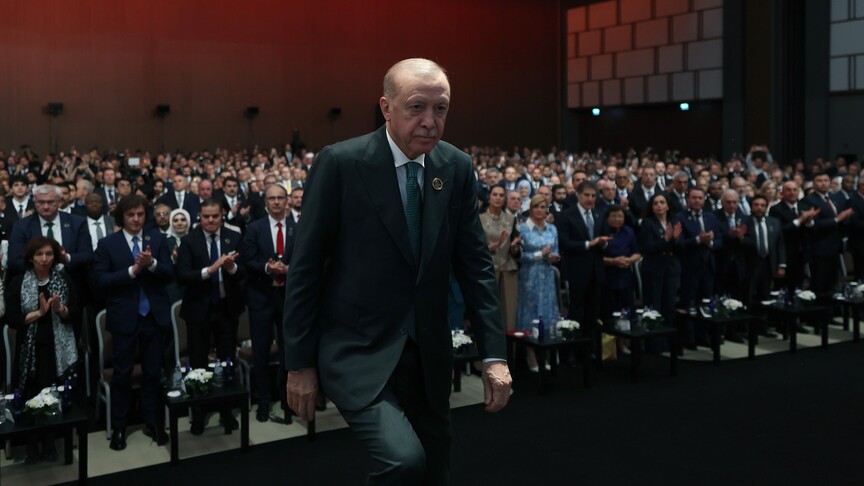
Turkish President Recep Tayyip Erdogan said on Friday the world is facing a deepening crisis in both power and direction, warning that the international system has reached a “serious and dangerous threshold.”
Speaking at the opening ceremony of the Antalya Diplomacy Forum 2026, Erdogan said the current global order has failed to respond effectively to major crises.
“The world today is experiencing not only a crisis of power but also a crisis of direction,” he said, adding that the so-called rules-based system remains silent when rules are violated, while mechanisms tasked with protecting human rights and global security are “ineffective, and often indifferent” in the face of severe attacks.
He described the current turmoil as “primarily a moral and existential crisis,” pointing to developments in Gaza following the events of Oct. 7 as evidence of the scale of the breakdown.
Highlighting the scale of the crisis, Erdogan said more than 73,000 Palestinians have been killed and over 172,000 injured in Israeli attacks over the past two and a half years.
“Reading what is happening in Gaza merely as a humanitarian tragedy would be incomplete,” he said, arguing that the situation reveals what the current international system allows, ignores, and protects.
He also criticized the global system’s response to conflicts across the region, saying it has failed “the most basic test of humanity” in places such as Syria, Gaza, the West Bank, and Lebanon.
Call for diplomacy, ceasefire opportunity
Erdogan stressed the importance of preserving diplomatic channels, saying disputes should not be resolved through violence.
“No matter how deep the disagreements, we must not allow words to be replaced by weapons or negotiations by bloody conflict,” he said.
Referring to tensions involving the US, Israel and Iran, Erdogan welcomed the ceasefire initiative and said it has opened a window of opportunity for lasting peace.
“We welcome the 15-day ceasefire declared through the efforts of Pakistani Prime Minister Shehbaz Sharif in this meaningless and extremely costly war triggered by the provocations of the Israeli government,” Erdogan said. “We believe this opportunity must be used in the most effective way to establish permanent peace.”
He emphasized that parties should act with patience and a conciliatory approach, while warning against attempts to undermine the process.
“At this critical stage, we must remain ready and vigilant against efforts by Israel to sabotage the negotiation process,” he added.
Highlighting the strategic importance of the Strait of Hormuz, Erdogan said access to open seas for Gulf countries should not be restricted.
“The essential point is to ensure freedom of navigation based on established rules and to keep the Strait of Hormuz open to commercial shipping,” he said.
Regional, global policy priorities
On Syria, Erdogan said strengthening stability, normalization and long-term peace in the neighboring country is vital for the region’s future.
“We are pleased with the progress Syria has made over the past one and a half years under the prudent leadership of President al-Sharaa, and I would like to express that we will continue to stand by the Syrian people going forward,” Erdogan said.
He reiterated Türkiye’s readiness to support direct negotiations, including a possible leaders’ summit, if the parties in the Russia-Ukraine war are willing.
Erdogan also underlined that a fair and inclusive negotiation process is key to ending the conflict.
He said promoting peace, stability and prosperity remains a priority in Türkiye’s Balkans vision, shaped by deep-rooted historical ties, expressing strong optimism about the Balkan Peace Platform launched with this approach.
Erdogan also said Türkiye continues to strengthen the Organization of Turkic States, which it sees as a guarantor of peace and stability in Eurasia, adding that Ankara will assume the rotating chairmanship from Azerbaijan at the 13th Turkic World Summit to be held later this year.
He said Türkiye continues its active efforts to ensure calm and security in Libya, describing it as another “brotherly geography.”
“We sincerely support the territorial integrity, sovereignty and development efforts of African countries. We stand by all diplomatic efforts to end the conflict in Sudan that has continued since April 2023, and our support for Somalia’s territorial integrity and economic prosperity remains steadfast,” Erdogan added.
“As Türkiye, we are pursuing peaceful foreign policies across different regions and continents while also strengthening our existing alliances,” he said.
Erdogan said Türkiye, as a leading member of NATO and a key guarantor of collective security in the Euro-Atlantic region, will host the alliance’s leaders’ summit in Ankara on July 7–8.
He added that preparations are already underway and expressed hope that key decisions will be taken at the summit to carry the alliance strongly into the future.
Erdogan also said Türkiye will host the 31st Conference of the Parties (COP31) to the UN Framework Convention on Climate Change in Antalya in November, adding that during its presidency, it will prioritize policies that link environmental issues with youth engagement, including expanding the Zero Waste initiative.
He reaffirmed Türkiye’s commitment to its EU membership goal, while calling on the bloc to overcome what he described as a “direction problem” and remain faithful to its founding vision.
Addressing tensions in the Aegean and Eastern Mediterranean, he said Türkiye aims to turn the region into a “basin of stability and prosperity,” while rejecting “maximalist unilateral approaches” that seek to exclude Ankara and the Turkish Republic of Northern Cyprus.
On broader regional policy, Erdogan said that Türkiye continues to pursue a peaceful foreign policy across regions while strengthening its existing alliances, and remains open to cooperation with neighboring countries through initiatives such as "the Development Road project" in the energy and connectivity sectors.