By Benjamin Garvey
HONG KONG
Hong Kong protest leaders have agreed to hold two rounds of talks with the Chinese territory's government, saying the public’s desire for negotiations was more important than the students’ disappointment over the proposed agenda.
The talks will start at 4 p.m. Hong Kong time (11 a.m. Turkish local time) on Friday.
The first session will focus on the constitutional basis for political-system changes and the second on legal requirements, the government and students said, according to local media reports.
The ground rules for the talks mean the government may not discuss making changes to the rules laid down by Beijing requiring all candidates for the city’s chief executive be vetted by a committee.
That conflicts with demonstrators’ demand that the 2017 elections be more democratic, and may mean the discussions will fail and lead to further civil disobedience.
A leader of one of the main student groups, Lester Shum, underlined that talks would only go ahead if the around 300 protesters who continued to demonstrate on Hong Kong streets Wednesday morning were not physically removed.
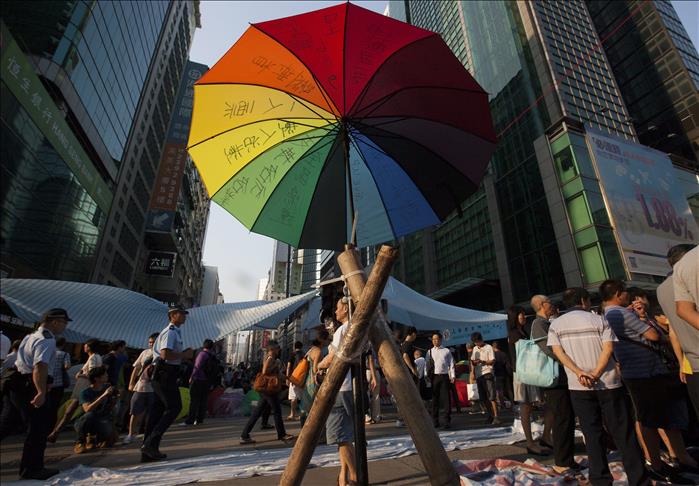
At the Mong Kok protest site, a woman, aged around 40, told an Anadolu Agency reporter that she felt "touched by what the students are doing."
"It's very courageous," the woman, who declined to give her name out of concerns for her privacy, added.
"But if you confront the Chinese government, you have to do it bit by bit - you cannot achieve everything in one go, like these students are trying to do."
Over the last 12 days, tens of thousands of people had gathered at protest sites to push Beijing to loosen controls over the former British colony.
Police had fired tear gas and used pepper spray to clear protest sites, while a faction of Hong Kong gangsters - triads - had been accused of attacking protests and sowing disharmony on behalf of Beijing.
Police were accused of standing by and doing little to stop the attacks, in some cases arresting then quickly releasing instigators who soon renewed their assaults.
Since pepper spray was used, the movement was dubbed the “umbrella revolution” because protesters en-masse used umbrellas to shield themselves.
In August, Chinese leaders ruled that while Hong Kongers could choose their next chief executive in the 2017 elections, the candidates would have to be approved by Beijing first.
Hong Kong -- an international financial center -- was a British colony from 1842 to 1997. The non-violent movement is seen as the biggest challenge to Chinese rule in the territory since Beijing resumed sovereignty.
Some observers had been concerned that if the protests persist and Hong Kong police again fail to disperse the demonstrators, the Chinese military -- known as the People’s Liberation Army -- could be ordered to intervene.
That scenario has revived memories of the killing of student protesters in Tiananmen Square, in the heart of Beijing, in June 1989.
The 1989 movement, initiated by students to push for a democratic China, ended when the military shot dead hundreds of people, perhaps more than 1,000.
www.aa.com.tr/en