05 March 2016•Update: 06 March 2016
By Alyssa McMurtry
MADRID
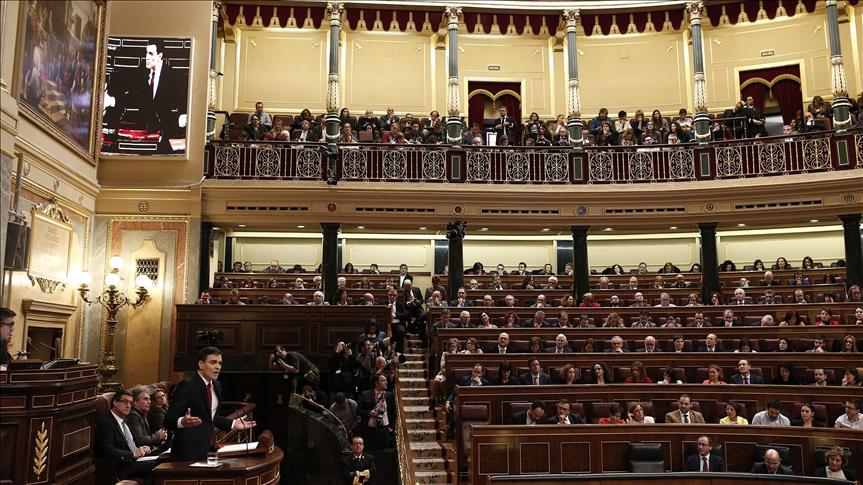
Spain’s Socialists failed to form a center-left coalition government following Friday’s final round of voting.
The proposal was resoundingly rejected by a dissonant Spanish parliament. Out of the 350 seats in the Spanish parliament, 219 politicians voted against the Socialists’ plan for a government and only 131 voted in favor.
Now the countdown begins towards fresh elections. Spain’s fragmented parliament now has two months to agree upon a government or elections will be held late June.
The results of Spain’s Dec. 20 elections created an unprecedented parliament composition in which four parties—the Popular Party, the Socialists, Podemos and Ciudadanos—each received between 28 percent and 14 percent of the popular vote.
The results left the country with a minority Popular Party government, with no obvious coalitions and months of political stalemate.
An attempt by Pedro Sanchez, leader of the Socialists, to form an “anti-Popular Party” pact with the centrist Ciudadanos Party and Podemos resulted in failure. Both rightwing Popular Party, led by current Prime Minister Mariano Rajoy, and the anti-austerity Podemos Party rejected it outright.
“You’ve had your opportunity and you’ve wasted it,” said Rajoy to Sanchez before he cast his ballot. “You didn’t want to go with the party who won the election and you didn’t present a viable alternative… Let us govern,” he said.
Rajoy also called Sanchez’s attempt to form a government “corrupt” and a “fraud, a trick and a farce”.
Rajoy, who won a minority government in the elections was the King’s first choice to form a government, but rejected the invitation due to lack of support. The King then passed the task to the Socialist leader.
The premier’s attacks were not as upsetting to Sanchez as Podemos’ lack of support.
“Pablo Iglesias has betrayed his voters,” said Sanchez in reference to the leader of Podemos after the vote.
Sanchez’s most recent seduction efforts have been directed at Podemos, which he hoped would back a “progressive” and “reformist” government.
Pablo Iglesias, the pony-tailed political science professor who leads Podemos, reiterated that he does not want to form a government with the centrist Ciudadanos Party. He urged Sanchez to join him, other left wing parties and separatist parties, to form a left-wing coalition.
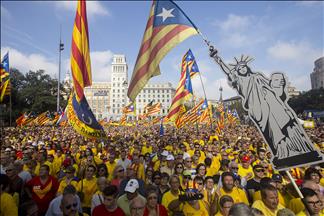
That agreement is not easy either. Podemos and the separatist parties are demanding a referendum for Catalonia, something Sanchez has repeatedly promised to prevent from happening.
Catalonia, a wealthy North-Eastern region of Spain, elected a separatist government in September, which has promised to separate from Spain within the next couple of years.
“We need a new government in Spain, but we can’t leave it to those who want to break it up or those who want to let it rot,” said Albert Rivera, leader of the Ciudadanos Party, referring to the corruption on the right and the separatists.
On Monday, politicians will re-start talks. The possibilities for government now remain the same, with the most likely options being that the Socialists leave behind Ciudadanos in favor of a left-wing and separatist coalition; that the relations between Rajoy and Sanchez thaw and the traditional parties join forces; or that Podemos has a change of mind and joins Ciudadanos and the Socialists. Yet, after the fierce debates and dysfunction of this week, all of these possibilities look less likely than ever.
More likely though, seems the possibility of fresh elections on June 26, which would guarantee Spain at least six months without a functioning government. Still, there is no sign Spanish voters have significantly changed their minds either.