ANKARA
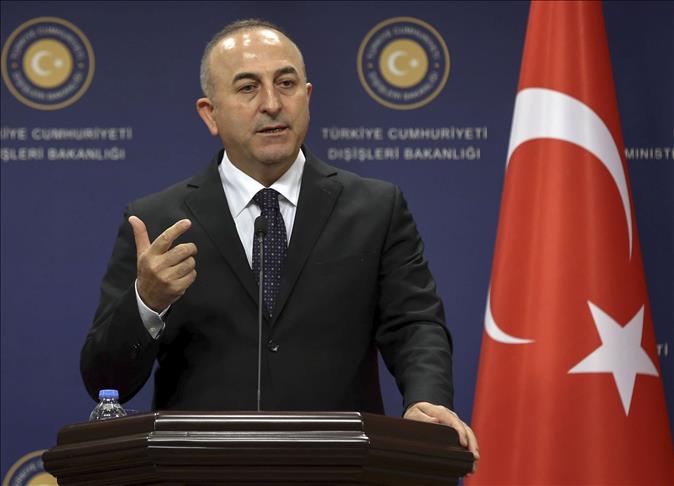
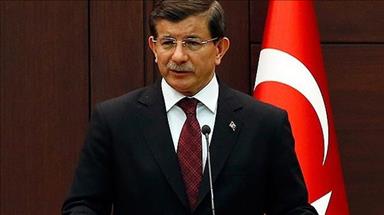
Turkey's Foreign Minister Mevlut Cavusoglu highlighted on Friday the intelligence sharing issue with regards to foreign fighters trying to join Daesh, saying Turkey can cope with the foreign fighters issue only with other countries' cooperation.
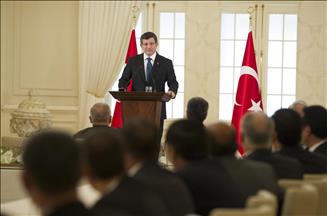
During a joint press conference with his Macedonian counterpart Nikola Poposki in Ankara, Cavusoglu said "Turkey is a transit country for foreign fighters to go to Syria and Iraq and it is normal to expect precautions from Turkey."
The foreign minister described the foreign fighters issue as "complicated" and said people who are coming from EU countries to join Daesh "cannot be stopped leaving their country."
Answering a question about claims in the Turkish media that a man allegedly working for Canadian intelligence helped the three teenage British schoolgirls cross from Turkey into Syria to join Daesh, Cavusoglu answered that the man is "a citizen of Syria," and "he works for a country in the U.S.-led coalition against Daesh."
On Thursday, in a televised interview, Cavusoglu said, "Do you know who was the person who helped these girls? This person was caught. It turned out to be someone who worked in the intelligence services of a country in the coalition."
The foreign minister also mentioned that the international media always criticizes Turkey over three British girls, but "Turkey is doing the best it can."
"Turkey has issued exclusion bans against 12,519 suspected people so far and deported 1,154 of them," Cavusoglu said.
British girls Shamima Begum, 15, Amira Abase, 15, and Kadiza Sultana, 16, went missing from East London in early February and reportedly arrived in Turkey to cross into Syria.
16 Indonesians arrested in southern Turkey
Turkey's Foreign Minister also talked about 16 Indonesians who were detained trying to cross to Syria on Thursday.
Cavusoglu said "further investigations are ongoing into these people."
A group of Indonesian visitors who had gone missing in Turkey appear to have been arrested in southern Turkey.
According to the Jakarta Post, the group is made up of three families and includes six children. It was part of a tour of 25 people arranged by the Jakarta-based Smailing Tours travel agency.
The tour group arrived in Turkey on Feb. 24 and the 16 members were separated from the rest of the group as they passed through immigration. They had been due to return to Indonesia on March 5.
"The 16 who set out with Smailing Tours have not been found,” Indonesian Commissioner General Badrodin Haiti, chief of the National Police, said, according to the Detik news website. “Now there are 16 more who were arrested by the Turkish authorities."
Cavusoglu said there has not been any information collected by the Turkish Foreign Ministry about the other missing 16 Indonesians, but "Turkey is working and sharing intelligence with Indonesia to get a result as soon as possible."
A Turkish diplomatic source also said Friday that the 16 were arrested trying to cross into Syria to join Daesh and were being detained awaiting repatriation in Gaziantep.
Iceland drops EU membership bid
On a question about Iceland's decision on not seeking EU membership anymore, Cavusoglu said this is the sole decision of Iceland, however, the EU "should also think what went wrong."
Cavusoglu slammed European Commission Chief Jean-Claude Juncker's decision on not seeking enlargement, saying the EU "should reconsider their Eastern Europe policy, neighborhood policy and enlargement policy."
Jean-Claude Juncker announced in July 2014 that the EU will not seek enlargement, but rather “consolidation objectives” over the next five years.
Iceland had first applied for EU membership in 2009, in the midst of a financial crisis.
However, the negotiations, which began in 2010, failed due to a conflict over the fishing industry. Fishing, which is the largest industry in Iceland, is regulated by the European Union for its members. The European Commission has issued complaints to Iceland about overfishing, last year, and has threatened economic sanctions.
Naming dispute between Greece and Macedonia
Speaking in the joint press conference as well, Macedonian Foreign Minister Nikola Poposki said it is very important for his country that Turkey recognizes Macedonia with its name in their constitution.
Greece opposes the use of the name because of its alleged ambiguity with the ancient Greek Macedonia area which mainly falls within present-day Greek territory.
Greece has offered "Northern Macedonia" as an alternative name for the Balkan country which was founded after the fall of Yugoslavia in 1991.
International organizations and some states have been using the "Former Yugoslav Republic of Macedonia" (abbreviated as FYROM) until a solution is found.
Poposki also mentioned that Macedonia is seeking EU membership for around ten years and Greece's veto has been blocking the process.
"This blockage also creates setbacks for stability in the region by the EU and NATO," Poposki added.